




💛 A quick favor, if you've got a second.
We're really happy that you chose to read one of our stories and sincerely hope you'll stick around to read more. We took our paywall down — for now — but that won't last forever, and when the gate goes back up, we'd love for you to already be on the inside.
It's free. So please enter your email here and don't forget to like and follow us on all of your favorite Social Media platforms!
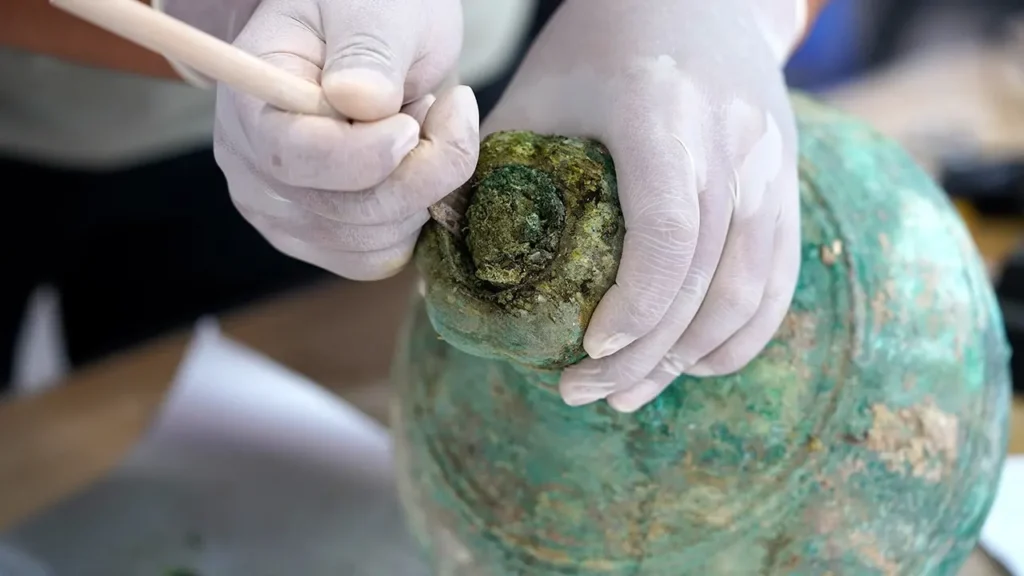
Archaeologists working at the Shanjiabao cemetery in China’s Ningxia Hui Autonomous Region have recovered an exceptionally well-preserved ancient alcoholic beverage sealed within a bronze vessel for more than two millennia. The discovery, dated to the Warring States period (475-221 B.C.), contained approximately 3,740 milliliters of liquid—nearly a gallon—making it one of the largest volumes of ancient fermented drink ever recovered from that era. The findings were published in the June issue of the Journal of Archaeological Science: Reports.
Ruru Chen, a researcher at Northwest University’s School of Cultural Heritage in Xi’an, noted that the preservation quality was extraordinary given the artifact’s age. The liquid appeared clear with a light blue-green hue, showed no noticeable odor, and contained only minimal sediment at its base. The bronze container featured a distinctive “garlic-shaped mouth,” a design commonly employed by the Qin people for storing alcoholic beverages.
Through comprehensive analysis involving organic chemistry, metabolomics, starch grain examination, and microscopic investigation, researchers identified the beverage as a non-distilled grain alcohol brewed primarily from broomcorn millet, supplemented with smaller quantities of wheat and barley. Chemical testing revealed high concentrations of lactic and oxalic acids alongside numerous organic compounds consistent with ancient cereal-based fermentation techniques. The findings suggest production methods that predate distilled spirits by centuries.
Scientists attribute the liquid’s exceptional preservation to multiple factors, including the arid local climate, the bronze vessel’s composition, its sealing methodology, and favorable burial conditions. Researchers plan future investigations to better understand the preservation mechanisms while encouraging broader scholarly interest in ancient Chinese brewing traditions and fermented beverage production.



More Stories
Colombia backs Trump security push while limiting U.S. role in anti-gang operations
Modern Science Finally Supports & Strengthens Biblical Account of the Crucifixion of Jesus Christ
Federal Prosecutors Convene Special Grand Jury to Investigate D.C. Schools’ Attendance and Graduation Practices