


💛 A quick favor, if you've got a second.
We're really happy that you chose to read one of our stories and sincerely hope you'll stick around to read more. We took our paywall down — for now — but that won't last forever, and when the gate goes back up, we'd love for you to already be on the inside.
It's free. So please enter your email here and don't forget to like and follow us on all of your favorite Social Media platforms!
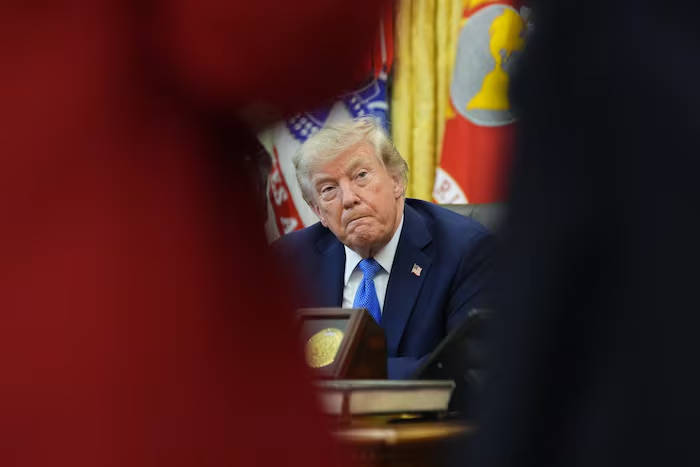
The Trump administration is exploring a potential agreement with Iran that could reopen the economically critical Strait of Hormuz, though success may hinge on concessions that could prove politically difficult for the president. One of the central obstacles involves how much authority Iran would retain over the Persian Gulf waterway, through which roughly one-fifth of global oil shipments typically flow. Both nations have indicated they are drawing close to a settlement, yet fundamental disagreements persist over the terms that would govern the strategically vital passage.
The core dispute centers on Iran’s demand for some degree of control over the strait, contrasting sharply with the Trump administration’s refusal to accept any arrangement that would allow Tehran to collect transit fees or establish permanent dominion over the waterway. Iran has signaled it will not permit a return to pre-war conditions when the passage functioned as an open international route, citing its continued ability to threaten commercial vessels through drone and missile attacks despite extensive U.S. military operations. Current proposals under discussion would establish separate entry and exit corridors controlled by Iran and Oman respectively, with assurances that no tolls or charges would be imposed on transiting ships.
Political analysts suggest the president’s traditional aversion to yielding ground creates an unusual dilemma for negotiations. Eliot Cohen, former State Department counselor under George W. Bush, characterized any concession as fundamentally at odds with Trump’s worldview. “He divides the world into winners and losers, and this would make him a loser,” Cohen said, noting that such an image “would be intolerable for him.” However, David Schenker, a former State Department official in Trump’s first term, countered that mounting economic pressures and elevated gasoline prices could motivate the president to accept compromise on the strait matter despite broader political ramifications.
Trump has downplayed concerns about the conflict’s impact on American military readiness, claiming Thursday that the U.S. military maintains “massive amounts” of weapons with large quantities in production. The assertion contradicts reporting from The Washington Post regarding his frustration with Defense Secretary Pete Hegseth over declining inventories of advanced weapons systems. When pressed by reporters, Trump acknowledged that certain munitions categories are “a little bit tighter” while characterizing others as in “virtually unlimited supply,” though he provided no specifics about which weapons face shortages.
A senior administration official characterized a recent Cabinet discussion on Iran as “robust and healthy,” explicitly denying that disagreements over strategy had erupted into conflict. The official declined to provide additional details about the deliberations but confirmed the meeting had not involved serious contention. The Center for Strategic and International Studies, a prominent Washington think tank, has released analyses indicating the U.S. military faces shortfalls in advanced missile interceptors and other critical systems based on budget documents and public records.
Senator Mark Kelly, an Arizona Democrat and former Navy pilot, attributed the weapons shortage to a military campaign that lacked clearly defined strategic objectives beyond launching more than 14,000 strikes. Kelly contended that better planning might have dramatically reduced the target list to hundreds rather than thousands of operations. He criticized Pentagon leadership for seeking “billions and billions of dollars” in additional appropriations to address what he characterized as a self-inflicted problem resulting from inadequate planning.
Maritime data indicates commercial traffic through the Strait of Hormuz remains severely constrained despite U.S. military assertions that the passage is open. Lloyd’s List Intelligence reported that vessel transits reached 84 last week, compared with 45 the previous week, yet this figure remains far below the typical pre-crisis level of more than 700 weekly transits. At least two ships sustained damage in the strait over the past week, while several others reported near misses or warnings attributed to Iranian Revolutionary Guard entities.
Trump has claimed the strait is currently “sort of open” and pointed to Navy operations against Iranian ports as evidence of U.S. control. However, he acknowledged that Iran retains the ability to threaten shipping through mines and weaponry, noting that “one mine sitting out there” could effectively disrupt commerce by deterring large commercial vessels from transiting the waterway. The administration has emphasized that any temporary arrangement would prohibit tolls or other charges on transiting vessels, with officials maintaining that Trump’s preferred approach remains diplomatic resolution.



More Stories
Federal voting arrest in New Jersey adds new pressure point in Sherrill-Trump standoff
Colombia backs Trump security push while limiting U.S. role in anti-gang operations
Former NFL cheerleader and ex-aide face off in close Rhode Island GOP primary