

💛 A quick favor, if you've got a second.
We're really happy that you chose to read one of our stories and sincerely hope you'll stick around to read more. We took our paywall down — for now — but that won't last forever, and when the gate goes back up, we'd love for you to already be on the inside.
It's free. So please enter your email here and don't forget to like and follow us on all of your favorite Social Media platforms!
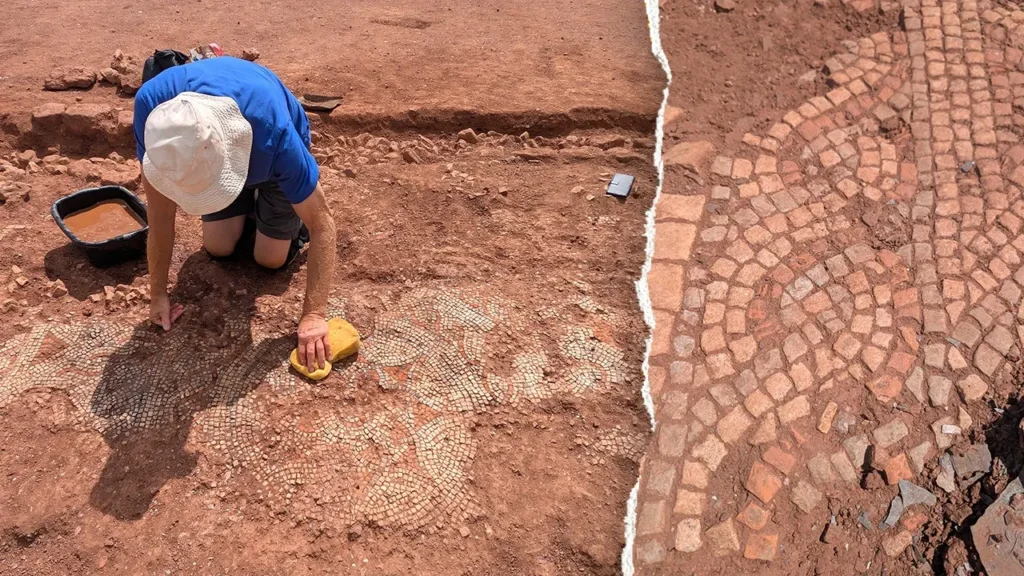
A fourth-century Roman villa buried beneath farmland in Devon has yielded significant archaeological treasures after lying hidden for more than 1,600 years. The site, located between Halberton and Sampford Peverell, was discovered through a collaborative effort between the University of Exeter and Cotswold Archaeology, operating under the Saving Halberton’s Ancient Roman Environment project.
The excavation’s most striking find is an intricately designed mosaic composed of thousands of colored stone cubes arranged in a floral motif. According to Bill Horner, county archaeologist at Devon County Council, this polychrome mosaic represents the westernmost example ever discovered at a Roman villa throughout Britain, underscoring the extent to which even remote regions of the province embraced Roman culture.
Beyond the main villa, archaeologists identified two additional stone structures on the property: a bathhouse and an agricultural building. The team also recovered numerous artifacts including a copper-alloy bracelet, a silver-plated spoon, a decorative drinking vessel, pottery shards, and an engraved gemstone bearing the image of Victory.
Project leader Susan Greaney of the University of Exeter noted that the elaborate bathhouse was particularly unexpected, suggesting the villa’s inhabitants held considerable wealth and social standing. The site was first brought to public attention in 2004 when local metal detectorist John Hill discovered initial Roman remains on the property.
Authorities are currently preparing to transport the mosaic to the Tiverton Museum of Mid-Devon Life for preservation and public display. The discovery adds to a growing body of significant Roman finds across England in recent years, including settlements and artifacts uncovered in the Cotswolds and during railway construction projects.

More Stories
Colombia backs Trump security push while limiting U.S. role in anti-gang operations
Modern Science Finally Supports & Strengthens Biblical Account of the Crucifixion of Jesus Christ
Federal Prosecutors Convene Special Grand Jury to Investigate D.C. Schools’ Attendance and Graduation Practices