



💛 A quick favor, if you've got a second.
We're really happy that you chose to read one of our stories and sincerely hope you'll stick around to read more. We took our paywall down — for now — but that won't last forever, and when the gate goes back up, we'd love for you to already be on the inside.
It's free. So please enter your email here and don't forget to like and follow us on all of your favorite Social Media platforms!
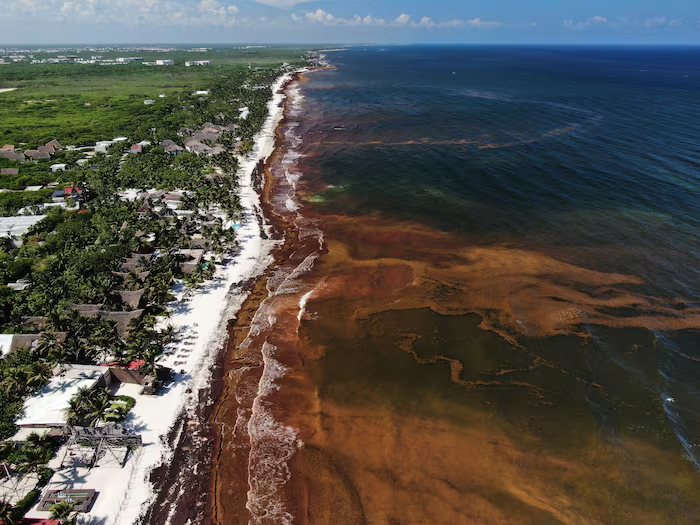
Massive quantities of sargassum seaweed are smothering beaches and coastlines throughout the Caribbean and Gulf of Mexico, creating hazardous conditions for marine ecosystems and delivering an economic blow to tourism-dependent regions. The University of South Florida’s Optical Oceanography Lab documented approximately 27 million metric tons of the self-sustaining algae across the Atlantic, Caribbean and Gulf of Mexico in July, marking unprecedented levels in areas traditionally spared from such blooms.
Scientists have identified 2025 as a turning point, with sargassum now reproducing directly within the region rather than merely drifting there via ocean currents. Brian Barnes, a research assistant professor at the University of South Florida, emphasized the anomalous nature of current conditions, noting that a record 40 million metric tons the previous year created conditions favorable for new local growth that never fully dispersed.
The proliferation stems from a combination of agricultural runoff, warming ocean temperatures and shifting wind and current patterns, according to marine experts. Scientists project 2026 will see the second-largest sargassum accumulation on record, with June alone registering 34 million metric tons—only slightly below year-earlier figures.
Mexico announced Thursday a $115 million investment to combat the advancing algae crisis, which threatens both environmental integrity and economic stability. Government officials estimate up to 9,000 tons reach Mexican Caribbean shores daily during peak periods, yet current removal capacity reaches only 1,200 tons per day.
The economic impact has proven severe in Quintana Roo, a major tourism hub where first-half sales declined 30 percent according to local business estimates. Restaurant worker Alan Vázquez described closing his establishment due to depleted customer traffic as decomposing seaweed transformed turquoise waters into dark, uninviting conditions.
Puerto Rico’s natural resources secretary, Waldemar Quiles, characterized current sargassum concentrations as unprecedented, prompting the governor to declare a state of emergency following heavy coastal accumulation. The previous record, established in 2022, peaked at approximately 22 million metric tons.
Environmental scientists caution that coastal infrastructure cannot sustain these recurring blooms. The seaweed depletes oxygen in nearshore waters, suffocates mangrove ecosystems, blocks sunlight from reaching coral and seagrass, and impedes hatchling sea turtles from reaching the ocean, while removal equipment risks destroying turtle nesting sites.
In the U.S. Virgin Islands, visitors traverse up to 25 feet across sargassum mats before accessing water, according to environmental consultant Amy Dempsey. Decomposing seaweed releases ammonia and hydrogen sulfide, producing odors reminiscent of rotten eggs and causing nausea, headaches and respiratory irritation in nearby communities.
Martinique recently opened emergency shelters to house residents affected by toxic gases after community protests. Island crews have collected more than 11,500 tons of sargassum this year, including 638 tons in a four-day period, processing the material for composting and bioenergy production.
Research from the University of South Florida and the National Oceanic and Atmospheric Administration, employing artificial intelligence analysis, found that macroalgae blooms increased more than 13 percent annually between 2003 and 2022 across the tropical Atlantic and Western Pacific. Overall blooms encompassed 16.9 million square miles, according to findings published earlier this year.


More Stories
Federal Prosecutors Convene Special Grand Jury to Investigate D.C. Schools’ Attendance and Graduation Practices
State Department Reissues Level 3 Travel Advisory for Israel Amid Terrorism and Armed Conflict Concerns
Forest Service Proposes Steep Fee Increases at Lake Tahoe Recreation Sites