



💛 A quick favor, if you've got a second.
We're really happy that you chose to read one of our stories and sincerely hope you'll stick around to read more. We took our paywall down — for now — but that won't last forever, and when the gate goes back up, we'd love for you to already be on the inside.
It's free. So please enter your email here and don't forget to like and follow us on all of your favorite Social Media platforms!
Jeanne Blanchard was born about 1681 in Port Royal, Acadia, the fifth child of Guillaume Blanchard and Huguette Gougeon.
Jeanne’s life was anything but easy, even by Acadian standards, but it all began normally enough.
In the 1686 census, Jeanne is reported as age 5, which places her birth about 1681.
She was living with her parents and four siblings near Port Royal, along the Rivière du Dauphin, on 5 arpents of land, with 20 sheep and 16 cattle. Her father, Guillaume Blanchard, is age 35, and her 27-year-old mother’s name is spelled Huguette Goujonne.
Jeanne’s grandparents, Jean Blanchard, 75, and Radegonde Lambert, 65, lived next door. No land or livestock was listed on their census entry, so one can assume that they were all living as an extended family unit in adjacent homes.
They were living along the rich salt marshes at BelleIsle, near the LeBlanc family, who were their neighbors.
Photo of a portion of the sign at the LeBlanc family marker, located at the red arrow beside the LeBlanc Village on this reproduction historic map.
In the census, Jeanne and her family lived near the LeBlanc village and other families known to reside at BelleIsle.
The local Catholic church, Église St. Laurent, is shown on the map as well, not far from Hebb’s Landing, on the far side of this bend in the river.
This settlement pattern makes sense. The Acadian families had originally lived primarily at and near Port Royal, today’s Annapolis Royal, but by the 1680s, they were already somewhat scattered, in part, due to earlier devastating attacks by the English.
Jeanne’s life is told in chapters along this river – that is – right up until the end.
In 1682, Beaubassin was founded by Acadians from Port Royal, and in 1686, the new Acadian governor reported that “the people had scattered and lived far from each other.”
He said that their homes were built behind the marshes, which were along the river.
That’s a perfect description of BelleIsle, perhaps the most fertile marshland in all of Acadia – and safely located more than 15 miles upriver, as the canoe paddles.
While English soldiers could get there in small boats, their ocean-going vessels with cannons could not venture upriver beyond Port Royal, and therefore, could not attack BelleIsle. Comparatively speaking, Port Royal was vulnerable and exposed, which is why it had a fort, and why families moved upriver, beginning in the 1650s.
By the 1680s, the most productive marshlands had been claimed, and many of the young married couples were moving north to the Minas Basin.
By 1688, there was both a labor and a manure shortage at Port Royal. Maintaining the dykes that held back the saltwater from the fields was labor-intensive work.
In Europe and the colonies, King William’s War between France and England dragged on, a constant source of chronic low-level anxiety for Acadian families, with everyone waiting for the next shoe to drop.
And drop, it did.
The 1690 Depredations
In 1690, Jeanne would have been about 9 years old.
Her day-to-day life probably consisted of attending church, saying her prayers, and joining her mother, aunts and perhaps her grandmother as they harvested vegetables, tended their farm animals, and baked bread.
Jeanne’s carefree childhood, living in the sunshine along the river, would come to an end soon enough.
Back in Boston, the English were determined to take Acadia once and for all, and began planning their offensive in March of 1690.
On April 28th, Sir William Phips, a man with a personal axe to grind, set sail as commander of the English expedition. His flagship, the Six Friends, carried 42 mounted guns, along with a second ship, the Porcupine, which sported another 16. They were accompanied by three additional ships, carrying a total of 446 provincial troops.
The Acadians at Port Royal were both outmanned and outgunned, with only 90 soldiers in the garrison and the fort itself in a horrific state of disrepair.
On this 1686 map, you can’t even tell that the fort is a fort.
The fort’s cannons weren’t even mounted so it stood no prayer of defending itself against the English onslaught. Worse yet, the entire garrison only possessed 19 muskets – about one musket for every four and a half soldiers.
France had long neglected Port Royal, and now the proverbial pigeons were coming home to roost. How could France have allowed this to happen to her colony?
On May 9th by the English Julian calendar (or May 19th on the French Gregorian calendar), the English ships sailed into the harbor and made contact with bilingual French Huguenot, Pierre Melanson, whose home was the closest to the bay, several miles downriver from Port Royal. Phips inquired as to the state of the fort and the town. History hasn’t revealed Pierre’s response, but Phips pulled up anchor the following morning, sailed up to the town, and anchored in the river there.
Phips demanded the fort and town’s surrender. He probably already knew, and could clearly see the condition of the fort, including its lack of cannons, from the river at Port Royal where his fleet was anchored.
Acadian Governor Meneval sent the local priest to negotiate surrender terms because the fort clearly could not defend itself, and doing otherwise would assuredly have resulted in slaughter. Phips and the priest agreed to terms, but when Meneval boarded the ship the following day to sign the agreement, Phips refused to put anything in writing or to sign any agreement. Meneval had little option other than to trust him.
The terms, as agreed to by both parties, stated that the residents would not be harmed or displaced, nor would their property be taken or damaged, and the soldiers would be unharmed and returned to France.
However, what occurred after Meneval surrendered, not that he had much choice, was not at all what had been agreed to in the unsigned agreement, as attested to by multiple witnesses on both sides.
1686 map of Port Royal and vicinity
As a child, Jeanne would have been unaware of what was transpiring downriver, at least until messengers made their way upriver to share the news and alert the residents.
At some level, the Acadian families had to know that they were sitting ducks, inviting catastrophe, without a functional fort.
Forget the fort. How were soldiers and Acadian families supposed to fight or even defend themselves without guns? That’s not administrative neglect, that’s suicide.
Jeanne’s parents probably gathered their children into the house for safety, or even took them into the rugged mountain range behind their homes to hide.
Beyond that mountain range lay the shores of what is today the Bay of Fundy, but between BelleIsle and the Bay lay more than five miles of rugged, mountainous terrain with dense forest that provided places to hide.
The English soldiers were unleashed by Phips upon the town of Port Royal and the surrounding area. They plundered the town and burned much of it, including the church that sat directly behind the fort.
Phips claimed his actions and those of his men were justified because he was unaware of the condition of the fort, so he didn’t receive the spoils he had anticipated. That’s unlikely, given his visit with Melanson.
Regardless, at least 28 homes were burned, almost one-third of the entire Acadian settlement, and livestock was stolen. The men were gathered together, probably in either the church or the fort, and forced to sign a loyalty oath to the English Crown.
The smoke wafting from the homes that had already gone up in flames, and hanging in a thick haze over the town, reminded them that they had little choice.
By now, everyone would have been afraid, and the children were probably terrified. Those four guns that Guillaume Blanchard owned in the 1686 census assuredly came in very handy. In fact, all 71 guns owned by the Acadian families would have been invaluable. But still, they had no chance of fending off 446 fully armed soldiers, with cannons.
Unfortunately, while the Acadian homes were located “behind the marshes,” they were still quite visible to the river, and no match for hundreds of professional soldiers.
In addition to the 90 soldiers garrisoned at the fort, the 1686 census, which was taken the same year that the map was drawn, recorded 95 families, some of which included older sons who could have helped defend the homestead.
Even with all of the men, older boys and soldiers combined, and a total of 90 guns between them, the Acadians still fell far short of the 446 well-armed, professionally trained English soldiers, backed up by cannons. The 1686 census recorded only 592 people in the Port Royal area, including women and children.
At least 28 homes were burned, but the mills and upriver farms were spared – probably because it was too risky for the English to fan out far enough to burn them all. The further they strayed from Port Royal, the more danger they faced.
The English were interested in easier prey.
Fortunately, Jeanne’s parents lived upriver, which made their farm uninviting. The English restricted their pillaging to homes closer to Port Royal. I can see them, running from home to home with their torches, lighting each one on fire before running to the next.
The Loyalty Oath
We don’t know a lot about what happened to the women and children during this attack, but the men were forced to sign a loyalty oath to the English monarchy. The only exceptions seem to be elderly men who may well not have been able to travel to the fort or the church, and who didn’t really concern the English anyway.
Under duress, Jeanne’s father signed the oath with his mark, probably gritting his teeth and swearing an entirely different oath under his breath.
After the Acadians were allowed to return to their farms, English pirates attacked them again later that summer and took what little was left. The remainder of their livestock was killed for sport, and more homes were burned.
Life looked quite bleak. Thank goodness for the Acadians’ dogged perseverance.
I can’t begin to imagine what 9-year-old Jeanne was feeling. I wonder if she ever felt safe again.
The 1693 Census
Three years later, in 1693, the next census was taken and Jeanne, now age 11, is living with her parents at BelleIsle. Their neighbor is Daniel LeBlanc, the patriarch of the LeBlanc family who founded the cluster of homes known as LeBlanc Village.
Jeanne’s father, Guillaume Blanchard, is noted as age 42, and her mother’s name is spelled Agate Goujon, age 37. Jeanne has 7 living siblings, including a baby sister, age 1. Jeanne’s oldest sister, Marie, is married to Charles Bourgeois, and lives with them. They also have a 1-year-old daughter. This combined household is living on 30 arpents of land with 40 sheep, 30 cattle, and 15 hogs.
Karma Bites Back
In 1696, the English attacked Port Royal again, doing the exact same things – except this time, they went a step further, ruining the Acadian dykes and flooding the fields with seawater, which meant that it would be at least three years before they could plant again.
It took that long for the salt to leach out of the soil once the dykes were repaired.
Somehow, Karma took a look and apparently decided that the English needed a lesson in humility. In 1697 and 1698, a devastating smallpox epidemic broke out in Boston, killing about 1,000 of the city’s 7,000 or 8,000 residents, more than 10% of the population by contemporaneous estimates.
Not only that, but the winter of 1697 and spring of 1698 were particularly severe, resulting in a massive shortage of fodder and hay, causing the death of large numbers of livestock in and around Boston. Puritan minister Cotton Mather referred to this crisis as a “terrible Famine” and wrote pleading letters to nearby colonies that had banned transporting corn and grain beyond their borders.
Their resources already depleted by years of warfare, the Bostonians now desperately needed the surplus grain that the Acadians would have been able to provide under normal circumstances. Except they couldn’t, because their dykes and fields had been ruined the year before by the English, and it was all they could do to feed their own families.
At least for a few years, the English left the Acadians alone.
Approaching Marriage Age
In the 1698 census, Jeanne is now 17 and lives with her parents and nine siblings. The youngest, Charles, is noted as ½, so about six months old. Their mother, Huguette Goujon, is 47, and Guillaume is now listed as 48. They have 26 cattle, 24 sheep, and 12 hogs on 34 arpents of land, including 7 fruit trees.
Those fruit trees would have been bearing apples, and Jeanne would have picked those delicious ruby-red apples each fall.
They live beside Laurent Doucet among the BelleIsle families.
Two years later, in the 1700 census, Jeanne is listed as 18, her father is 49 and her mother is 45. Jeanne’s two youngest siblings have died since 1698. They own 39 sheep and 26 cattle and are living on 30 arpents of land.
At 18, Jeanne has been of marriageable age for about four years, but no suitors have won her heart. That would soon change.
Wedding Bells – Olivier Daigle
According to Donald J. Hébert’s book, Acadians in Exile, quoting from the Loppinot Papers, 1687-1710, Jeanne Blanchard married Olivier Daigle on August 8, 1700,
Olivier Daigle, inhabitant of Por-Royal [sic], son of deceased Olivier & Marie Godet, marriage contract dated 8 Aug 1700 to Jeanne Blanchar [sic], daughter of Guillaume & Hugette Gorujar [sic, for GOUGEON]. (Port Royal: Notarial Acts: G3 2040).
In the 1701 Port Royal census, Jeanne Blanchard, 20, is married to Olivier Daigre (d’Aigre, Daigle, d’Aigle), and they are raising his brother Bernard’s two children, who were born at Pisiguit: Pierre, age 5, and Anne, age 3. It’s unclear why, given that Bernard and his wife are both living, and the children weren’t yet old enough to be useful farmhands. Olivier and Jeanne have 9 cattle, 8 sheep, and 6 hogs on 7 arpents of land.
Based on their neighbors, they don’t appear to be living at BelleIsle, but across the river where the Daigle homestead is located.
During my 2024 visit, I stumbled across the Daigle land, unaware at that time that Jeanne Blanchard had lived here with her first husband for about nine years.
The 1703 census contains much less information, but Olivier is listed with his wife, 2 boys, 1 girl, and 1 gun bearer. The gun bearer would have been Olivier himself. This suggests that Bernard’s children, Pierre and Anne, are probably still living with them, and Jeanne has given birth to her first child, a boy.
In fact, that’s accurate, because:
Paul Daigre was born about 1701 and died before January 1752, probably in Beaubassin.
Jeanne’s second child, another son, arrived two years later, in 1703, apparently after the census was taken.
Olivier Daigre Jr. was born on August 10, 1703, and died on December 9, 1756, in Falmouth, Cornwall. His godparents were René Granger and Magdelaine Broussard.
No Peace
In the 1707 Port Royal census, we find Olivier listed with his wife, along with 2 boys less than 14, 2 girls less than 12, 15 cattle, 12 sheep, and 8 hogs living on 4 arpents of land. They have 4 guns.
Now, it appears that Jeanne has two boys and two girls. Apparently Bernard’s children are no longer living with Jeanne and Olivier. Pierre may have gone back to live with his parents in Grand-Pré, but there are no further records for Anne, suggesting that she died before she was old enough to marry.
Marie Daigre was born to Olivier and Jeanne in 1704 and died on December 5, 1756, in Penryn, Cornwall.
By 1704, about the time Marie was born, Acadia was under attack again by the English.
Settlements and the church at Port Royal were looted, and the dams were “dug down,” supposedly as revenge for Indian attacks in New England, instigated by the French.
Jeanne’s next child, her namesake, arrived two years later.
Jeanne Daigre was born on February 1, 1706, and died in 1757 in Liverpool. Her godparents were Jean Gautier, building contractor, and Elisabeth Blanchard. Her baptism was not registered until March 19th.
When Daniel d’Auger de Subercase became governor of Acadia in April 1706, he arrived with 160 soldiers, ¾ of whom were young men from the “quays of Paris,” with no training or experience.
Subercase immediately went on the offensive, encouraging Native raids against English targets in New England. He also encouraged the corsairs of Port-Royal to attack English colonial ships. The privateers were very effective, and the English fishing fleet on the Grand Banks was reduced by 80% between 1702 and 1707.
In New England, public outrage simmered, then grew into a fever.
The next English attack occurred in June of 1707 and consisted of 1,000 men led by Massachusetts and joined by men from Rhode Island and New Hampshire. After 11 days, it failed.
If at first you don’t succeed, try again.
A second attack occurred in late August, and it too failed.
Unfortunately, the soldiers at Port Royal were suffering, starving, and in terrible condition. France continued to ignore Subercase’s pleas for reinforcements and supplies that never arrived.
Were it not for the Acadian men, probably including Jeanne’s father, brothers, and husband, and their Native allies, Port Royal wouldn’t have been able to muster any resistance at all.
In 1708, Queen Anne’s War intensified, and hostilities between the English and French did too.
Subercase desperately needed to repair and reinforce the fort, and it was clear that no help was to be had from France.
So, having no other choice, he turned Port Royal into a French pirate hub, financing their needs through captured English booty. In 1708 alone, the privateers captured 35 English merchant ships and brought them back to port, but with that came new problems. By the end of the year, Port Royal was overcrowded with 470 English prisoners who had been captured on those ships. That was more than the entire 1707 census of Rort Royal – 459 people including women and children.
Subercase engaged in negotiations with the Massachusetts governor to arrange for hostage trades in order to reduce the number of English prisoners.
The Acadians were taking this opportunity to shore up their defenses. In 1708, the fort’s store and an additional ship were built, along with a new powder magazine and bombproof barracks. The riverbanks were cleared to remove cover for attackers.
Prisoners taken from English ships reported that the English were planning attacks on Acadia in 1708 and 1709. I’m sure no one was surprised.
Unfortunately for us, there were no censuses taken between 1707 and 1714. However, thanks to baptismal records that began in 1702, we know that:
Marguerite Daigre was born on April 2, 1708. She died on Aug 14, 1763 in Connecticut. Godparents were Jean Bastarche and Marguerite Godet. Her baptism was not registered until June 7th. Jeanne Blanchard’s name is mis-recorded here as Anne Blanchard, but Olivier’s name is recorded accurately. Marguerite’s mother’s name is recorded correctly in her 1728 marriage record to Germain Richard, where Jean LePrince, her stepfather, is noted as married to her mother, Jeanne Blanchard, and signs as a witness.
These delayed baptism registrations suggest that they did not live near a church, which is accurate given that they lived far upriver, near today’s Bridgetown.
The nearest church was the St. Laurent Chapel across the river at BelleIsle, labeled as the “Mass House” on this 1733 map, which was also the closest cemetery. The next closest church and cemetery were in Port Royal. The Daigre homestead is not shown on this map but could have been the land labeled with Jean LePrince’s name. Based on later lawsuits, we know it was near and possibly adjacent to the Bastarche land at far right.
Tragedy Strikes
On September 22, 1709, the priest recorded in the parish register that Olivier D’Aigre, around 40 years old, had died and was buried that same day.
This twenty-second of September of the year one thousand seven hundred nine, I, the undersigned, performing the parish functions at Port Royal in Acadia, certify that Olivier D’Aigre, inhabitant of Port Royal, aged about forty years, was buried by Monsieur Gaulin, missionary to the Indigenous people of Acadia, in my absence, with the customary ceremonies; who died after having received with benefit all the last sacraments and having lived with edification during his life. In witness whereof, I signed the present register the same day and year as above.
Brother Justinien Durand, Recollect missionary
We’ll never know what happened, of course, but a 40-year-old man does not die of old age. Was there an accident, or did he succumb to an infection from an injury, or something else? One thing we do know is that there was time for the priest to be summoned and arrive, and for last rites to be administered.
This probably eliminates some forms of death, such as drowning, because if he died immediately, there would not have been time for the priest to be summoned and attend him. I do wonder why no witnesses were listed. That’s unusual.
One thing is for sure, Jeanne would have been heartbroken and terribly afraid.
Her husband was dead, and she was four months pregnant with their unborn child.
How would she live? Who would harvest that fall’s crops? Who would plant the next crop? What would become of her and their five, soon-to-be six, children, all under 8?
Jean-Baptiste D’Aigre was born on Feb 22, 1710, and died on November 12, 1757, in Penryn, Cornwall.
Somehow, Jeanne managed.
1710 Depredations
Wouldn’t you know it, the English returned again, but this time with even more men and guns. On September 24th, five English ships sailed into the river, transporting more than 3,400 troops who attacked Port Royal.
Jeanne, now a widow, had a seven-month-old baby, plus five other children below the age of 10.
Her saving grace was that she lived as far upriver as possible, either the most distant or second most distant Acadian home. No one would bother with her there – at least that was her prayer.
It’s possible that the Mi’kmaq people would have assisted her, and I’d wager Jeanne was a pretty good shot with a gun. A widow on the edge of civilization with six children to protect is absolutely the person you DO NOT want to mess with.
This time, Port Royal was not unprepared. The fort had been rebuilt, but they still had few soldiers. Their 300 fighting men would have included all able-bodied Acadian men up and down the river, not just soldiers.
Those brave men held the fort for 19 days, which in and of itself was pretty much a miracle.
Jeanne would not have witnessed the battle, and she was too far upriver to hear anything either. That doesn’t mean that messengers weren’t filling her in, and it’s certainly possible that residents of Port Royal were making their way upriver in boats and canoes seeking safety.
I sure hope they brought some food and supplies along!
This time, the English occupation was complete. The French surrendered the fort and were granted the dignity of being allowed to leave in an orderly fashion, just before the English marched in.
What a sad day for the people of Acadia.
Port Royal was renamed Annapolis Royal, the river’s name was changed to the Annapolis River, and the fort was now Fort Anne.
While the English now controlled the fort, and claimed ownership of all of Acadia, the terms of surrender were confusing and fiercely contested. Even the boundaries of “Acadia” weren’t agreed upon. The English claimed Acadia was all of Nova Scotia, New Brunswick and part of Maine, extending to the St. Lawrence. The French claimed Acadian consisted only the southwestern portion of Nova Scotia, leaving everything else as sovereign French territory, at least until the Treaty of Utrecht in 1713.
One of the terms of surrender stated that inhabitants within cannon-shot of the fort, defined as three English miles, could stay for two years, meaning they had two years to either take a loyalty oath to the English crown, or move their “moveable items” to a French-controlled territory, meaning Île Royale (Cape Breton Island) or Île Saint-Jean (Prince Edward Island).
481 Acadians pledged allegiance to the Queen of England, the French troops left, and the English appointed an administrator to manage Port Royal, now renamed Annapolis Royal.
Jeanne clearly lived more than twice that distance away, so she wasn’t covered by this provision. But what did that mean?
Could she stay for two years before she had to remove?
Did she have any protection at all?
Could the English simply take her property now, and everyone else’s at BelleIsle and further upriver?
Or did she not have to move in two years?
Did she have to move at all?
Could she move if she wanted to?
Since she was a widow, could she even sign a loyalty oath to preserve her property? There is no known instance of anyAcadian woman signing a loyalty oath.
Why were these Acadian families left in limbo?
We don’t know exactly what went on upriver during this time, but the priests helped organize resistance, just beyond the protection line, of course.
The Acadians did not want to live under English masters, but neither did they want to leave, so they initially resisted.
Finally, given enough time, taxation, and harassment by the English, the Acadians decided they wanted to go, so they were making plans to leave quickly, taking their livestock and possessions with them.
Be careful what you ask for…
By this time, that’s not at ALL what the English had in mind. They (now) wanted the Acadians to stay, grow crops for them, and pay taxes. The English had quickly learned that they needed the Acadians because they didn’t have the first clue how to farm the marshlands.
Resistance was not dead – only hiding – and not well at that.
The balance of power was shifting around like a fish flopping within sight of water.
Then, the French saw another opportunity!
Bloody Creek
After the English captured the fort and Port Royal in 1710, the Acadians refused to feed them, or harvest lumber they needed to repair the fort. That winter was very bleak for the English soldiers quartered there, so the English began sending expeditions upriver to attempt to enforce their demands.
In June of 1711, a detachment of English soldiers from Fort Anne ventured upriver and was ambushed by a band of Indians. Reports varied between 50 and 150. Thirty soldiers, a major, and the fort engineer were killed at Bloody Creek, 12 miles east of Annapolis Royal, and were probably buried in the marshes at BelleIsle.
The Native people were close allies and often intermarried with the Acadians.
Truthfully, I’ve never been convinced that the ambushers were (entirely) “Indians” anyway, especially given that records show that some Acadian men were held in the dungeon in the fort, and died there, after this attempt to ambush the English and retake the fort.
Following their victory at Bloody Creek, the Acadians within the protection zone moved upriver, and roughly 600 men gathered and blockaded Fort Anne. The English fort commander went for reinforcements, returning with another 200 fully armed men, after which the 600 Acadian and Indian men withdrew. They might well have been successful if they had the benefit of artillery or siege cannons to breach the fort’s walls, but they did not – and motivation alone was not enough.
On April 13, 1713, Acadia officially passed to England, with France ceding all of Nova Scotia.
Now, the Acadians were truly ready to leave, en masse, but the English prevented it. The English persistently pressured the Acadians to take another oath of allegiance, but they steadfastly refused. This probably wouldn’t have applied to Jeanne, a female, who was likely doing her best to lay low and remain as inconspicuous as possible.
I’ve often wondered if Jeanne clandestinely took part in the resistance. She would have been in the best possible location to do so.
By now, she had survived as a widow for four long years since Olivier’s death, but the future was anything but certain.
The 1714 Census
The only census under the English was taken in 1714.
In the 1714 census, Jeanne is listed as “Widow Olivier, with three sons and two daughters,” although she actually had three sons and three daughters. Just goes to show that census takers weren’t much different then than they were in other times and places, and they probably didn’t visit her in person – much to her great relief.
“Oh yeah, that’s Olivier’s widow that lives way up there. She has a passel of kids – five I think.”
Jean LePrince
Apparently, Jeanne had been a widow long enough. More than five years. That chapter was about to come to an end.
Jeanne Blanchard married Jean LePrince on January 30, 1715. He was born about 1692 in Minas, according to the 1693 census. Jean’s father died before his birth, a situation similar to that of Jeanne’s youngest son.
It was a rather unusual union, and I’ve always wondered if it was a marriage of love, convenience, or economic necessity. Hopefully at least some of the first.
Jeanne was 10 or 12 years older than Jean Le Prince, the opposite of a typical age gap in Acadian couples where the man is often substantially older than his wife. She would have been about 34, and he was about 22. That’s a big difference, raising questions.
They probably met when he was trading in the Port Royal area given that his family lived in Minas. His mother was raised near what is now Bridgetown, and had married his father there. That’s also where Jeanne’s land was located.
I hope that their bond was one of mutual attraction, and Jeanne was not a victim. Jean was “interesting,” and somewhat unruly, to put it mildly.
Jeanne Blanchard would have been considered a good catch, a widow with land she had owned with her previous husband. She had been a widow for going on six years – an eon in Acadian time. Which begs the question of why she had not already remarried.
A widow who was a decade or more older than Jean LePrince from Minas. A man whose character wouldn’t have been well-known to people living in Port Royal, especially not upriver, in the remotest part of the Annapolis River Valley. I hear alarm bells.
When Jean married Jeanne in 1715, she had been widowed for half a decade, farming on her own in addition to everything else, and was clearly a resourceful and capable woman. That doesn’t mean she wouldn’t welcome a new partner.
At 22, Jean was only eight years older than Jeanne’s eldest child.
Jean hadn’t grown up in Port Royal, so she wouldn’t have known him well. A few years later, this mattered a lot more than Jeanne could ever have imagined, when lawsuits abounded and all hell broke loose.
Did she live to regret her choice?
Jeanne’s marriage record states that she is the widow of Olivier D’Aigre.
Jeanne signed with her mark that looks something like a cow with horns, beneath the signature of Jean LePrince and above the mark of her father.
Her father signed with his mark, and her brother by the same name signed with his signature below the elder Guillaume. I don’t know quite how to interpret this.
Was Jeanne’s father simply a witness, conveying tacit approval or was this a wholehearted family endorsement of Jeanne’s marriage?
Tense Times and a Growing Family
Their marriage was probably timely, because tensions were rising and the situation in Acadia was escalating again. At least Jeanne didn’t have to face the future alone.
The Acadians were preparing to move to Cape Breton, and the English were doing everything they could to prevent it. By September 1715, the fort’s gates had been shut, depriving the Acadians of much-needed resources. They were prevented from trading with the English at the fort, and also with the Indians. Now the Acadians desperately wanted to leave, but they couldn’t, as the English continued to tighten the economic screws.
Jean and Jeanne began their family immediately, with their first child, Marie-Josèphe, arriving just 10 months later.
Marie-Josèphe LePrince was born on November 3, 1715, recorded in the Port Royal vestry book which served both churches. She died sometime after 1763. Her godparents were Guillaume Blanchard, the son, and Marie D’Aigre, the daughter of Jeanne Blanchard and Olivier d’Aigre. Marie-Josèphe must have had a special relationship with her older sister, Marie. Unfortunately, they would be separated by 1723 when Marie, with her new husband, Jean Terriot (Theroit), relocated to Grand-Pré.
The Acadian situation with removal versus non-removal flip-flopped back and forth through 1717, when a new English fort commander once again demanded an unconditional loyalty oath. Were Jean and Jeanne simply numb to all this by now, focused instead on raising their growing family?
Honoré (Le)Prince was born on August 2, 1717 in Port Royal and died before February 17, 1762, in Quebec. His godparents were his eldest brother, Paul D’Aigre, and Agnes Godet.
Joseph (Le)Prince was born on February 9, 1719 in Port Royal and died on May 23, 1781, in Bécancour, Quebec. His godparents were his brother, Olivier D’Aigre, and Marguerite Bourgeois.
1720 – The Loyalty Oath, Again
Conflict between the English and Acadians was a constant state of affairs, but it worsened again in 1720 when the English began threatening to expel the Acadians because they refused to swear their loyalty to the English monarch.
We’ll never know how much of this threat was bluff and how much was real.
On May 9, 1720, those who had become British subjects by taking the dreaded oath were offered free exercise of their religion, a guarantee of their property, and their civil rights.
A secondary offer was made. If the Acadians did not take the oath, they could leave, but could not take any of their possessions with them.
The Acadians replied that they feared the Indians if they took the oath, and they promised to be faithful and peaceful. They explained that they couldn’t leave in the year allotted to them because no one would buy their land. The French had no intention of the Acadians selling their land – they were counting on abandonment.
The French government encouraged the Acadians to move to Cape Breton Island, then called Île Royale, but the land where they were to relocate was rocky and poor. Furthermore, the English government was underhandedly keeping them at Port Royal by holding their possessions hostage. The English didn’t want to lose their supply source. The Acadians, they lamented, were difficult to control.
I think the Acadians took pride in not allowing the English to push them around.
English Governor Philipps pronounced the Acadians ungovernable and stubborn, and stated that they were directed by bigoted priests. He went on to say that the Acadians couldn’t be allowed to relocate because it would strengthen the population of their French neighbors. The Acadians were also needed to build fortifications and to produce supplies for the forts. He said that they couldn’t leave until “there are enough British subjects to be settled in their place,” and he hoped plans were being made to bring in British subjects. Furthermore, he expected problems from the Indians who didn’t want the Acadians to move.
Anyone who knows anything about the Acadians understands that this would simply have made them even more determined and steadfast in their resolve.
This back-and-forth standoff had been going on now for a decade. I can’t count the number of times the players changed their minds – go, stay, no, we won’t go, we’re leaving and you can’t stop us, we’ll stay but you’ll be miserable. You have to leave, get out, you can’t leave, you can leave but not take anything, we need English settlers, what will we do without you. And so it went.
Everyone was probably exhausted, and no Acadian was making any long-term investment in anything because they could lose their land and everything else in the blink of an eye.
Those poor Acadians. This drama never ends. And of course, Jeanne was pregnant again.
Jean Baptiste LePrince was born on February 9, 1721, in Port Royal and died on January 11, 1811, in Saint-Grégoire-le-Grand, Nicolet. His godparents were Charles Blanchard and Angelique Richard.
Pierre LePrince was born on May 28, 1723, and was baptized by Pierre Godet the elder. His birth was recorded June 24th. He died on January 3, 1758 and was buried the following day in Quebec City. His godparents were Pierre Blanchard and Marguerite, last name unstated.
1729 – Resolution and Deception
The loyalty oath continued to be an insurmountable issue for the next several years, until in 1729 when Governor Philipps ended it once and for all – just not terribly honestly.
Philipps let both parties think they were getting what they wanted by having the Acadians sign an oath they agreed to that was less restrictive.
The oath itself was written on page one.
The exceptions and exclusions the Acadians wanted were recorded on page two.
They signed on page three, relieved that the constant harassment would finally stop.
But Philipps sent only the front page and the signature page back to England, omitting page two. No one, except him, knew the difference, and Acadia lived in relative peace under English rule until 1755, when the English rounded up and expelled the entire Acadian population.
Relative Peace
While the Acadians writ large were now living peacefully, Jeanne’s family was not. Is this woman EVER going to get a reprieve?
By 1730, Jeanne was about 49 years old and Jean, of course, was at least a decade younger.
With peace finally having been reached, meaning they had a future there, the Acadians focused once again on land in the Annapolis River Valley.
There’s some question about where and how Jean LePrince obtained his land.
Of course, we know that Jeanne Blanchard had her husband’s land, but it appears that Jean LePrince may have owned land of his own, or land he somehow obtained, in addition to hers, or both.
Unfortunately, land transactions in Acadia are fuzzy, at best, for a wide variety of reasons.
Some researchers hold that Jean’s father owned land along the river, near the Daigre land, that was never sold after he moved to Pisiguit in 1686, and before his death in 1693. That’s certainly possible.
If this is the case, it would explain why his son, Jean, returned to the Port Royal area when he was about 22 and met Jeanne, whose land lay in close proximity.
Jean refused to allow the English to survey his land in 1729, so we know he had land at that time. But what did “his” land mean? Was it the original Daigle land, or was it his father’s land, or something else?
As it turns out, based on a 1733 map, we do know where Jean’s land was located. I’m presuming this is where Jeanne and Jean lived, at least at some point, but presume is a dangerous word in genealogy, and even more so when dealing with Acadian land.
Gaudet Village is today’s Bridgetown.
Jean was René Forest’s neighbor. Jean’s eldest daughter married René Forest’s son, and his two eldest sons married René’s daughters. René and Jean were also first cousins.
The star in the river identifies the location of the 1711 Battle at Bloody Creek. One of the tributaries sprang forth on Jean’s land.
Jean’s Land Today
Based on these maps, and the shape of the river, when I visited Nova Scotia in 2024, I was able to locate at least the general area where Jean LePrince and Jeanne Blanchard lived and raised their children.
The Button Brook Cemetery is located beside the road today.
The LePrince land is someplace near Button Brook on the south side of the Annapolis River, but north of the main road.
It’s difficult to pinpoint an exact location using the old maps. Jean and Jeanne would have farmed Olivier Daigle’s land too, further east, beyond Bridgetown.
Acadian homes stood on the high ground, with the saltmarsh dykes draining the land closer to the river. Today’s roads are built on that same high ground too.
An abandoned railroad, now a rail trail, is accessible by foot, bicycle, and some small vehicles, although it’s blocked by center barriers in some areas and the bridges are iffy. That said, it provides a much more authentic view of the lands near the river than the contemporary road.
This is the view north along Bloody Creek, viewing mountains across the Annapolis River in the distance.
Jean’s land along the rail trail had an abundant meadow.
The rail trail runs along the river. It’s no wonder they fought so hard to keep this heartstoppingly beautiful land.
If they did indeed live on Jean’s land, this is the view Jeanne would have seen. If they lived further upstream on the Daigle land, that’s around the bends in the river.
A small creek dividing Jean’s fields, or perhaps those of Jean and René, empties into the river.
You can see it on Google’s satellite view.
What looks like unremrakable pastureland on both sides of the river today required constant maintenance of the dykes and their aboiteaux to keep the saltwater out of the fields.
This land may look peaceful today, but this neighborhood wasn’t exactly peaceful then.
Drama
Jean LePrince may hold the Acadian record for lawsuits, at least for a peasant. This web of interwoven lawsuits, accusations, and people he clashed with is detailed in Jean’s article, here.
That said, Jeanne is mostly silent in these suits, except in 1752, and I’m still not quite sure how to interpret what happened.
I’ve created a chart putting these contracts and lawsuits in chronological order, trying to make sense of these events.
They began not long after the 1729 loyalty oath document, which means the Acadians knew they were staying.
Dates
Players/Role
Location
What
Lawsuit #1 – Jan. 22, 1731
Jean asserted that he had inherited from the estate of the widow Richard at L’Anse-Contre (uncertain reading of place name; appears to read L’Ancontre or similar), notably [the share] of Pierre Dupuis
Widow Richard (Isabelle Petitpas died Sept. 1729) had made a will before witnesses, a will that Jean claimed was contrary but whose authenticity was recognized by the Council of His Majesty at Annapolis Royal, on January 22, 1731
Contract #1 – Oct. 1, 1731
Jean LePrince & Jeanne Blanchard purchase land from Jean-Baptiste Préjean
Tract of land in the upper of the Annapolis Royal River extending from “the aboiteau that one made to divert the stream of the Lower Meadow situated in the upper of the said river”
Contract states that Jean Prince can build a mill along the river in partnership with others
Contract #1 – Oct. 1, 1731
Jean LePrince & Jeanne Blanchard purchase share that Jean-Baptiste Préjean possessed
A point that is along the large stream of the earthly paradise*1 of the low land
Contract states that Jean Prince can build a mill along the river in partnership with others
Lawsuit #2 – Jan. 28, 1732
Jacques Goupil accuses Jean LePrince of abusing his good faith in a land exchange, that the land Prince had transferred to him already belonged to him.
Goupil (1686-1734) is married to Marie Daigre (1677-1719), sister of Olivier Daigre who married Jeanne Blanchard – suit sent to arbitration, outcome unknown
Lawsuit #3 – Feb. 21, 1735
Jean Prince, Pierre Dupuis and Baptiste Richard, ordered to pay damages caused by the animals of Jean Bastarche to the harvest of Jacques Goupil, because these three neighbors had not maintained their common fence
Jean-Baptiste Richard is the son of Alexandre Richard & Isabelle Petitpas.
Contract #2 – April 13, 1742
Sharing or subdivision of Jean LePrince’s property between 5 children
One would interpret this to mean he had died, but he was living
Contract #3 – Jan. 19, 1746
New division or redistribution of these same properties among four sons of Jean LePrince
Daughter Marie-Josèphe LePrince has married Jacques Forest and is omitted
Contract #4 – July 3, 1752
Settles division of land held in common with Bernard Pellerin*2 and 2 younger sons of Jean Prince
Goes with contract #5
Contract #5 – July 3, 1752, appendix to the first contract
Jeanne Blanchard, wife of Jean Prince, the share of lands reverted to her*3 of lands acquired by Jean-Baptiste Préjean and Alexandre Pellerin*2, to her two younger sons, Jean-Baptiste and Pierre, for 33 livres, six sols
States that Jeanne Blanchard, wife, not widow, of Jean Prince transferred land.
*1 – “earthly paradise” is the same place as Paradis Terrestre
*2 – Bernard Pellerin and Alexandre Pellerin are brothers, but I can find no relationship to the Blanchard, LePrince, Daigle or Préjean families.
*3 – Why did these lands revert to Jeanne?
I think the gist of this is that Jeanne forced Jean to distribute at least some property to all of their children, then redistribute it to the four boys, then the two youngest children, but why? This is so strange.
Let’s look at some of the specific language extracted from Jean LePrince’s article.
1742
The second contract is one of sharing or subdivision of the property of Jean Prince between his five children. It is dated April 13, 1742.
Note that this is just 11 years after Jean LePrince, or Prince as it’s written here, acquired the property from Jean-Baptiste Préjean. This is highly unusual. In 1742, Jean LePrince’s children would have been ages 27 (daughter), 25, 23, 21, and 19 (sons). This also doesn’t say whether it’s one property or all of Jean’s property, whatever that might be.
As for the third contract, dated January 19, 1746, it makes a new division or redistribution of these same properties among the four sons of Jean.
This is even more unusual and suggests that either none of his sons had actually “taken possession,” or they were all living on the land and farming it jointly. It also appears to cut Jean’s eldest child, daughter Marie-Josèphe Le Prince, who had married Jacques Forest in 1734, out of the land distribution. I wonder if this was a result or cause of family friction.
The fourth contract, dated July 3, 1752, settles a division of land held in common up to that time with Bernard Pellerin and the two younger sons of Jean Prince.
Does this mean the two sons held this through Jean, or independently?
Finally, the fifth contract, which is in fact an appendix to the first, but with the same date as the fourth, constitutes a transfer by Jeanne Blanchard, wife of Jean Prince, of the share that reverted to her of lands acquired by Jean-Baptiste Préjean and Alexandre Pellerin, to her two younger sons, Jean-Baptiste LePrince and Pierre LePrince, for the price of thirty-three livres, six sols. This appendix bears the date July 3, 1752, the same as the fourth contract.
In 1752, if Jean was living, he would have been about 60 years old. The fact that his wife was involved with this distribution suggests that Jean might have been deceased by this date. But then again, that’s what an earlier researcher thought about the 1742 contract, and we know that he signed as a witness to his son’s marriage in 1747.
If Jean had been deceased in any of these transactions, then why was Jeanne referred to as his wife, not his widow?
It’s a mess with lots of drama… much of which is omitted here because it has nothing directly to do with Jeanne – although she was living through every day of it, and it clearly affected her.
Several of the landowners we’ve been discussing are shown on this map by MapAnnapolis. Jean LePrince bought or acquired land from Jean-Baptiste Préjean. Jean Bastarche is Jean LePrince’s neighbor, as is the Richard family. Alexandre Richard, shown on this map, is the husband of Isabelle Petitpas, whose will Jean LePrince contested in 1731.
We know from the lawsuit that the Richard land, above, lies adjacent to the LePrince land, and the Daigre land too.
Jean LePrince’s wife, Jeanne Blanchard, was the widow of Oliver Daigle (D’Aigre, Daigre), who was the son of an earlier Oliver (Olivier) Daigle (c1643-before 1685). It’s possible that Jean LePrince was farming the Daigle land after their 1715 marriage, until he purchased the Préjean land in 1731. At that point, he would have been farming all of that land.
This also tells us unquestionably that in 1735, these families were sharing a common fence line, so they are clearly neighbors.
Based on these descriptions, it appears that this stream near Bridgetown may well be the mill stream discussed.
This freshwater stream is the only one that appears large enough to have been dammed to power a mill. This view shows the stream on the south side, before it travels beneath the highway.
The stream exits beneath the highway and makes its way north to the river.
All of these photos are along the road where the Daigle, Bastarche, LePrince and DuPuis families lived. Their lands intersected, bordering one another, and this would have been the neighborhood where Jeanne spent her entire adult life.
This original hand-drawn 1733 map shows something slightly different. At far left, we can see Alexandre Richard. I can’t read the next name, moving to the right, but the name with the red arrow shows Jean LePrince, and then further right is Bastarche.
Based on what we know, this appears to be the original Daigle land, shown with four houses. This doesn’t resolve Jean’s land adjacent to René Forest, though, so there could have been 3 parcels of land altogether.
It’s possible that by 1742, in order to protect her children’s future inheritance, Jeanne insisted that Jean divide up his land – if not in actuality, then at least legally. Except for their only daughter, who had married. But why was she omitted?
What about the Daigle children? Did Jeanne insist that Jean divide up his land because her Daigle children would inherit their father’s land? Or maybe they already had? That said, all of her Daigle children settled in Beaubassin or Grand-Pré and didn’t remain nearby.
How was Jeanne involved in whatever was transpiring, or was she at all? Was she complicit in whatever was going on? In particular, the 1731 suit regarding the will of Widow Richard (Isabelle Petitpas). Do these contracts and lawsuits just seem suspect today, but really weren’t at the time? The Widow Richard suit certainly makes it appear that Jean LePrince was trying to pull a fast one. Why would Jean LePrince have inherited from Isabelle Petitpas? There is no known family relationship.
Was Jeanne the long-suffering wife who was embarrassed by her husband’s behavior, but felt she had no control over what he did? Did she roll her eyes and silently go to church anyway?
Or do the glimpses we see of her in these contracts, lawsuits, and disputes show Jeanne standing up and saying, “Nope, you’re not doing that on my watch?”
In other circumstances, this cluster of unusual lawsuits spanning two decades would lead us to believe that Jean LePrince was deceased prior to 1742, but he was not. In 1747, he signed the parish register for the marriage of his son, Jean-Baptiste. Both Jean and Jeanne were listed the parish register in 1750 when their son Pierre married.
It’s likely that Jean was still living in 1752 when the final contracts were executed, because there’s no burial for him prior to that.
This occurred just three years before all of the Acadians would lose everything anyway.
All of this drama and hard feelings involving many families in the upriver neighborhood ironically named Paradise on Earth would have been for naught. Their enemy wasn’t each other, and that common enemy, the English, would be the undoing of all of them.
Here’s what we do know.
Jeanne Blanchard’s last child married on February 3, 1750, in Port Royal. Both Jean and Jeanne are listed as parents, and neither are noted as deceased. There’s no subsequent burial record for either of them either.
So where is Jeanne?
Jeanne’s Death
Jeanne died sometime between July 3, 1752, when she is noted in that lawsuit in Port Royal, and February 15, 1762, the date of her son Jean’s second marriage in Bécancour.
Jeanne was not listed on the burial record of her son Pierre on January 4, 1758 in Quebec, although Jean LePrince was given as his father. It does not state that Jean LePrince is deceased, but that doesn’t necessarily mean that he’s living either.
We don’t know why Jeanne, then about 76, was omitted from Pierre’s burial record. In January 1758. Was she deceased or simply left out of the record?
The priest was assuredly overwhelmed. Quebec was in the midst of a horrific smallpox epidemic, and on the same day that Pierre was buried, so were Acadians Jeanne Landry, Claude Landry, Marie-Isabelle Thibodeau, Isabelle Aucoin, Marguerite Cormier and two others, one who was not Acadian and another unnamed infant. And that’s just one day in one parish.
Smallpox was ravaging the city. The epidemic wave began in November 1757, peaked during December 1757, and lasted through February 1758.
By the end of 1757, approximately 1,500 to 1,800 Acadian refugees were living in Québec City and its vicinity, and were already weakened by two years of displacement, hunger, and severe cold.
André-Carl Vachon’s study provides statistics and additional information.
Month
Acadian burials at Notre-Dame-de-Québec
All burials
November 1757
38
78
December 1757
179
222
January 1758
71
129
February 1758
18
43
There were 306 Acadian burials in four months at Notre-Dame alone. Contemporary accounts stated that, during December, as many as fifteen to twenty Acadians were being buried each day.
Jeanne’s granddaughter, Marie-Josèphe LePrince, daughter of Joseph, died on the same day that her uncle, Pierre LePrince, was buried.
These deaths just seem grievously unfair. Unjust. To survive countless trials against immeasurable odds, and then succumb just weeks after deliverance. So many had already been lost.
Not all burials were recorded in the parish registers. Burials from the two hospitals were recorded separately, but neither Jean nor Jeanne are found there.
The LePrince survivors moved upriver to Bécancour.
On February 15, 1762, in Bécancour, Quebec, Jean LePrince, Jean’s namesake son, married Marie Madeleine Bourg.
The parish entry says:
Year 1762, the fifteenth of February, after having published three banns of marriage between Jean LePrince, son of Jean LePrince and of Jeanne Blanchard, deceased of Port-Royal, his father and mother, and Marie Madeleine Bourg, widow of Pierre Richard, daughter of Michel Bourg and of Marie Cormier, her father and mother, also deceased, residents of Beaubassin, after having obtained dispensation for the third degree [of consanguinity], we received their mutual consent of marriage and gave them the nuptial blessing, in the presence of the parents and a large number of other persons, they declared not knowing how to sign.
This entry tells us two things.
That Jean LePrince and Jeanne Blanchard are deceased by February 15, 1762. It also suggests that they both died in Port Royal, so before the 1755 Expulsion, but that’s not actually what it says.
This doesn’t say either one died IN Port Royal, it says they were “of” Port Royal, in Acadia, which was true no matter where they died.
Jean LePrince, the son who remarried in 1762, was exiled someplace in 1755. His first wife, Judith Richard, died sometime between 1753, when their last known child was born in Port Royal, and September 29, 1756, when their daughter was buried at Notre-Dame-de-Québec.
Jean’s brother, Pierre LePrince, buried two daughters, Marie Anne Josephte on August 5, 1756, and Isabella on September 14, 1756.
So these two brothers were together in Quebec at that time, just eight months after that horrific Expulsion, along with more than 600 first-wave Acadians who are found in the Quebec parish registers beginning about that time. How did they get there between December 1755 and August 1756?
There is no burial record for Jeanne or Jean at Port Royal, in Grand-Pré or in Quebec.
So, what happened?
Can we piece anything together?
Perhaps.
Escape
By December 1755, when the cruel expulsion took place, Jeanne would have been 73 or 74 years old, depending on her birthday. No spring chicken by any measure, but there’s no record of her burial in the parish records. However, the last recorded burial in the Port Royal records was in October of 1754, nearly 14 months before those death ships onto which the Acadians were forced departed. We know people had to have died during that time, so the records are incomplete for that timeframe.
Furthermore, Jeanne was alive in February of 1750 when her son married, and in the 1752 lawsuit, but we know she was deceased by 1762, as reflected by her son’s marriage record in Quebec.
If she was living at the time of the Expulsion, her fate was very probably tied to that of her children.
What do we know about her children?
Name
Birth
Death
1755 Expulsion Destiny/Comment
Children
Paul Daigre
Circa 1701 Port Royal
Before January 1752 when his wife is listed as a widow in Beaubassin
Died before the expulsion
5
Olivier Daigre
Aug. 10, 1703 Port Royal
Dec. 9, 1756, in Falmouth, Cornwall
Grand-Pré to Virginia to England in 1756
9
Marie Daigre
1704 Port Royal
Dec. 5, 1756, in Penryn, Cornwall
Grand-Pré to Virginia to England in 1756
10
Jeanne Daigre
Feb. 1, 1706 Port Royal
1757 in Liverpool, England
Grand-Pré to Virginia to England in 1756
8
Marguerite Daigre
April 2, 1708 Port Royal
Before Aug. 14, 1763, either in Grand-Pré or Connecticut
If lived until the expulsion, Grand-Pré to Connecticut
7
Jean-Baptiste Daigre
Feb. 22, 1710 Port Royal
Nov. 12, 1757, in Penryn, Cornwall
Grand-Pré to Virginia to England in 1756
8
Marie Josèphe Le Prince
Nov. 3, 1715 Port Royal
After 1787, probably CT in New England, or possibly in Quebec
Port Royal to Connecticut, possibly went with daughter to Quebec in 1787
9
Honoré Le Prince
Aug. 2, 1717 Port Royal
After Jan. 7, 1760 and before Feb 17, 1762 in Bécancour, Quebec
Port Royal to unknown, in Bécancour by 1760
7
Joseph Le Prince
Feb. 9, 1719, Port Royal
May 23, 1781, Bécancour, Quebec
Port Royal to (probably) Miramichi, NB, then in May 1757 to Quebec
8
Jean-Baptiste Le Prince
Feb. 9, 1721, Port Royal
March 28, 1787, Bécancour, Quebec
Port Royal to unknown, Quebec City by September 1756, when his daughter died
8
Pierre Le Prince
May 28, 1723 Port Royal
Jan. 3, 1758, Quebec City
Port Royal to unknown, Quebec City before August 1756, when his daughter died
3
All of Jeanne’s children with Olivier Daigre made their way to either Beaubassin or Grand-Pré as adults. Four of those six wound up being exiled to Virginia, then on to England the following year, where they may well have died during a smallpox epidemic. One died before the Expulsion. A second may have died before the Expulsion, but her family wound up in Connecticut, and she may have as well.
All of Jeanne’s children with Jean LePrince, with the exception of Marie-Josephe, were in Quebec before the Treaty of Paris, which was signed in February of 1763. That treaty allowed the Acadians to leave the colonies as soon as the various colonial governors agreed. Since her LePrince sons were all in Quebec before that date, we can infer that they were not sent to the colonies and instead made their way to Quebec shortly after the Expulsion, long before the Treaty of Paris was signed. This means they escaped the Expulsion one way or another – probably together since they are found together in Quebec. This makes sense, given that the land distribution to the four boys meant they lived together on the same land, as is also suggested by the 1733 map showing multiple homes.
We know that Jeanne’s daughter, Marie-Josephe LePrince, was in Connecticut and encouraged her family to immigrate to Quebec in 1787 because she was concerned that they were losing their French-Catholic heritage.
Since there’s no record of Jean’s death, Jean LePrince, Jeanne Blanchard’s somewhat irascible husband, who wasn’t about to be told what to do, was probably still alive in 1755 at 62. If so, there’s a very real possibility that he ensured his wife and children had an escape route.
Maybe Jean LePrince’s recalcitrance and the traits that caused him to be somewhat “difficult,” “rough around the edges,” and chronically noncompliant are the same qualities that saved his family.
Given that there’s no burial record for either Jean or Jeanne at Port Royal, it’s certainly possible that Jean devised some method for evading the British. It helped that their land was among the farthest from Port Royal, some 25 miles or so upriver, which meant they were also the least visible to the English and most difficult to monitor. I can’t imagine that he would have taken his family to Port Royal to willingly climb aboard those ships, nor that Jeanne would have willingly gone anyway.
Perhaps no one noticed Jean, Jeanne, and four of their adult children making preparations that far upriver, or if they did, no Acadian was about to say a word. It’s also entirely possible that the Mi’kmaq people assisted the upriver Acadians.
But how might that escape have happened?
The Long Walk Across the Mountain
Maybe after the deportation order was read in Grand-Pré on September 5th, a group of Port Royal Acadians realized what was happening and escaped in the late summer and early fall, abandoning their farms when they saw the proverbial handwriting on the wall.
Perhaps by the time December 8th rolled around and the rest of the Acadians were being forced to walk the snow-covered Queen’s Wharf in Port Royal, leaving their meager belongings stacked there, then herded onto ships, Jean, Jeanne, and most of their family were long gone. In the other direction.
Their daughter, Marie-Josephe, who was married to Jacques Forest and had been excluded from the land transactions in favor of the sons, was their only child who was rounded up and forced onto those ships. Perhaps the rift within the family was real and enduring, although her brothers stood as godparents when her children were baptized.
How I wish we could go back in time and ask questions.
Maybe all the English found of the LePrince family were abandoned homesteads – perhaps those four clustered together on the 1733 map.
Based on the evidence that we do have, I suspect that Jeanne and her family were among the Acadians, primarily from BelleIsle and further upriver, including their Richard and Préjean neighbors, who escaped.
If the LePrince family and their adult children were part of this exodus, why didn’t Marie-Josèphe and her husband, Jacques Forest, go with them instead of waiting to be rounded up and placed on a ship bound for an unknown destination? Perhaps Jacques didn’t believe it would happen, and that everything would blow over one way or another like it always had before. Or perhaps they thought their chances of survival were better on the English ships than in the wilderness.
They may have been right.
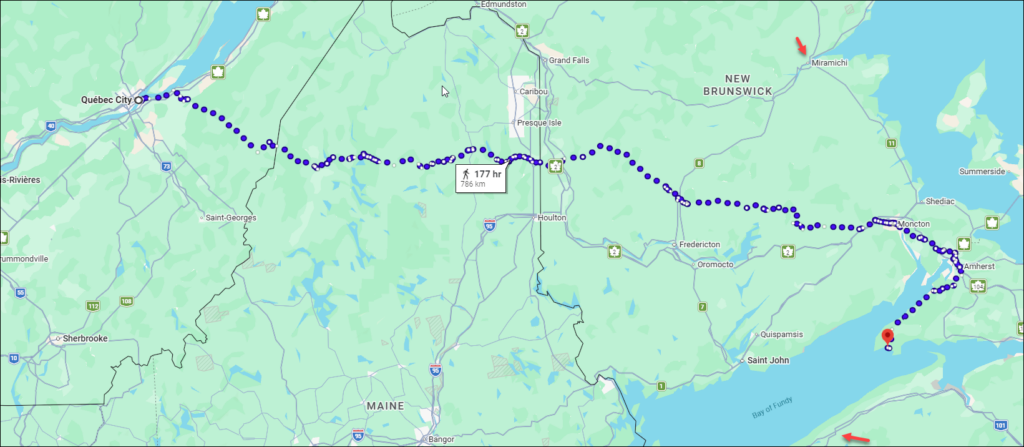
On foot, the group traveled upriver and over the brutal North Mountain to Aylesford, where many died, then on to today’s Morden beach where they spent the winter. We don’t know how many began that journey. Reports vary between 300 and 400, but a dowsing survey reported about 406 unmarked graves at the Morden site, so there may well have been more who began the overmountain escape. Using the Quebec parish records between 1756 and 1763, when the Treaty of Paris was signed, and reconstructing those families provides a sort of reverse census of which families escaped, or tried to. Many families found in Quebec were from Beaubassin and Chignecto, but not all.
For those Port Royal families who chose this risky overland route and survived the brutal winter, their Mi’kmaq allies helped them reach Chignecto, across the bay on the border of Nova Scotia and New Brunswick, where they eventually escaped to Quebec.
Between inadequate shelter and starvation, many of our Acadian family members did not survive that roughly 30-mile, midwinter trek across North Mountain. Even fewer would have made it without the Mi’kmaq, who guided and helped feed them.
The following spring, when the ice began to melt, with the help of the Mi’kmaq, the group encamped on Morden Beach forged their way to Refugee Cove in today’s Cape Chignecto Provincial Park, where they were then guided by French officer Charles Deschampes de Boishebert.
Some eventually made their way to Camp d’Esperance at Miramichi, and others struck out across the wilderness, walking or canoeing to Quebec.
Without the Mi’kmaq and Wolastoqiyik people, who launched a veritable rescue mission, those cross-country Acadians would have assuredly perished on their 800 mile journey.
Some appear in the Quebec City records as early as 1756, with others in 1757. Many horrifically difficult months are unaccounted for, serving as silent testimony, before our refugees reappear, like holiday lights twinkling back on one by one in the Quebec records. How sad that the way we find them again is due to the massive number of deaths reflected in parish records, as many lights were extinguished forever.
The priest in Quebec and others wrote in journals about the devastating conditions of the Acadians when they arrived. They died in such numbers from smallpox and famine (beginning in October of 1757) in addition to typhus, scurvy and yellow fever that often multiple people were buried in the same coffin.
Morden Beach
Before leaving Morden, the Acadians erected a driftwood cross to honor their fallen family members, known as the French Cross, which stood until about 1820. Residents rebuilt this cross on the beach in 1964, and it still stands today. I can’t help but wonder if Jeanne, then in her mid-70s, is buried nearby or someplace in the Canadian wilderness.
Were the Acadians marking the location of their deceased family members with that cross, or praying for mercy and deliverance?
Probably both.
We will never know positively that this was the LePrince family’s path to Quebec, but after eliminating the other possibilities, it is the most probable known route consistent with that evidence. There weren’t many avenues of escape. Given that these families and their neighbors appeared in the same location in Quebec, at about the same time, it’s probable that the four LePrince families remained together, possibly with one or both parents. There must have been some small comfort in that.
I feel certain that Jean and Jeanne would have chosen this risky route rather than comply. I can envision Jean, even in his 60s, leading the charge alongside Pierre Melanson, the purported leader, although Melanson’s identity is uncertain. Compliance was not Jean’s strong suit. And Jeanne? She was made of steel. These qualities just might have saved their family from the looming English atrocity, but sadly, not from the deadly, invisible smallpox enemy that took hold in their refugee accommodations in Quebec.
The grim reaper seemed to be stalking them.
Acadian historian André-Carl Vachon, based on ship logs, official correspondence, and church records, believes that Joseph LePrince and his four children were aboard one of two ships that left Miramichi (in present-day New Brunswick) in May and June of 1757 with a total of 269 passengers. Unfortunately, no LePrince is on the Camp d’Esperance list there.
Everything in Acadia was in a state of turmoil at that time, and records, where they do exist, are incomplete. Furthermore, conditions at Camp d’Esperance were deteriorating too. If Joseph was there, his other siblings and their families, who are found in the same locations in Quebec, probably escaped from and to the same locations – although apparently not at the same time.
If Vachon is correct about Joseph, and I believe he is, then two of the LePrince brothers, Pierre and Jean, were together, arriving in 1756, and Joseph arrived in the summer of 1757. We don’t know when the fourth brother, Honoré, arrived, but he would not have struck out across an unfamiliar wilderness on his own. There was safety and assistance in numbers.
As for Jeanne, I don’t want to remember her as frightened and shivering, forced at gunpoint down the wharf to board those waiting death-ships in Port Royal on December 8th, 1755. Instead, I prefer to remember her attempting to escape, and encouraging her four adult children, their spouses, and 26 grandchildren as she shepherded them along the frozen trail, perhaps carrying the youngest.
As she prayed for survival, if not for herself, then for them.
I can’t help but wonder where she died.
The map gives us a line, but their journey was not a line. It was brush being chopped ahead of them, canoes slipping into wilderness creeks where the English could not see them, hiding, waiting, portaging, starving, and moving again.
And yes, pausing to dig graves along the way.
Chignecto may have been the terrible dividing point where she had to make a decision. The path ahead diverged. Goodbye may well have meant forever – and she had to say goodbye to someone.
Pierre and Jean LePrince appear in Québec by the summer of 1756, while Joseph apparently went toward Miramichi and reached Québec in the summer of 1757. Honoré’s route is unknown. The family may have stood someplace on the Isthmus of Chignecto and separated, perhaps for the last time, because different guides, opportunities, or dangers pulled them in different directions.
If Jeanne reached Chignecto, which path did she follow? Did she go toward Miramichi with Joseph and his children? Toward Québec with Pierre and Jean? Was Jean still beside her? Or had she already been left beneath a cross at Morden or on North Mountain?
Jeanne’s last known record leaves her at home in 1752. By 1762, she was dead. Between those two points lies an enormous landscape of possible graves: the mountain, Morden Beach, somewhere near Chignecto, Camp d’Espérance, beside an unnamed creek or portage, or Québec itself during the epidemic. Wouldn’t that have been a terrible irony – to have survived so much, only to die in Quebec of smallpox?
My instinct, and it is only an instinct, is that she died somewhere along the escape route. At her age, simply reaching Québec would have been extraordinary. Yet if anyone could have done it, it was probably Jeanne.
Her children reappeared, one by one, but she simply disappears.
If that ordeal claimed her life, that’s alright too. Jeanne was always brave, persisting in the face of adversity, and I’m proud of her.
Her four sons and many of her grandchildren survived.
It’s much better to have died trying.
By Verne Equinox – Own work, CC BY-SA 3.0, https://commons.wikimedia.org/w/index.php?curid=17426250



More Stories
Sep. 19: South Florida faces a wet weekend with showers and storms
Vanderbilt pulled off the most improbable last-second victory you’ll ever see in college football
Engelbert Humperdinck reveals how an untied shoelace saved his life during British Army service