


💛 A quick favor, if you've got a second.
We're really happy that you chose to read one of our stories and sincerely hope you'll stick around to read more. We took our paywall down — for now — but that won't last forever, and when the gate goes back up, we'd love for you to already be on the inside.
It's free. So please enter your email here and don't forget to like and follow us on all of your favorite Social Media platforms!
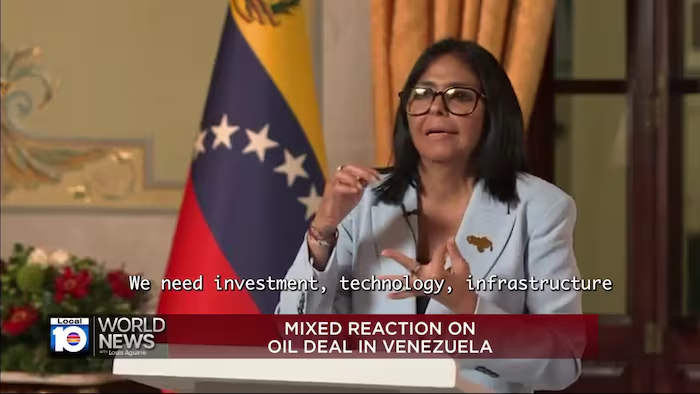
At 84 years old, José Toro Hardy remembers when Venezuela allowed private and foreign investment in the oil sector. He also remembers when Hugo Chávez forced out oil companies.Toro Hardy, an economist, served as a member of the board of directors of Petróleos de Venezuela, or PDVSA, from 1996 to 1999, when Chávez assumed the presidency.“It might be a good deal for Venezuela if the investments actually come,” Toro Hardy said about what President Donald Trump described on Friday as the “biggest oil deal in world history.” Delcy Rodríguez, who stepped up as Venezuela’s interim president after Nicolas Maduro’s capture, announced on Saturday night that she was granting a “historic” 25-year deal and said it would increase output to 1.5 million barrels per day at 17 oilfields.“Our oil production should be more than 6 million barrels per day,” Toro Hardy said. The Wall Street Journal reported on Saturday that the parties involved were the Pentagon’s Office of Strategic Capital and billionaire Alejandro Betancourt, of North American Blue Energy Partners, or NABEP, a production company.“The U.S. is going to take a 35% passive stake in a private company that is run by a Venezuelan who has done some deals for oil in Venezuela before, and ultimately that would give them preferential rights to buy about 20% of the production that comes from these investments at cost,” Ellen Wald, the president and founder of Transversal Consulting and a senior fellow at the Atlantic Council Global Energy Center, told Bloomberg on Monday.Betancourt, 46, also known as Leopoldo Alejandro Betancourt López, was the subject of investigations on money laundering in the U.S., Switzerland, and Spain, The Washington Post reported last week. U.S. federal prosecutors dropped a case against him in 2020. He has previously denied wrongdoing.Jesus Yansen was among the Venezuelans who accused Venezuela’s interim president of doing everything she could to distract the public. “We need investment, technology, infrastructure,” Rodríguez told Venezuelans about the benefits of a deal that would allow the U.S. to contribute capital and technology. Some of the Venezuelans who lived through Chávez’s seizures of private property mistrust her administration. “What should have been done, was to try to arrange things in Venezuela to have elections, to have a legally elected president, and then to sign a new contract with this government,” Toro Hardy said. Related storiesWasserman Schultz among Democrats opposing Trump’s ‘biggest oil deal in world history’What we know about Trump’s deal giving US access to vast oil reserves in VenezuelaTrump says US has entered deal with Venezuela to take control of 65 billion barrels of oil reservesExperts: ‘A lot of questions around’ Trump’s Venezuela oil deal, what it means for South FloridaTorres contributed to this report from Miami.

More Stories
National Pancake Day is here. Check out the pancake deals to grab this weekend.
Dem House hopeful endorsed by activist who said ‘evil Jews run the world’
Far-right settlers divert West Bank spring water as Israel backs heritage site takeovers