


💛 A quick favor, if you've got a second.
We're really happy that you chose to read one of our stories and sincerely hope you'll stick around to read more. We took our paywall down — for now — but that won't last forever, and when the gate goes back up, we'd love for you to already be on the inside.
It's free. So please enter your email here and don't forget to like and follow us on all of your favorite Social Media platforms!
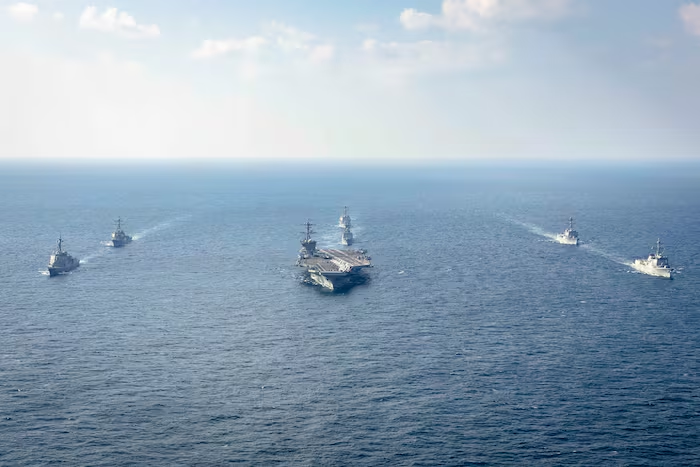
South Korea’s military announced Friday that a multinational defense exercise involving the United States and Japan will proceed next month, underscoring the three nations’ commitment to countering Pyongyang’s nuclear arsenal. The announcement came just one day after North Korea threatened retaliation against what it characterized as American aggression, signaling a deepening freeze in prospects for near-term diplomatic engagement between Washington and the regime.
The Freedom Edge exercise will run for five days beginning September 7 in waters surrounding South Korea’s Jeju Island, officials confirmed. Organizers described the operation as a defensive undertaking designed to strengthen allied responses to North Korean nuclear and ballistic missile capabilities while reinforcing stability throughout the region.
The trilateral drill marks a continuation of exercises that began in 2024, featuring coordinated air and naval operations focused on advancing joint ballistic missile defenses, anti-submarine capabilities, surveillance coordination, and related military skills. The maneuver represents an escalation in complexity compared to previous iterations of allied defense coordination.
The planned exercise contrasts sharply with President Donald Trump’s recent move to curtail the annual Ulchi Freedom Shield drill by six days, a decision he attributed to efforts to strengthen his relationship with North Korean leader Kim Jong Un. North Korea rejected this olive branch, dismissing the shortened timeline as insufficient and launching approximately 10 short-range ballistic missiles in response.
Pyongyang has historically condemned trilateral drills as hostile provocations and accused participating nations of plotting to encircle China while pressuring Russia. North Korea has stated it will not resume diplomatic talks unless the United States abandons its precondition requiring denuclearization discussions.
On Thursday, North Korea’s Foreign Ministry claimed the U.S. was pursuing “hostile moves” including potential transfers of air-to-air missiles and equipment to South Korea, pledging to deliver a “serious, immediate and powerful response” across multiple domains. Analysts suggest Kim Jong Un, strengthened by an expanded nuclear arsenal and closer ties to Russia, now seeks international recognition as a nuclear power and comprehensive sanctions relief in exchange for partial weapons reductions.

More Stories
Colombia backs Trump security push while limiting U.S. role in anti-gang operations
Chicago Mayor Issues Executive Order Requiring Contractor Diversity Disclosures and ICE Ties Reporting
Federal Prosecutors Convene Special Grand Jury to Investigate D.C. Schools’ Attendance and Graduation Practices