


💛 A quick favor, if you've got a second.
We're really happy that you chose to read one of our stories and sincerely hope you'll stick around to read more. We took our paywall down — for now — but that won't last forever, and when the gate goes back up, we'd love for you to already be on the inside.
It's free. So please enter your email here and don't forget to like and follow us on all of your favorite Social Media platforms!
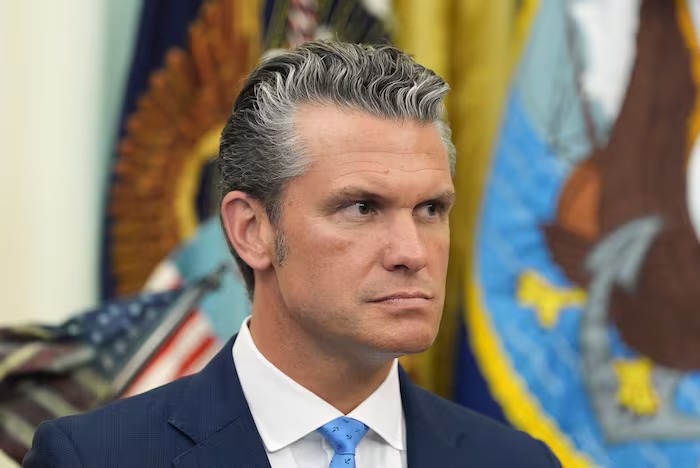
U.S. District Judge Rita Lin issued a written decision Thursday declaring that the Pentagon violated federal law when it designated artificial intelligence developer Anthropic as a supply chain risk. The ruling favored Anthropic in its ongoing dispute with the Department of Defense over the government’s effort to punish the company for publicly opposing certain military applications of AI technology. Government attorneys have indicated plans to appeal the decision.
The conflict emerged in February when President Donald Trump and Defense Secretary Pete Hegseth publicly accused Anthropic of threatening national security and imposed the supply chain risk designation on the company. Anthropic CEO Dario Amodei had refused to capitulate, expressing concerns that the company’s artificial intelligence systems could enable mass surveillance operations or power autonomous weaponry without sufficient human oversight.
In her 59-page ruling, Lin—a judicial appointee under former President Joe Biden—concluded that the government’s stated rationale lacked any factual foundation. The judge wrote that the Pentagon’s actions stemmed from an intent to make Anthropic a cautionary example rather than legitimate concerns the company would sabotage its own technology, and that neither constitutional law nor applicable federal statute permits such retaliation based solely on corporate criticism of policy.
Lin noted in prior proceedings that the government’s position appeared inconsistent with First Amendment protections. During a July 30 hearing, she characterized the administration’s legal arguments as “really troubling” and observed that the government’s evidentiary position had weakened considerably as litigation progressed.
Anthropic filed suit against the Pentagon in March, characterizing the supply chain designation as part of an illegal retaliation campaign targeting the company’s principled refusal to grant unrestricted military access to its technology. The company also challenged a Trump social media directive that instructed all federal agencies to discontinue use of Anthropic’s Claude chatbot and services.
A separate case remains pending before the federal appeals court in Washington involving different Pentagon regulations the department invoked to justify the supply chain risk classification. An Anthropic spokesperson acknowledged the ruling and stated the company intends to cooperate with government partners on artificial intelligence initiatives that serve national security interests.
The dispute has highlighted industry divisions over AI’s military applications. OpenAI, ChatGPT’s developer and Anthropic’s primary competitor, moved swiftly to negotiate a Pentagon partnership shortly after the government imposed penalties on Anthropic for its refusal to comply. Both companies are simultaneously preparing for significant initial public offerings.
More Stories
Federal voting arrest in New Jersey adds new pressure point in Sherrill-Trump standoff
Colombia backs Trump security push while limiting U.S. role in anti-gang operations
Former NFL cheerleader and ex-aide face off in close Rhode Island GOP primary