


💛 A quick favor, if you've got a second.
We're really happy that you chose to read one of our stories and sincerely hope you'll stick around to read more. We took our paywall down — for now — but that won't last forever, and when the gate goes back up, we'd love for you to already be on the inside.
It's free. So please enter your email here and don't forget to like and follow us on all of your favorite Social Media platforms!
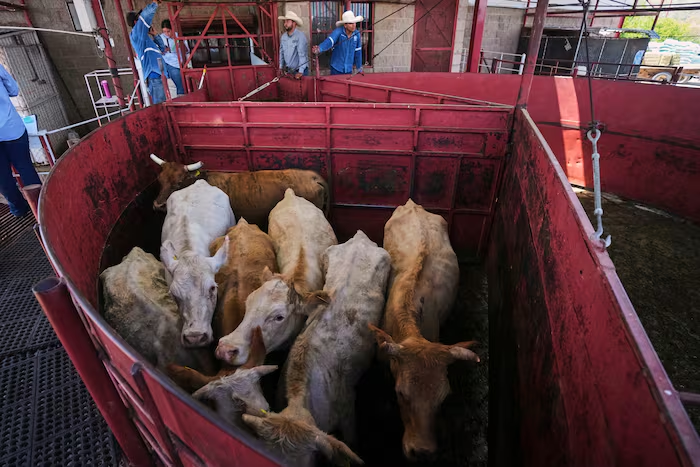
The Trump administration is moving forward with reopening a Douglas, Arizona border crossing to Mexican cattle shipments beginning Monday as part of a strategy to combat soaring beef prices. The U.S. Department of Agriculture has determined that concerns about New World screwworm transmission have diminished sufficiently to permit cattle movement at this crossing, located approximately 230 miles southeast of Phoenix, with plans to expand to additional crossings in New Mexico and Texas.
President Donald Trump announced Friday that he would permit 331,000 tons of imported ground beef to enter the U.S. tariff-free over the next 90 days, sold below market rates to address consumer costs. The administration closed the border to livestock from Mexico in May 2025 to combat screwworm spread, a parasitic threat that has devastated cattle populations. Economists, however, remain unconvinced that either measure will provide meaningful relief at grocery store checkout counters.
Derrell Peel, Oklahoma State University agribusiness professor, noted that the phased reopening approach means Mexican imports will take months to return to traditional supply levels. Mexico historically has supplied 1.1 million head of cattle, representing roughly 3% of U.S. livestock supply. “I don’t expect to see any measurable impact on cattle prices or beef prices soon,” Peel stated, emphasizing that the administration faces political pressure to demonstrate action on this high-profile issue.
Ground beef prices have surged 57% from July 2021 to July 2026, climbing from $4.39 to $6.89 per pound, with a 10% year-over-year increase. Uncooked steak prices have risen 35% over five years, reaching $13.06 per pound in July. Overall food prices have increased approximately 25% during the same period, making beef’s price trajectory particularly pronounced.
The U.S. cattle herd dropped to 86.2 million head on January 1, marking the lowest level in 75 years, according to the USDA. This decline stems from a combination of multi-year drought conditions in cattle-producing regions and two decades of depressed livestock prices that prompted ranchers to reduce herds. Texas A&M University professor David Anderson characterized the current situation as “the culmination of some 18, 19, 20 years of very low cattle prices.”
Agriculture Secretary Brooke Rollins selected the Arizona crossing for initial reopening because Sonora and Chihuahua in northern Mexico maintain stronger animal health protocols than other regions. All cattle will undergo inspection to confirm freedom from screwworm infestation before crossing into the U.S. The New World screwworm, a parasite with flesh-eating larvae, was largely eradicated from the United States by the 1960s but reemerged in southern Mexico in late 2024.
More than 40 screwworm cases have been confirmed in southern Texas and southeastern New Mexico since the first U.S. detection on June 3, affecting cattle, sheep, goats and dogs. The parasite represents a significant threat to the nation’s $113 billion cattle industry. House Agriculture Committee Chair John Boozman called the USDA approach “careful, science-based,” noting that restoring cattle trade is essential for border state producers and industry competitiveness.
Major meat processors have responded to cattle shortages by scaling back operations. Tyson Foods announced in November that it was closing its beef plant in Lexington, Nebraska, with additional closures planned for facilities in Utah and Illinois. JBS USA similarly announced closures in Memphis and near Philadelphia, though it committed to maintaining some Pennsylvania operations to preserve 400 jobs.
Rebuilding the nation’s depleted herd will require years, given that cattle typically produce only one calf annually, according to Peel. Using breeding heifers for reproduction further restricts food supply availability during the recovery period. Experts contend that elevated beef prices will persist for the foreseeable future, leaving policymakers with limited options to provide short-term consumer relief.

More Stories
Colombia backs Trump security push while limiting U.S. role in anti-gang operations
Chicago Mayor Issues Executive Order Requiring Contractor Diversity Disclosures and ICE Ties Reporting
University of Pennsylvania Climate Scientist Demands Supreme Court Packing Pledge From Democratic Candidates