


💛 A quick favor, if you've got a second.
We're really happy that you chose to read one of our stories and sincerely hope you'll stick around to read more. We took our paywall down — for now — but that won't last forever, and when the gate goes back up, we'd love for you to already be on the inside.
It's free. So please enter your email here and don't forget to like and follow us on all of your favorite Social Media platforms!
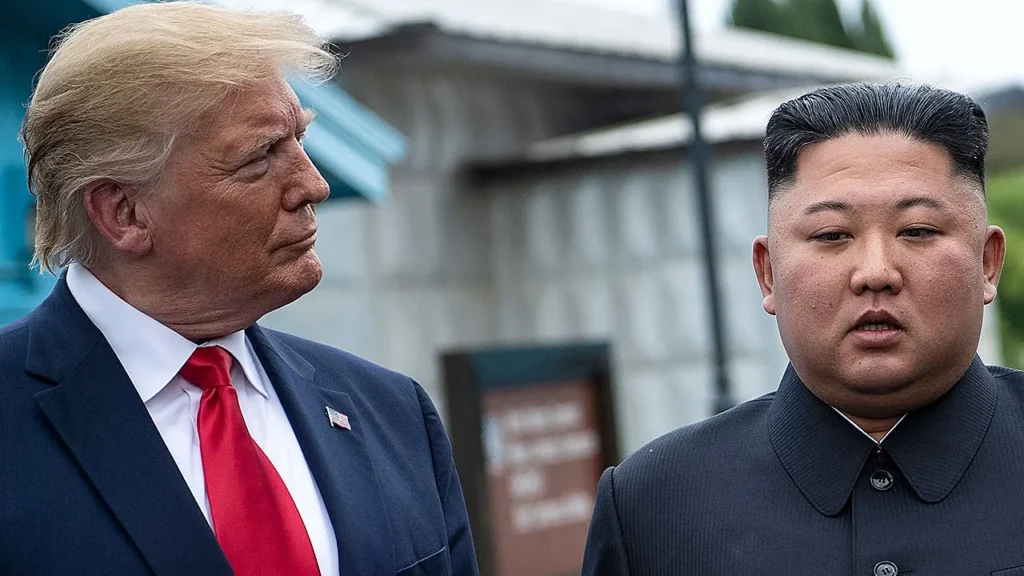
President Donald Trump is attempting to restart high-level negotiations with North Korean leader Kim Jong Un, but the diplomatic terrain has shifted considerably since their first-term engagements. Pyongyang now commands a more substantial nuclear stockpile, maintains strengthened ties with Russia, and faces reduced motivation to negotiate compared to eight years ago, according to foreign policy analysts.
The current standoff presents Trump with fundamentally different constraints than his previous diplomatic efforts. North Korea’s possession of an estimated 50 to 70 nuclear warheads and multiple delivery systems eliminates any realistic military solution, effectively narrowing Trump’s options for achieving the comprehensive denuclearization agreement that eluded his first administration. A complete elimination of the North Korean nuclear arsenal appears increasingly implausible under current circumstances.
Victor Cha, Korea chair at the Center for Strategic and International Studies, suggested Trump may view North Korea diplomacy as a vehicle to redirect media attention from his concurrent nuclear confrontation with Iran. Cha noted that North Korea represents a distinctly different challenge given its mature weapons program and operational delivery capabilities, which fundamentally distinguish it from the Iranian nuclear situation.
Rather than pursuing total denuclearization, negotiators are considering more modest objectives. These could include formal restrictions on nuclear and intercontinental ballistic missile testing, establishment of crisis communication channels between Washington and Pyongyang, reduction of North Korea’s military coordination with Russia, or a peace treaty that permits Kim’s nuclear arsenal to remain intact while improving bilateral relations.
Trump announced this week that he expects to meet Kim before year’s end, emphasizing the personal rapport developed during their earlier summits. A White House official confirmed the leaders will convene “at the appropriate time” but declined to specify timing, venue, or logistical preparations for such an encounter.
The strategic balance has shifted decidedly in Pyongyang’s favor since 2018. North Korea previously operated under intense pressure from United Nations Security Council sanctions and internal food shortages that gave Trump considerable leverage. The regime’s deepening partnership with Russia—forged through weapons and troop contributions to Moscow’s Ukraine campaign—has provided access to economic and military support while diminishing international accountability mechanisms.
Kelsey Davenport, director for nonproliferation policy at the Arms Control Association, asserted that comprehensive agreements eliminating North Korea’s weapons are no longer feasible. She argued that Pyongyang can now negotiate from a position of substantially greater strength than it held during the 2018 Singapore summit, where Kim pledged to pursue complete denuclearization without establishing verification procedures or implementation timelines.
Trump has already signaled his negotiating approach by reducing joint military exercises with South Korea, mirroring actions he took during his initial diplomatic outreach to Kim. North Korea responded dismissively, launching approximately 10 short-range ballistic missiles toward its eastern waters the following day, indicating Pyongyang’s demands extend beyond modest confidence-building measures.
Anthony Ruggiero, who directed North Korea policy at the National Security Council during Trump’s first term, characterized the exercise reduction as consistent with earlier diplomatic patterns. He noted that Trump’s willingness to implement such concessions aligns with his established negotiating framework, though observers expressed surprise at the timing of the move.
Washington possesses several potential inducements for Kim, including phased sanctions relief, modifications to military deployment levels, reduced exercise frequencies, and a peace agreement recognizing North Korea’s de facto status as a nuclear power. For the regime, an accord preserving its weapons arsenal while winning U.S. recognition would represent significant diplomatic progress toward its long-standing objective of achieving international acceptance as a legitimate nuclear state.
Cha identified several limited achievements that could constitute diplomatic success. These include formal prohibitions on nuclear and ICBM testing, reduced military coordination between Pyongyang and Moscow, establishment of crisis management communication channels, and possibly a peace declaration or treaty formally concluding the technically unresolved Korean War state dating to the 1953 armistice.
Recovery of American military remains from the Korean War represents another potential humanitarian accomplishment. The 2018 Singapore agreement included commitments to repatriation efforts, resulting in Pyongyang’s transfer of 55 boxes containing presumed American remains in 2018. Future negotiations could restart joint recovery operations inside North Korea, with prior cooperative efforts occurring as recently as 2005.
A direct crisis communication channel between U.S. and North Korean military commanders holds particular strategic value given the absence of established direct contact protocols. Such a mechanism could prevent miscalculation if American radar systems detected ballistic missile launches, allowing immediate clarification of North Korean intentions rather than defaulting to worst-case assumptions.
North Korea has demonstrated measurable restraint since Trump returned to office despite conducting several ICBM tests during the Biden administration in 2022, 2023, and 2024. The regime has not launched an ICBM in flight since January 2025, and has refrained from nuclear weapons testing since 2017, suggesting possible willingness to consider limitations on escalatory activities.
Experts emphasize that comprehensive verification of any agreement would prove extraordinarily difficult. Davenport advocated for measures focusing on nuclear risk reduction and program deceleration, including missile testing moratoria, crisis communication infrastructure, and potential freezes on nuclear development. International Atomic Energy Agency inspector access remains unrealistic in near-term negotiations, though satellite imagery analysis of reactor operations and plutonium reprocessing facilities could provide limited monitoring capability.
Renewed negotiations will test the U.S.-South Korea alliance durability and shared strategic objectives. Seoul may welcome reopened dialogue channels after years of diplomatic silence, yet remains apprehensive about concessions affecting American troop deployments or military exercise levels. South Korea likely received no advance notice of Trump’s exercise reductions but could ultimately view restarted U.S.-North Korea negotiations favorably if they generate sustained diplomatic engagement.
The critical tension involves American force disposition on the Korean Peninsula. North Korea seeks withdrawal of U.S. military personnel, South Korea demands their retention, and Trump’s actual preferences remain ambiguous. This fundamental disagreement over troop levels will likely determine whether any negotiated agreement can satisfy both Seoul’s security interests and Washington’s diplomatic objectives with Pyongyang.

More Stories
Colombia backs Trump security push while limiting U.S. role in anti-gang operations
Trump Threatens FCC Action Against NBC’s Welker Over Endorsement Coverage
Chicago Mayor Issues Executive Order Requiring Contractor Diversity Disclosures and ICE Ties Reporting