


💛 A quick favor, if you've got a second.
We're really happy that you chose to read one of our stories and sincerely hope you'll stick around to read more. We took our paywall down — for now — but that won't last forever, and when the gate goes back up, we'd love for you to already be on the inside.
It's free. So please enter your email here and don't forget to like and follow us on all of your favorite Social Media platforms!
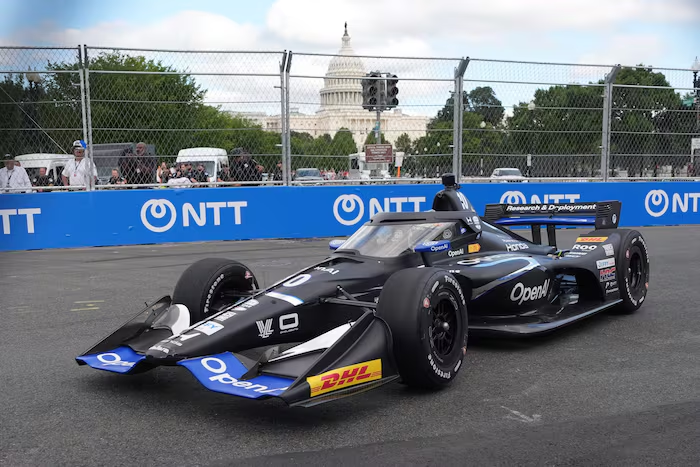
Drivers competing in Washington’s maiden Freedom 250 Grand Prix have shifted focus from the scenic backdrop of the nation’s capital to the challenging surface conditions of the newly constructed 1.7-mile street course. The track’s prominent landmarks — including the Capitol Building near Turn 1 and the Washington Monument in the distance — have given way to practical concerns about pavement quality during on-track testing sessions.
Series points leader Alex Palou expressed enthusiasm about the layout while highlighting a critical issue: substantial bumps throughout the circuit, particularly heading into Turns 2 and 6. “Very bumpy, huge bumps heading into Turn 2 and Turn 6. Massive bumps that are going to spice things up,” Palou said following a Saturday morning practice session. The track features seven turns, nearly all left-hand configurations, creating what appears straightforward on paper but presents technical challenges at racing speed.
Pato O’Ward, who claimed victory at Mid-Ohio last month, identified the straightaway along Pennsylvania Avenue between Turns 1 and 2 as particularly problematic. Multiple drivers reported significant surface irregularities on both the exit of Turn 1 and the approach to Turn 2, complications that will define the circuit’s characteristics throughout the weekend. Driver Louis Foster experienced these conditions firsthand when he struck a bump near the Independence Avenue straightaway and collided with the wall.
Despite the surface issues, Palou emphasized the track’s favorable passing opportunities compared to other downtown circuits. Turn 2, a sharp bend concluding the Pennsylvania Avenue straightaway, and Turn 5, a 90-degree left from 7th Street, offer strategic overtaking positions that should produce competitive racing. Palou noted the track’s width provides advantages over tighter courses like Detroit, where faster drivers struggle to execute passes.
Palou secured the top practice lap at 56.6145 seconds in the second session before winning qualifying later Saturday. Meanwhile, NASCAR’s four-time Cup champion Jeff Gordon dominated a two-race IROC event in the nation’s capital, with Kurt Busch finishing second in both competitions. Organizers anticipate humid conditions for Sunday’s 147-lap, 250-mile race, with drivers bracing for the physical demands typical of street course competition.

More Stories
Indiana coach Curt Cignetti tells restless Hoosiers fans not to gripe over 38-0 win
Packers Running Back Josh Jacobs Placed on Commissioner Exempt List Pending Misdemeanor Charges
Denver Broncos Linebacker Jonathon Cooper Placed on Commissioner’s Exempt List Amid Domestic Violence Charges