


💛 A quick favor, if you've got a second.
We're really happy that you chose to read one of our stories and sincerely hope you'll stick around to read more. We took our paywall down — for now — but that won't last forever, and when the gate goes back up, we'd love for you to already be on the inside.
It's free. So please enter your email here and don't forget to like and follow us on all of your favorite Social Media platforms!
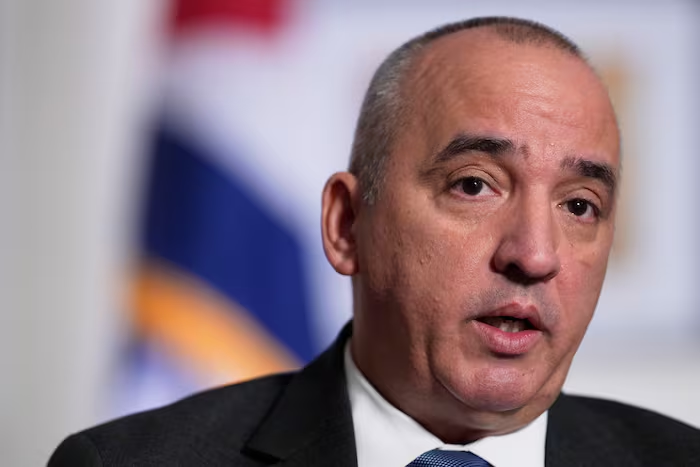
Cuba’s ambassador to the United Nations challenged the Trump administration this week over what he characterized as a fundamental contradiction in U.S. policy toward the island nation. Ambassador Ernesto Soberón Guzmán told the Associated Press that the United States has repeatedly demanded Cuba embrace private investment and economic liberalization, yet continues to escalate sanctions that make such reforms nearly impossible to implement successfully.
Soberón Guzmán directed his critique at Secretary of State Marco Rubio, the chief architect of the Trump administration’s Cuba strategy, questioning the logic behind imposing new sanctions roughly every two weeks. In response, the State Department defended the measures through Rubio, stating that additional penalties would continue as needed to prevent Cuba from creating “escape valves” in its economy.
The administration announced fresh economic sanctions on Thursday targeting Cuban state-owned mining, metal and construction enterprises. These measures follow a January oil blockade that compounded an existing decades-long embargo, combining to trigger severe electricity shortages, fuel scarcity, transportation disruptions and shortages of medicine and food across the Caribbean nation.
Cuba’s president, Miguel Díaz-Canel, introduced sweeping economic reforms in June designed to expand private business opportunities, permit imports and exports without state intermediaries, authorize private banking, and attract foreign investment in sectors including real estate, solar energy and tourism. The ambassador said these changes represent genuine Cuban commitment to economic opening and would progress far more rapidly without sanctions constraints.
William LeoGrande, a professor at American University specializing in U.S.-Cuba relations, argued that the Trump administration’s stated desire for Cuban economic liberalization contradicts its enforcement strategy. He characterized the sanctions policy as fundamentally incompatible with meaningful foreign investment, suggesting the administration’s actual goal extends beyond economic opening to regime change.
The timing of escalating sanctions coincides with Cuba’s economic deterioration following the January ouster of Venezuelan leader Nicolás Maduro, who had provided crucial economic support to the island. John Kavulich, president of the U.S.-Cuba Trade and Economic Council, noted that Cuba implemented more significant economic and financial reforms during the past eight months than at any comparable period since the 1959 revolution.
Christopher Hernandez-Roy, acting director of the Americas program at the Center for Strategic and International Studies, observed an irony inherent in current U.S. policy: American pressure is driving Cubans toward greater economic liberalization out of necessity, while simultaneously restricting the resources and market access required for such reforms to meaningfully improve living standards.
Rubio, a former Florida senator whose parents were born in Cuba, has dismissed the announced reforms, calling Cuba “a failed state” with an ineffective economic model and claiming its leaders lack competence in addressing economic problems. He stated that the administration remains committed to supporting Cuban prosperity and freedom, particularly given the nation’s proximity to the U.S. mainland, located just 90 miles away.
Soberón Guzmán indicated that diplomatic conversations between the United States and Cuba are ongoing but declined to characterize the nature or substance of discussions he described as highly sensitive. He stressed that despite Cuba’s substantial policy changes, the U.S. government maintains what he characterized as an aggressive stance toward the Cuban people.

More Stories
Federal voting arrest in New Jersey adds new pressure point in Sherrill-Trump standoff
Colombia backs Trump security push while limiting U.S. role in anti-gang operations
Former NFL cheerleader and ex-aide face off in close Rhode Island GOP primary