


💛 A quick favor, if you've got a second.
We're really happy that you chose to read one of our stories and sincerely hope you'll stick around to read more. We took our paywall down — for now — but that won't last forever, and when the gate goes back up, we'd love for you to already be on the inside.
It's free. So please enter your email here and don't forget to like and follow us on all of your favorite Social Media platforms!
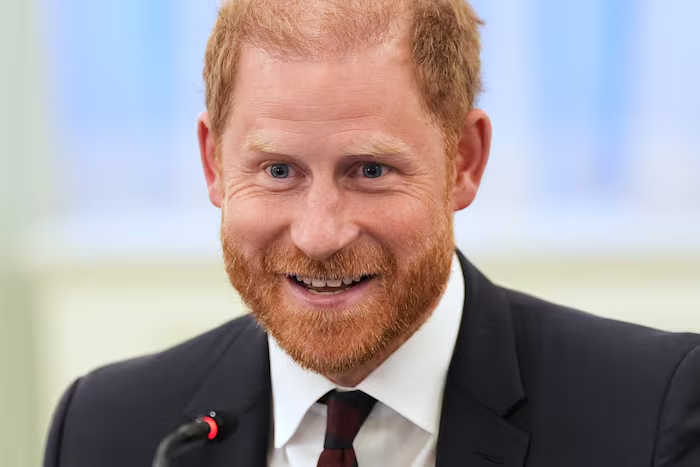
Prince Harry convened with U.S. veterans, military officials, spouses and nonprofit representatives at a Washington hotel Wednesday evening to discuss how communities can better harness the skills of returning service members. The Duke of Sussex emphasized that talented individuals who have served already exist within communities and need greater recognition for their capabilities and battlefield experience.
During the 80-minute conversation organized by The Independence Fund, Harry announced plans to develop a business-focused initiative that compensates veterans for their expertise rather than relying on volunteer contributions. The British Army veteran, who spent a decade in uniform including two Afghanistan deployments, stressed that service members possess invaluable communication abilities, moral leadership and capacity to function under extreme pressure that remain underutilized in the private sector.
Harry noted in remarks to the Associated Press that younger military personnel increasingly seek meaningful work and continued service to others, regardless of their branch or nationality. However, these competencies frequently fail to translate effectively when transitioning to civilian employment, he indicated.
Several wounded veterans at the roundtable detailed specific challenges they face upon discharge. Garrett J. Carnes, a retired Marine corporal who lost both legs, emphasized how critical physical activity remains for his rehabilitation. Jason Wheeler, a Navy and Army veteran, described the difficulty obtaining military benefits coverage for necessary surgery and recalled the indignity of crawling off a commercial aircraft with his service dog despite medical predictions he would never walk again.
Attendees also raised concerns about inadequate veterans’ health facilities in rural areas and overburdened mental health services at Veterans Affairs offices nationwide. Sarah Verardo, chief executive of The Independence Fund, noted that Harry’s engagement with patients at Walter Reed National Military Medical Center visibly strengthened their resolve and confidence.
Harry’s visit included stops at Arlington National Cemetery, where he placed a wreath, and the military medical center. Jane Horton, a senior defense adviser in the Trump administration and Gold Star wife, praised Harry for channeling personal trauma into meaningful advocacy that resonates throughout the veteran community.
Beyond veterans’ issues, Harry expressed broader concerns about concentrated power among a small global elite making decisions affecting billions of people across political and technological spheres. He advocated for younger leaders with different perspectives and suggested that reduced testosterone-driven decision-making could benefit global governance.

More Stories
Christa Pike Survives Botched Double Execution Attempt; Tennessee Halts Remaining 2026 Executions
Tennessee’s Lone Death Row Female is Scheduled for Execution Wednesday for 1995 Torture/Murder
Colombia backs Trump security push while limiting U.S. role in anti-gang operations