


💛 A quick favor, if you've got a second.
We're really happy that you chose to read one of our stories and sincerely hope you'll stick around to read more. We took our paywall down — for now — but that won't last forever, and when the gate goes back up, we'd love for you to already be on the inside.
It's free. So please enter your email here and don't forget to like and follow us on all of your favorite Social Media platforms!
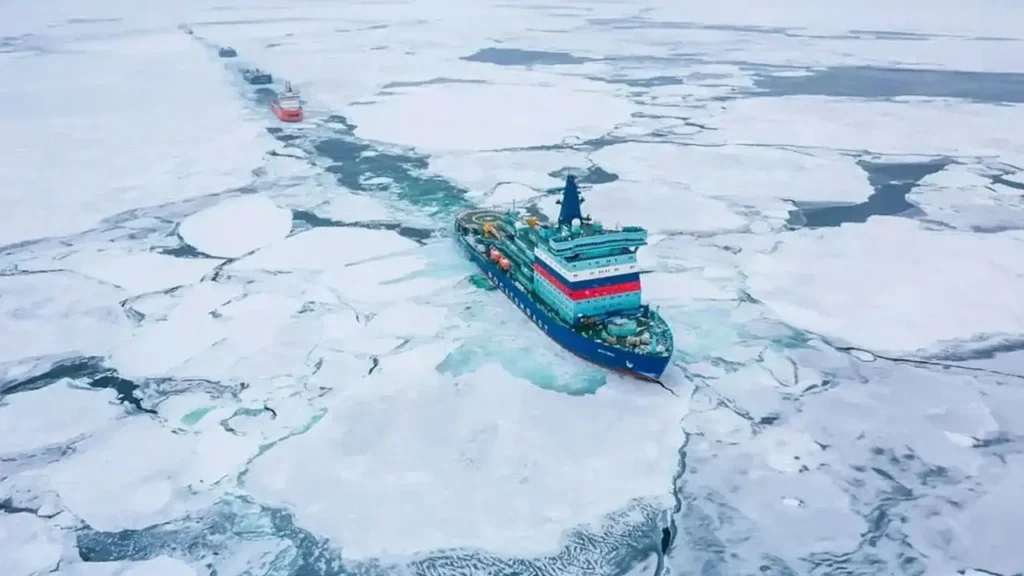
Beijing has initiated regular seasonal container shipments to Europe via Russia’s Northern Sea Route, marking an expansion of Chinese commercial operations in the Arctic as cooperation between Moscow and Beijing deepens across military and economic domains. The service, though modest in scale with just over eight voyages scheduled this season, signals a broader strategic repositioning as climate change makes polar waters increasingly navigable and accessible for international commerce.
A vessel operated by Sea Legend Shipping departed from Ningbo-Zhoushan Port on August 15, bound for Felixstowe, England, with the voyage expected to take approximately 20 days through Russian Arctic waters. The route bypasses traditional chokepoints including the Strait of Malacca, Bab el-Mandeb, Red Sea, Suez Canal, and Strait of Gibraltar, offering China a geopolitically significant alternative for Europe-bound trade.
A U.S.-China Economic and Security Review Commission staff report released August 20 warns that Russia’s isolation following its 2022 invasion of Ukraine has forced Moscow to accept greater Chinese presence and investment in the Arctic, a region Russia has historically guarded as central to its sovereignty. Chinese state-owned enterprises now control a combined 20 percent stake in the sanctioned Arctic LNG 2 project, while Beijing and Moscow are jointly developing year-round commercial shipping infrastructure and ice-class container vessels slated for service in 2027.
Pentagon strategists and White House officials have increasingly identified the Arctic as critical to American national security and economic interests. A White House official stated that the United States, as an Arctic nation, will pursue its security objectives and ensure regional stability amid intensifying competition from China and Russia.
Energy asymmetries underscore the deepening Russia-China relationship. China accounts for roughly half of Russia’s crude oil exports while Russian oil represents only about one-fifth of Chinese imports, according to the commission report. Beijing has purchased approximately $372 billion in Russian fossil fuels since the Ukraine invasion, creating economic leverage that exceeds mutual dependency.
Russia transported seven crude shipments totaling approximately 6 million barrels toward Asia through the Northern Sea Route so far this season as of mid-August, nearly half the entire 2023 season’s volume, with China as the principal destination. The expanded Arctic corridor enables Moscow to redirect energy exports eastward while circumventing Western sanctions and trade restrictions.
Military cooperation between Beijing and Moscow has accelerated in the polar region. The USCC report documents at least 119 combined military exercises as of April 2026, with July operations including submarine, anti-submarine, and drone activities. Chinese bombers entered the Alaskan Air Defense Identification Zone for the first time during a joint China-Russia patrol in 2024, marking an unprecedented penetration of North American airspace.
Analysts emphasize that despite the Arctic’s limited immediate commercial viability, the region’s strategic significance lies in preventing adversaries from establishing uncontested dominance. The Bering Strait, separating Russia from Alaska, presents both a potential chokepoint and vulnerability for U.S. interests, though American military presence in the region remains constrained by limited icebreaker capacity and infrastructure capabilities.

More Stories
Colombia backs Trump security push while limiting U.S. role in anti-gang operations
Chicago Mayor Issues Executive Order Requiring Contractor Diversity Disclosures and ICE Ties Reporting
Federal Prosecutors Convene Special Grand Jury to Investigate D.C. Schools’ Attendance and Graduation Practices