

💛 A quick favor, if you've got a second.
We're really happy that you chose to read one of our stories and sincerely hope you'll stick around to read more. We took our paywall down — for now — but that won't last forever, and when the gate goes back up, we'd love for you to already be on the inside.
It's free. So please enter your email here and don't forget to like and follow us on all of your favorite Social Media platforms!
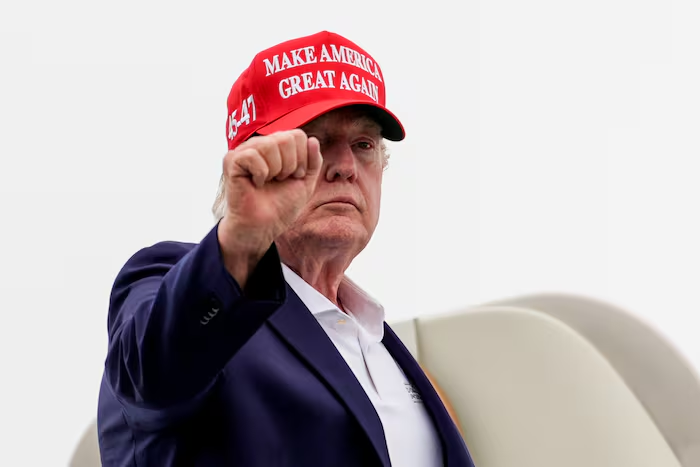
President Donald Trump announced Wednesday that he is postponing a 50 percent tariff on $20 billion in Canadian imports, with the two nations reaching an agreement just under two hours before the levies were scheduled to take effect. The three-day pause provides negotiators additional time to work toward a broader agreement while temporarily relieving pressure on the already strained trade relationship between the neighboring countries.
Trump posted on Truth Social that he had “paused the 50% Tariffs against Canada” based on a deal between the two nations, pending document finalization. Had the tariffs proceeded at 12:01 a.m. Wednesday as originally planned, they would have affected Canadian goods ranging from hockey sticks to tongue depressors.
Canadian Prime Minister Mark Carney said “substantial progress” had been made but significant work remained ahead. Chamber of Commerce President Candace Laing warned that the three-day reprieve, while offering temporary relief, fell short of the certainty a signed interim agreement would provide, describing the current situation as an undesirable state of limbo.
The postponement carries broader political implications beyond immediate economic effects. Canada had signaled it would retaliate with its own tariffs if Trump’s levies took effect, potentially escalating a trade dispute between nations that exchanged $880 billion in goods and services annually.
The Trump administration imposed new sanctions on the International Criminal Court on Tuesday, freezing assets of ICC President Tomoko Akane and senior trial lawyer Abdoulaye Seye within U.S. jurisdictions. Secretary of State Marco Rubio characterized the tribunal as “corrupt and fatally politicized,” accusing it of maliciously abusing its authority and unfairly prosecuting American and Israeli soldiers.
The ICC responded by stating the sanctions undermine the rule of law and place the international legal order at risk. The statement warned that threatening judicial officials for applying the law jeopardizes the entire system of international jurisprudence.
In military developments, South Korea and the United States agreed to substantially reduce their joint Ulchi Freedom Shield exercises following Trump’s direct order to scale back operations. The drills, which began Monday for an initially scheduled 11-day period, will now conclude Friday rather than August 27, with both nations downsizing some joint field training components.
South Korean officials expressed surprise at Trump’s unannounced directive, which came without advance consultation and raised questions about joint defense readiness. Trump cited his relationship with North Korean leader Kim Jong Un and South Korea’s stance on Iran as reasons for the reduction.
Florida’s primary elections delivered mixed results for incumbents and notable victories for progressive candidates. Republican Rep. Byron Donalds, Trump’s chosen candidate, won the GOP nomination for governor, positioning him to potentially become the state’s first Black governor if elected in November.
A mysterious political consulting firm called Median Strategies admitted to fabricating multiple election polls this month, including surveys regarding the Democratic gubernatorial primary in Wisconsin, Nevada’s gubernatorial race, and Los Angeles’s mayoral contest. The fake results highlighted vulnerabilities in relying on unvetted polling data, particularly after Mayor Karen Bass’s campaign shared the fabricated California poll on social media.
A federal judge ruled Tuesday that paint tests on the Eisenhower Executive Office Building adjacent to the White House may proceed, clearing a temporary hurdle for Trump’s proposed renovation project. The proposed paint job, estimated to cost at least $7.5 million, aims to apply a fresh white coat to the 19th-century granite landmark.
Preservationists, architects, and historians have opposed the painting plan, arguing that granite surfaces should not be painted as the coating would trap moisture and cause stone degradation. U.S. District Judge Dabney L. Friedrich determined that plaintiffs challenging the project had not demonstrated that preliminary test work would cause irreparable damage.

More Stories
Colombia backs Trump security push while limiting U.S. role in anti-gang operations
Former NFL cheerleader and ex-aide face off in close Rhode Island GOP primary
Trump Threatens FCC Action Against NBC’s Welker Over Endorsement Coverage