


💛 A quick favor, if you've got a second.
We're really happy that you chose to read one of our stories and sincerely hope you'll stick around to read more. We took our paywall down — for now — but that won't last forever, and when the gate goes back up, we'd love for you to already be on the inside.
It's free. So please enter your email here and don't forget to like and follow us on all of your favorite Social Media platforms!
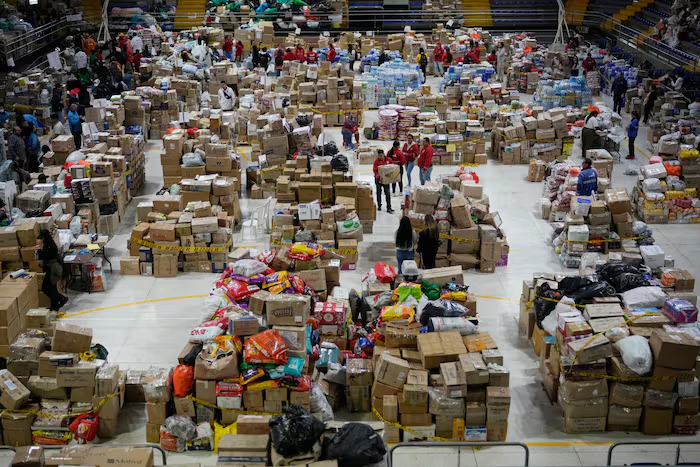
A powerful 7.4 magnitude earthquake struck western Colombia on August 10, leaving at least 312 dead and destroying approximately 29,000 homes, according to government figures released Wednesday. The Choco region, already among the country’s most economically disadvantaged areas, bore the brunt of the catastrophe, with the epicenter in this heavily forested and mountainous zone.
The quake’s impact proved particularly severe for Choco’s roughly 600,000 residents, predominantly Afro-Colombian and Indigenous populations, who already contended with severe poverty, inadequate infrastructure and chronically underfunded schools and hospitals. The United Nations Office for the Coordination of Humanitarian Affairs reported that approximately 69,000 people—roughly 10 percent of the region’s population—were affected or displaced by the disaster.
Luis Mora, representative of the United Nations Population Fund in Colombia, characterized the situation as a “triple crisis” encompassing the earthquake’s immediate humanitarian consequences alongside the region’s longstanding underdevelopment and ongoing armed conflict involving rebel groups fighting over illegal mining operations and drug trafficking networks.
Quibdo’s sole public hospital quickly became overwhelmed following the earthquake, with emergency rooms operating at double capacity and patients treated on stretchers in hallways. Dr. Cristian Maturana reported that 36 patients requiring complex fracture treatment were transported to Medellin due to insufficient personnel and equipment, while a power surge destroyed the facility’s blood storage refrigerator.
Isolation continues to hinder recovery efforts, as only two unreliable roads connect Choco to the remainder of Colombia, with many communities accessible solely by air or water. The region’s approximately 406 miles of Pacific coastline lack any roads connecting interior settlements, complicating distribution of humanitarian aid and medical supplies.
President Abelardo de la Espriella visited the region twice following the disaster, pledging billions of dollars in infrastructure investment and employment initiatives. The administration announced plans to appoint a dedicated official overseeing recovery efforts and provide rental subsidies for displaced families.
Ismael Arias, a 66-year-old mathematics teacher whose two-story home collapsed, expressed skepticism regarding government promises given Choco’s historical pattern of neglect. Arias invested approximately $32,000 constructing his residence through bank loans and faces significant difficulty rebuilding on his modest teaching salary.

More Stories
Colombia backs Trump security push while limiting U.S. role in anti-gang operations
Federal Prosecutors Convene Special Grand Jury to Investigate D.C. Schools’ Attendance and Graduation Practices
State Department Reissues Level 3 Travel Advisory for Israel Amid Terrorism and Armed Conflict Concerns