


💛 A quick favor, if you've got a second.
We're really happy that you chose to read one of our stories and sincerely hope you'll stick around to read more. We took our paywall down — for now — but that won't last forever, and when the gate goes back up, we'd love for you to already be on the inside.
It's free. So please enter your email here and don't forget to like and follow us on all of your favorite Social Media platforms!
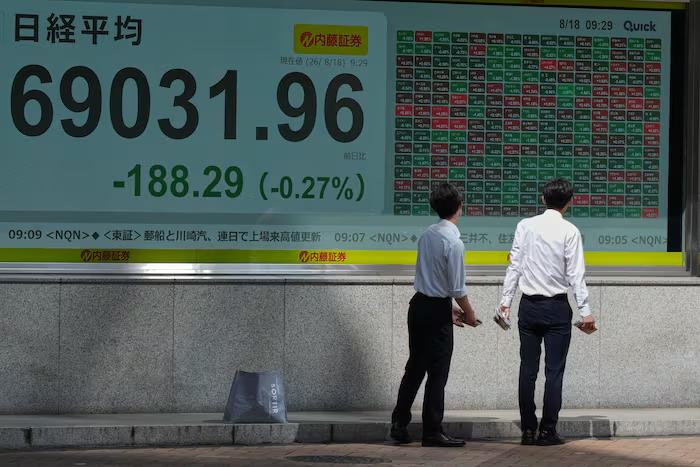
Stocks across Asia fell during early Tuesday trading as crude oil’s climb higher and mounting inflation anxieties dampened investor sentiment, despite encouragement from solid quarterly earnings. Japan’s Nikkei 225 slid 1.6% to close at 68,098.54, while Australia’s S&P/ASX 200 managed a modest 0.2% gain to 9,088.60. South Korea’s Kospi dropped 0.6% to 6,933.60, Hong Kong’s Hang Seng retreated 0.6% to 25,289.88, and Shanghai’s Composite fell 0.5% to 3,963.53.
Market watchers attributed the downturn partly to geopolitical tensions affecting global oil supplies, particularly concerning the implications of the conflict with Iran on energy markets. Japan, which relies almost entirely on imported crude, faces particular vulnerability to price swings. Strong earnings reports from Asian corporations in recent weeks, following positive results from American companies, have provided some counterbalance to these broader concerns.
Analysts at BofA Securities highlighted that artificial intelligence investment benefits have expanded considerably beyond initial beneficiaries, now spanning semiconductor equipment, power systems, machinery, and materials manufacturing. Japanese companies posted robust results for the April-June period, suggesting the Bank of Japan may follow the U.S. Federal Reserve’s path toward raising interest rates within months, according to analysts Masashi Akutsu and Tetsuhiro Tokuyama.
Wall Street extended its pullback from recent highs on Monday, with the S&P 500 declining 0.5% to 7,745.06 despite remaining near its all-time peak set Thursday. The Dow Jones Industrial Average lost 272.63 points to 53,459.78, and the Nasdaq composite dropped 84.25 to 26,644.91.
Crude oil’s sharp acceleration upward during afternoon trading intensified market pressure, with U.S. benchmark crude gaining 34 cents to $84.84 per barrel in early Asian trading Tuesday. Brent crude, the global standard, climbed 21 cents to $91.08 per barrel after gaining 2.7% to $90.87 on Monday.
Last month’s volatility in Brent crude, which traded between $72 and $102 per barrel, reflected shifting prospects for a potential U.S.-Iran agreement that could restore normal oil tanker movement through the Persian Gulf. Higher crude prices have elevated Treasury yields, with the 10-year yield climbing to 4.72% from 4.68% late Friday, rising substantially from 3.97% before the Iran conflict began.
The yield surge reflects market expectations that elevated oil prices will worsen inflation and increase the likelihood of additional Federal Reserve rate increases. Though higher rates could help contain inflation, they do so by intentionally constraining economic growth. Long-term U.S. mortgage rates have already jumped near their highest point in a year following the Treasury yield’s climb, though recent data indicated July’s inflation figures came in better than midsummer projections.
Currency markets saw the U.S. dollar strengthen to 159.43 Japanese yen from 159.37 yen, while the euro ticked upward to $1.1585 from $1.1581.

More Stories
Colombia backs Trump security push while limiting U.S. role in anti-gang operations
Federal Prosecutors Convene Special Grand Jury to Investigate D.C. Schools’ Attendance and Graduation Practices
State Department Reissues Level 3 Travel Advisory for Israel Amid Terrorism and Armed Conflict Concerns