


💛 A quick favor, if you've got a second.
We're really happy that you chose to read one of our stories and sincerely hope you'll stick around to read more. We took our paywall down — for now — but that won't last forever, and when the gate goes back up, we'd love for you to already be on the inside.
It's free. So please enter your email here and don't forget to like and follow us on all of your favorite Social Media platforms!
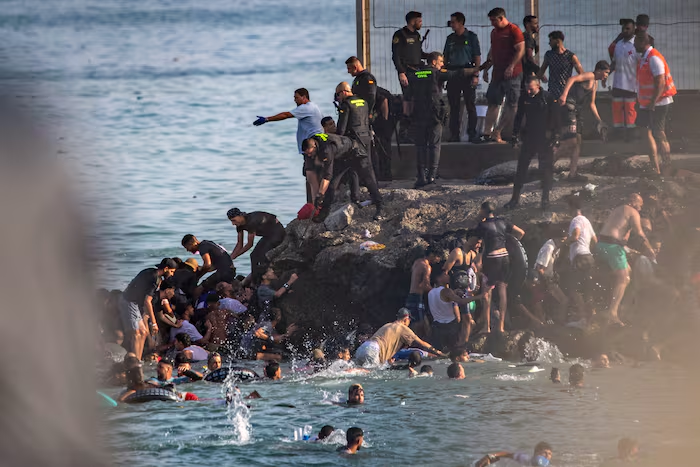
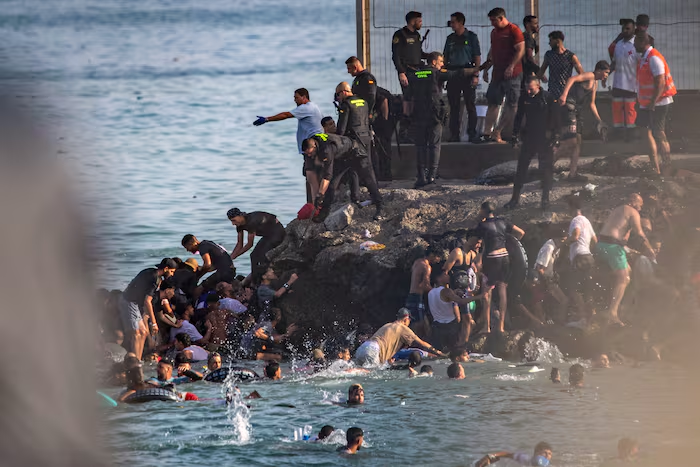
Three Moroccan men with starkly different circumstances died during last month’s catastrophic attempt to reach Ceuta, a Spanish enclave on North Africa’s coast. Ayoub Akbili, 31, held a physics degree but worked at an automobile parts factory earning $421 monthly, hoping to fund his mother’s hernia surgery. Hamza Haibouri, 28, played semi-professional soccer and earned roughly $540 monthly, aspiring to advance his athletic career in Europe. Abdelouahed Iken, 19, was a high school student drawn by images of European prosperity his friend shared on social media.
Misinformation about border access triggered a mass movement of more than 70,000 prospective migrants from Morocco and surrounding regions toward Ceuta in late July. Participants either swam or attempted to scale a breakwater separating them from the Spanish territory, resulting in at least 90 confirmed deaths—the deadliest crossing between the two nations on record. Human rights organizations have challenged official death counts as incomplete, while Moroccan and Spanish governments blamed social media falsehoods and human trafficking networks for fueling the crisis.
Akbili paid a driver $129—equivalent to two months of rent—for transport to the border on July 31, despite earning barely above the national median wage. Eyewitnesses reported scenes of extreme chaos, with crowds so densely packed that police deployed tear gas and stun grenades to disperse them. An Interior Ministry document attributed his death to severe head trauma and classified it as unnatural, yet his family received conflicting explanations and questioned the official account of how he died.
Haibouri was vacationing in Martil, a coastal town roughly 25 miles from Ceuta, when he witnessed migrants heading toward the border and decided to join the effort. Though he had not played competitive soccer matches that year, he maintained his monthly earnings from the sport. News of his death came through announcements on his soccer club’s social media channels.
Iken, who could not swim, purchased a life jacket before the crossing after misleading his mother about where he was going. His family discovered his death through Facebook posts, learning he drowned after becoming overwhelmed in the water. Remittances sent to Morocco by overseas nationals reached $6.6 billion during the first half of the year, accounting for more than 3 percent of the country’s GDP and underscoring Europe’s economic magnetism.
Repatriation of bodies from Ceuta required families to pay approximately 2,500 euros, a prohibitive expense for many bereaved relatives. Spanish authorities completed necessary documentation for returning the deceased, but Morocco’s government refused to accept the paperwork without clarification on cost responsibility or financial support for grieving families. Spanish forensic officials finished autopsies on 82 migrants recovered from Spanish waters.
Haibouri’s sister submitted to DNA testing to confirm her brother’s identity despite having received his identification documents from authorities. Officials refused to permit her to view his body, and family members projected at least 20 additional days would be required before repatriation could occur. The Trade Union Network for Migration in Morocco called on both governments to assume financial responsibility for returning deceased migrants to their families.

More Stories
Christa Pike Survives Botched Double Execution Attempt; Tennessee Halts Remaining 2026 Executions
Tennessee’s Lone Death Row Female is Scheduled for Execution Wednesday for 1995 Torture/Murder
Federal voting arrest in New Jersey adds new pressure point in Sherrill-Trump standoff