


💛 A quick favor, if you've got a second.
We're really happy that you chose to read one of our stories and sincerely hope you'll stick around to read more. We took our paywall down — for now — but that won't last forever, and when the gate goes back up, we'd love for you to already be on the inside.
It's free. So please enter your email here and don't forget to like and follow us on all of your favorite Social Media platforms!
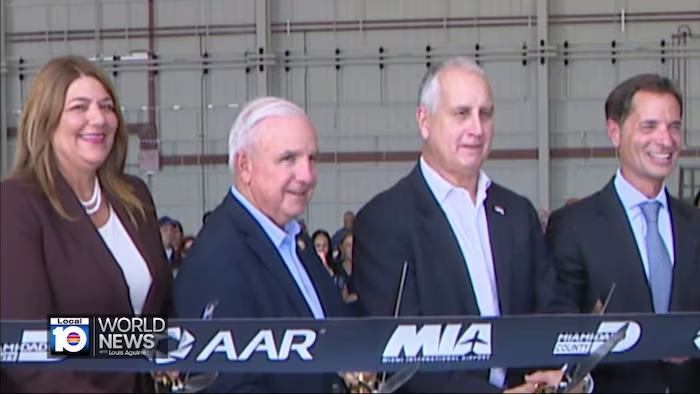
Two Republican congressmen from South Florida are calling for restraint regarding expectations for imminent political upheaval in Cuba, even as the Trump administration maintains its hardline economic sanctions strategy aimed at destabilizing the communist government. U.S. Representatives Mario Diaz-Balart and Carlos Gimenez, both representing Cuban American constituencies, argued that while pressure from Washington remains essential, meaningful change may require an extended timeline.
When asked whether Raúl Castro would voluntarily abandon power, Diaz-Balart dismissed the possibility but emphasized the administration’s commitment to intensifying economic and diplomatic pressure on Havana. He stopped short of endorsing military intervention but insisted that maintaining all policy options—including military action—remains strategically prudent. Gimenez echoed this position, suggesting that keeping adversaries uncertain about potential responses serves U.S. interests.
Both lawmakers framed Cuba’s proximity to American shores and its historical ties to adversarial nations as significant national security concerns. Diaz-Balart drew parallels to Venezuela, asserting that genuine political transformation must culminate in regime change rather than mere reforms. Gimenez warned that without progress within 18 to 24 months, the window for successful intervention could permanently close.
Cuba analyst Andy Gomez offered a more pessimistic assessment, contending that the opportunity for change has already narrowed to just six months. Gomez argued that current sanctions primarily harm ordinary Cubans rather than compelling government negotiations, leaving military action as the only remaining leverage. He cautioned that even military intervention would not guarantee swift democratization, noting that generational indoctrination presents formidable obstacles to establishing democratic governance.
Gomez speculated that potential junior military officers who did not participate in the 1959 revolution might eventually seize power following Castro’s death, though he expressed frustration with the White House’s failure to articulate a coherent long-term transition strategy. He noted that while the Venezuela policy emphasized stabilization, recovery, and transition, no equivalent roadmap exists for Cuba, particularly given fundamental economic and geopolitical differences between the two nations.

More Stories
Federal voting arrest in New Jersey adds new pressure point in Sherrill-Trump standoff
Colombia backs Trump security push while limiting U.S. role in anti-gang operations
Former NFL cheerleader and ex-aide face off in close Rhode Island GOP primary