


💛 A quick favor, if you've got a second.
We're really happy that you chose to read one of our stories and sincerely hope you'll stick around to read more. We took our paywall down — for now — but that won't last forever, and when the gate goes back up, we'd love for you to already be on the inside.
It's free. So please enter your email here and don't forget to like and follow us on all of your favorite Social Media platforms!
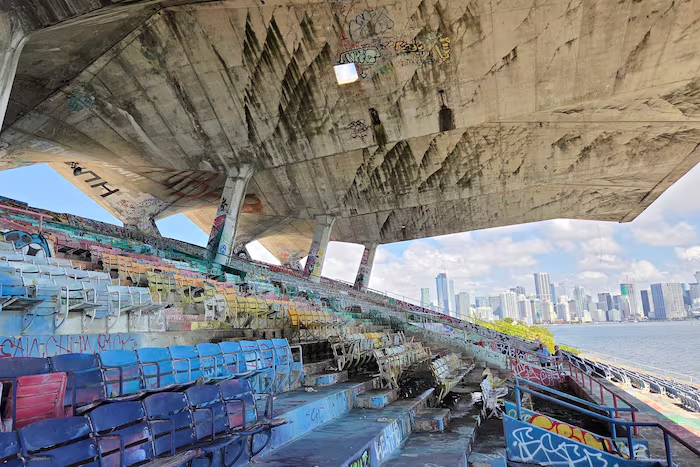
Miami voters will decide Tuesday whether to allow the city to partner with a private management company to restore the Marine Stadium, an architecturally significant venue that has deteriorated for more than three decades on Virginia Key. The 6,500-seat facility, designed by Cuban refugee architect Hilario Candela and completed in 1963, represents a pinnacle of midcentury Brutalist design with its distinctive cantilevered roof and commanding views of the city’s skyline and Biscayne Bay.
Once a thriving cultural and entertainment hub, the stadium hosted powerboat racing competitions, major political events, and performances by legendary artists including Gloria Estefan and Jimmy Buffett. The venue also served as the filming location for Elvis Presley’s 1967 film “Clambake” and hosted President Richard Nixon and entertainer Sammy Davis Jr. at a 1972 campaign rally, while residents gathered there for Easter sunrise services and celebrations of Our Lady of Charity.
Hurricane Andrew’s devastation in 1992 forced the stadium’s closure, and it has remained unused and deteriorating for more than three decades despite being listed on the U.S. National Register of Historic Places in 2018. The property now sits fenced and covered with graffiti, though structural engineers have confirmed the venue remains fundamentally sound.
The restoration effort has been championed by Jimmy Buffett’s daughter Savannah and advocacy group Restore Miami Marine Stadium, founded in 2008 after city officials proposed demolition. In a 2022 letter before his death, Buffett urged officials to preserve the “little cathedral of musical fun,” recalling a 1985 concert where he performed with the Coral Reefer Band on the venue’s floating stage.
Breakwater Hospitality Group, selected to manage the restoration project, envisions transforming the stadium into an entertainment destination comparable to Denver’s Red Rocks Amphitheatre. The private company would develop adjacent parking areas into a flex park with public recreational facilities while the city retains complete ownership and uses event revenues to fund repairs and upgrades at no cost to taxpayers.
Project architect Richard Heisenbottle confirmed that completed construction permits are already in place, with plans to incorporate modern amenities and accessibility requirements while preserving the structure’s historic character. The original galvanized steel rebar reinforcement has protected the concrete from significant deterioration during decades of abandonment.
However, not all residents support the proposal. Ernesto Cuesta, head of the Brickell Homeowners Association, expressed concerns about noise and traffic impacts on nearby neighborhoods and wildlife, advocating instead for converting the site into a public park with expanded green space.
Miami Commissioner Damian Pardo emphasized that the referendum addresses a critical capacity issue, as city government previously lacked resources to operate a major event venue. He characterized the moment as opportune for finally reviving a landmark that “encapsulates a unique time period in Miami” and “connects with Miami at a very deep and personal level.”

More Stories
Former NFL cheerleader and ex-aide face off in close Rhode Island GOP primary
University of Pennsylvania Climate Scientist Demands Supreme Court Packing Pledge From Democratic Candidates
Democratic Candidate Pia Dandiya Discusses House Race in District 22