

💛 A quick favor, if you've got a second.
We're really happy that you chose to read one of our stories and sincerely hope you'll stick around to read more. We took our paywall down — for now — but that won't last forever, and when the gate goes back up, we'd love for you to already be on the inside.
It's free. So please enter your email here and don't forget to like and follow us on all of your favorite Social Media platforms!
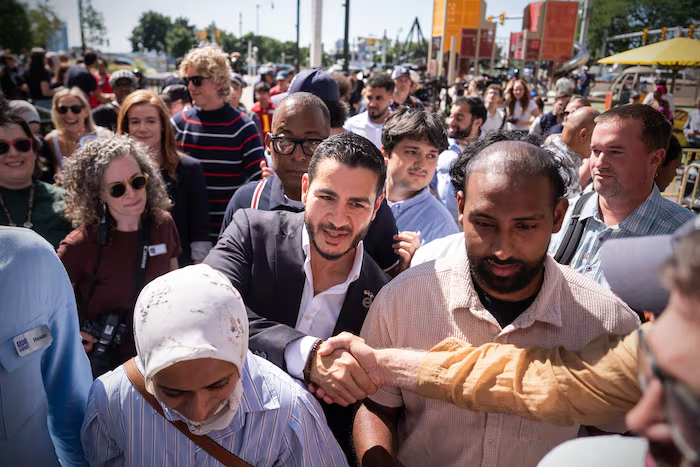
Abdul El-Sayed achieved a historic milestone this month when Michigan Democrats selected him as their first Muslim nominee for U.S. Senate. The milestone comes as widespread anti-Muslim sentiment persists across the country, temping celebrations within the Muslim American community with sobering awareness of the challenges ahead.
Republican leaders, including President Donald Trump, have responded by emphasizing El-Sayed’s full name, Abdulrahman Mohamed El-Sayed, while characterizing him as a threat to national security. U.S. Rep. Nancy Mace of South Carolina took the rhetoric further, declaring on social media that “every single Muslim holding public office in America is a Trojan horse, and a threat to both national security and our republic.”
El-Sayed has dismissed such attacks as reflecting weakness among opponents whose political ideas lack substance. He told MS NOW after his primary victory that shared values transcend religious identity and predicted opponents would resort to Islamophobia rather than substantive policy debate.
The anti-Muslim sentiment extends well beyond electoral politics into local communities nationwide, where residents have mounted fierce opposition to mosque construction proposals. Edward Ahmed Mitchell, national deputy director of the Council on American-Islamic Relations, acknowledged recent gains for Muslim Americans in political representation and cultural visibility while warning of an organized backlash manifesting in hate rhetoric and mosque targeting.
McKinney, Texas, a major Dallas-Fort Worth suburb, emerged as a flashpoint in August when the city council met to consider a site plan for the McKinney Islamic Association’s mosque, classroom and gymnasium complex. Despite heated anti-Islam remarks at the Aug. 4 meeting, the council voted unanimously to approve the project, though opponents booed former Mayor George Fuller when he urged fair consideration of the proposal.
U.S. Rep. Keith Self, a Republican whose district encompasses McKinney, spoke against the mosque during the four-hour hearing, invoking concerns about child marriage and honor killings. Fuller later described the atmosphere as unprecedented in its display of “hate, anger and lack of humanity” in his community.
A comparable scenario unfolded in Mooresville, North Carolina, when town commissioners held a public comment session on Aug. 3 regarding an already-approved mosque under construction. Residents expressed hostility toward Islam and criticized commissioners for insufficient transparency about the project’s development, with some speakers citing violence by Islamic extremists in Nigeria as justification for local opposition.
Town commissioners subsequently released a summary emphasizing that the mosque project complied with local zoning ordinances for religious assembly and received equivalent treatment to church proposals. The commissioners stated that decisions must follow adopted ordinances and legal requirements without allowing differential treatment based on religion.
In Oklahoma, the Islamic Society of the Tulsa area filed a federal lawsuit on Aug. 3 against Broken Arrow’s mayor and four city council members, challenging a January vote that rejected a rezoning proposal for the region’s first mosque. The council had voted 4-1 in January to deny the rezoning request after dozens of residents voiced anti-Muslim objections, with council members citing infrastructure concerns about roads, sewers and flood management.
The lawsuit alleges the council violated state and federal religious land-use laws by treating the mosque proposal differently from comparable rezoning requests. Meghan Murphy, an attorney with CAIR’s Legal Defense Fund, stated that council members fabricated infrastructure justifications to mask their religious opposition.
Mosque construction opposition has historical precedent in the United States. A Murfreesboro, Tennessee, mosque project initiated in 2010 faced court challenges lasting more than three years, during which the Muslim community endured public protests, vandalism, arson and bomb threats before the mosque was ultimately completed.
Republican officeholders have intensified anti-Muslim messaging over the past year, introducing congressional bills targeting sharia law and expressing concerns about Muslim population growth in major cities and potential terrorism connections. CAIR and other civil rights organizations characterize these fears as baseless and politically motivated.
Republican governors in Texas and Florida have supported initiatives to shut down CAIR operations, alleging terrorism ties. CAIR has denied these allegations and filed lawsuits contending the governors’ efforts violate constitutional protections.
Muslim American leaders characterize the current climate as politically driven scaremongering designed to mobilize voters. Mitchell noted that anti-Muslim hate typically rises during election cycles but has reached particularly severe levels this year.
More Stories
Federal voting arrest in New Jersey adds new pressure point in Sherrill-Trump standoff
Colombia backs Trump security push while limiting U.S. role in anti-gang operations
Former NFL cheerleader and ex-aide face off in close Rhode Island GOP primary