


💛 A quick favor, if you've got a second.
We're really happy that you chose to read one of our stories and sincerely hope you'll stick around to read more. We took our paywall down — for now — but that won't last forever, and when the gate goes back up, we'd love for you to already be on the inside.
It's free. So please enter your email here and don't forget to like and follow us on all of your favorite Social Media platforms!
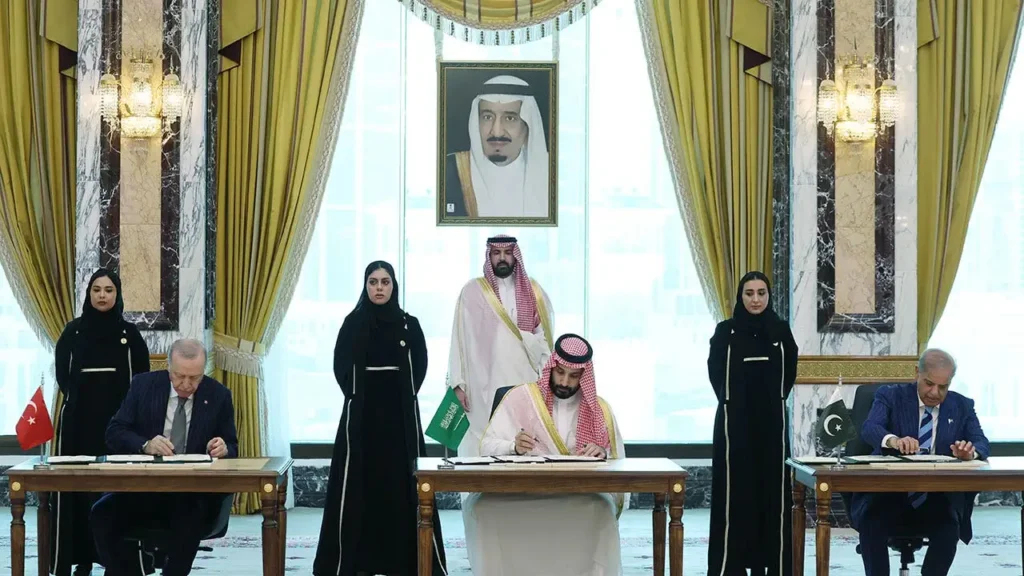
Saudi Arabia, Turkey and Pakistan have formalized a defense alliance that is prompting analysts and policymakers to weigh whether the three nations are constructing a rival regional bloc or simply establishing a more efficient security arrangement among American partners. The three countries, each maintaining long-established defense relationships with the United States, bring distinct strategic objectives to the partnership while collectively possessing the potential to recalibrate the balance of power across the Middle East.
Saudi Crown Prince Mohammed bin Salman, Turkish President Recep Tayyip Erdoğan and Pakistani Prime Minister Shehbaz Sharif executed the Mecca Joint Defence Agreement on August 7. The accord establishes that any armed attack on one signatory would be treated as an attack on all three, creating a collective deterrence framework. Turkish Foreign Minister Hakan Fidan characterized the arrangement as functionally equivalent to NATO’s Article 5 mutual-defense clause the following day, though he clarified that member nations would determine the scope and nature of their responses on a case-by-case basis through a new ministerial committee. A general secretariat will be established in Saudi Arabia to coordinate operations.
Saudi Arabia signed a separate Strategic Defense Agreement with the United States in November 2025 and received major non-NATO ally status, yet did not obtain the treaty-level Article 5-style guarantee it had pursued for years. The new pact with Turkey and Pakistan potentially serves as a hedge against uncertainty regarding Washington’s long-term security commitments. Pakistan, a nuclear power, gains improved energy security and access to Saudi investment alongside expanded regional standing, while contributing considerable military assets whose nuclear umbrella coverage for alliance members remains unclear. Turkey, already a NATO member, secures a broader market for its expanding defense sector and strengthens its strategic position as tensions with Israel intensify.
Officials from Saudi Arabia have disputed characterizations of the agreement as a sectarian or military bloc directed against any specific nation or connected to nuclear competition. Turkish authorities similarly have portrayed the pact as strictly defensive rather than targeting Iran or others. Iranian Foreign Ministry spokesman Esmaeil Baghaei stated on August 10 that Tehran viewed the agreement as reflecting regional countries’ preference for self-reliance in security matters rather than dependence on external powers, and said Iran saw no reason for concern about its intentions.
Sinan Ciddi, senior fellow at the Foundation for Defense of Democracies, expressed skepticism about the pact’s immediate military substance, questioning whether it constitutes a genuine NATO-style deterrent with enforceable collective defense obligations. He emphasized that each member enters with separate motivations: Saudi Arabia seeks reassurance over American reliability, Pakistan pursues energy security and regional leverage, and Turkey gains commercial opportunities and deterrent capacity amid Israeli tensions. Ciddi suggested the arrangement prioritizes economic and commercial cooperation over substantive security integration comparable to NATO.
Saudi officials have rejected the notion that the partnership represents a retreat from its relationship with Washington, with a kingdom source telling Fox News Digital that the United States remains its primary strategic partner. The source denied that expanding ties with Pakistan and Turkey diminish its commitment to the United States and dismissed claims the pact represents a “Muslim NATO,” a Sunni alliance, or opposition to Israel or normalization efforts. Aziz Alghashian, senior non-resident fellow at the Gulf International Forum, characterized the agreement as supplementary to rather than competitive with American engagement, arguing it enables greater burden-sharing for the United States through enhanced regional cooperation.
Raza Rumi, distinguished lecturer at the Roosevelt House Public Policy Institute at CUNY, outlined Pakistan’s strategic gains through the pact, including defense production cooperation, technology sharing, intelligence coordination and air and missile defense capabilities. However, he cautioned against interpreting the mutual-defense language as equivalent to an Article 5 guarantee absent joint planning, unified command structures and established crisis procedures. Rumi warned against assuming the region is already dividing into fixed opposing camps, describing member states as hedging their strategic options rather than committing to permanent alignments.
India’s Ministry of External Affairs announced on August 11 that it was evaluating the pact’s implications for its security interests and regional stability, pledging to take necessary measures to protect its position. Ciddi raised broader concerns that even a militarily limited pact could prompt rival alignments to calcify, potentially drawing Israel, Greece, Cyprus and India into deeper counter-partnerships. He cautioned that security agreements, while intended to purchase security, simultaneously generate tension that could destabilize the region.
Rumi argued that characterizing the pact as a direct countermeasure to the Abraham Accords or the India-Middle East-Europe Economic Corridor would be premature. He identified an emerging competition over the Middle East’s trajectory—between American-led economic integration involving India, Israel and the Gulf states and efforts by Saudi Arabia, Turkey and Pakistan to develop greater strategic independence from Washington.

More Stories
Federal voting arrest in New Jersey adds new pressure point in Sherrill-Trump standoff
Colombia backs Trump security push while limiting U.S. role in anti-gang operations
Former NFL cheerleader and ex-aide face off in close Rhode Island GOP primary