

💛 A quick favor, if you've got a second.
We're really happy that you chose to read one of our stories and sincerely hope you'll stick around to read more. We took our paywall down — for now — but that won't last forever, and when the gate goes back up, we'd love for you to already be on the inside.
It's free. So please enter your email here and don't forget to like and follow us on all of your favorite Social Media platforms!
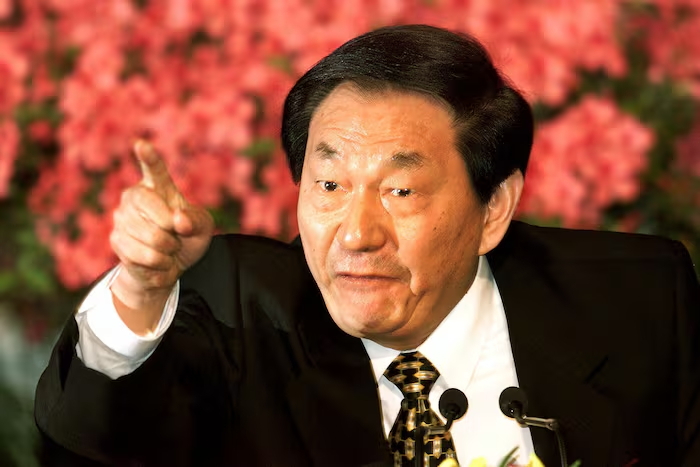
Zhu Rongji, the forceful Chinese Premier who engineered sweeping economic reforms that helped ignite the nation’s rapid expansion and secured its entry into the World Trade Organization, died Wednesday morning in Beijing. He was 97. State media confirmed the death, attributed to illness.
As premier from 1998 to 2003, Zhu aggressively restructured China’s state-owned enterprises, demanding efficiency and profitability despite the social costs. His tenure produced unprecedented economic growth that averaged above 8 percent annually between 2000 and 2010, peaking at 14.2 percent in 2007. The reforms helped China overtake Japan as the world’s second-largest economy in 2010.
Known for his sharp tongue and impatience with bureaucratic resistance, Zhu earned nicknames including “Boss” and “Madman Zhu” for his combative approach to reform. He clashed repeatedly with Communist Party conservatives and entrenched industrial interests who opposed his push for structural change, yet persisted in implementing policies that modernized the economy at considerable expense to workers displaced by corporate restructuring.
Zhu’s most significant achievement was orchestrating China’s accession to the WTO in December 2001, following years of protracted negotiations. The membership locked in free-trade commitments and provided him leverage to force local officials to cease protecting inefficient state enterprises. His 1999 Washington trip to secure U.S. backing nearly derailed when both the Clinton administration and domestic rivals criticized his market-opening proposals.
Born October 23, 1928, in Hunan Province, Zhu’s early career was interrupted by political persecution. Labeled a “rightist” in 1957 for praising Hungarian and Yugoslav reforms, he was exiled to perform manual labor during the Cultural Revolution. After rehabilitation in 1979, he rose rapidly through Shanghai’s political ranks before joining the national leadership as deputy premier in 1991.
Zhu distinguished himself by accepting public responsibility for government failures, a stark departure from party orthodoxy. After devastating 1998 floods killed 4,150 people, he criticized faulty flood barriers as “no stronger than bean curd.” Three years later, he apologized on national television following a schoolhouse explosion in southern China that killed at least 42 people, predominantly children.
Beyond his economic agenda, Zhu brought an uncommon informality to state leadership, frequently cracking jokes and occasionally poking fun at himself. At a 1999 press conference, he joked that a recent photograph made him resemble “a dead man,” drawing laughter from assembled journalists.
Though ranked third in the Communist Party hierarchy behind President Jiang Zemin and National People’s Congress Chairman Li Peng, Zhu lacked an independent political base. He repeatedly complained that this limitation allowed officials to disregard his directives, constraining his reform agenda despite his formal authority over economic policy.
As deputy premier in the 1990s, Zhu engineered a tax system that increased revenue transfers to Beijing from local governments—an achievement he later said warranted a Nobel Prize in economics. He also initiated China’s residential privatization drive in 1998, allowing families to purchase apartments from state enterprises. Within a decade, majority urban ownership had shifted to private hands.
Zhu maintained a pragmatic approach to market economics, avoiding wholesale privatization while restructuring major state enterprises in banking, aviation, energy and other sectors into profit-focused corporations under continued government ownership. He built upon predecessor Deng Xiaoping’s 1979 reform initiatives, adding the administrative muscle necessary to implement far-reaching structural change.

More Stories
Federal voting arrest in New Jersey adds new pressure point in Sherrill-Trump standoff
Colombia backs Trump security push while limiting U.S. role in anti-gang operations
Former NFL cheerleader and ex-aide face off in close Rhode Island GOP primary