

💛 A quick favor, if you've got a second.
We're really happy that you chose to read one of our stories and sincerely hope you'll stick around to read more. We took our paywall down — for now — but that won't last forever, and when the gate goes back up, we'd love for you to already be on the inside.
It's free. So please enter your email here and don't forget to like and follow us on all of your favorite Social Media platforms!
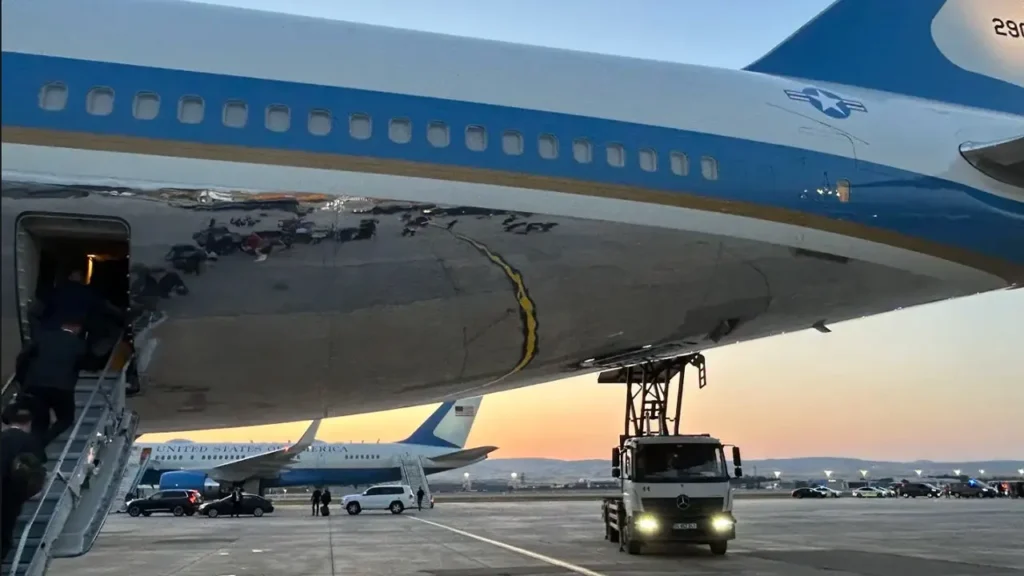
President Donald Trump boarded a different military aircraft during last month’s NATO summit in Turkey while White House personnel, Secret Service agents, military members and journalists stayed aboard a decoy plane, according to reports that have reignited scrutiny over passenger safety protocols. The switch occurred as officials responded to what they assessed as a credible Iranian threat targeting the presidential aircraft, leaving dozens of individuals on an unprotected plane with no publicly disclosed defensive measures in place.
The Washington Post initially reported Trump’s clandestine transfer to an alternative jet after appearing to board the older Air Force One in Turkey. Those remaining aboard the aircraft, including Secretary of State Marco Rubio and traveling journalists, continued on to the United Kingdom before Trump rejoined the group. The Wall Street Journal subsequently reported that Israeli intelligence had alerted the Trump administration to a specific threat involving shoulder-fired missiles aimed at what adversaries believed was the presidential plane.
Bill Gage, a former Secret Service agent, told Fox News that those aboard the decoy aircraft “probably did face an elevated risk,” though he characterized the operation as a justified tactical response given the threat assessment. He noted that maintaining operational secrecy among the highest government levels would have been essential, suggesting few people would have known in advance about the switch.
Robert McDonald, a former senior Secret Service official, explained that such deceptive presidential movements—known colloquially as “shell games”—are part of standard security protocols when credible intelligence warrants extraordinary action. He expressed confidence that both aircraft were being tracked and escorted by military assets, asserting the White House would not have allowed either plane to operate without protective measures.
The reported operation differs from previous instances of presidential deception. During President Bill Clinton’s 2000 visit to Pakistan, a marked decoy aircraft arrived first before Clinton landed separately in an unmarked plane. However, some observers noted that past surprise presidential trips typically involved limited press pools sworn to secrecy, unlike the Turkey operation involving full aircraft crews and journalists.
CNN’s Jake Tapper, who traveled with President Barack Obama on a classified Afghan trip, acknowledged that previous administrations had used deception for presidential protection but said he had never heard of using an Air Force One full of staff and journalists as a decoy amid an active threat. Former White House Press Secretary Ari Fleischer defended the reported action, writing that protecting a sitting president from credible threats supersedes press relations concerns.
The White House declined to comment on whether officials assessed separate risks to those left aboard the decoy aircraft or what protective measures, if any, were implemented. The Pentagon and Air Force directed inquiries to the White House, leaving unresolved questions about the safety protocols governing such operations.

More Stories
Colombia backs Trump security push while limiting U.S. role in anti-gang operations
Trump Threatens FCC Action Against NBC’s Welker Over Endorsement Coverage
Chicago Mayor Issues Executive Order Requiring Contractor Diversity Disclosures and ICE Ties Reporting