


💛 A quick favor, if you've got a second.
We're really happy that you chose to read one of our stories and sincerely hope you'll stick around to read more. We took our paywall down — for now — but that won't last forever, and when the gate goes back up, we'd love for you to already be on the inside.
It's free. So please enter your email here and don't forget to like and follow us on all of your favorite Social Media platforms!
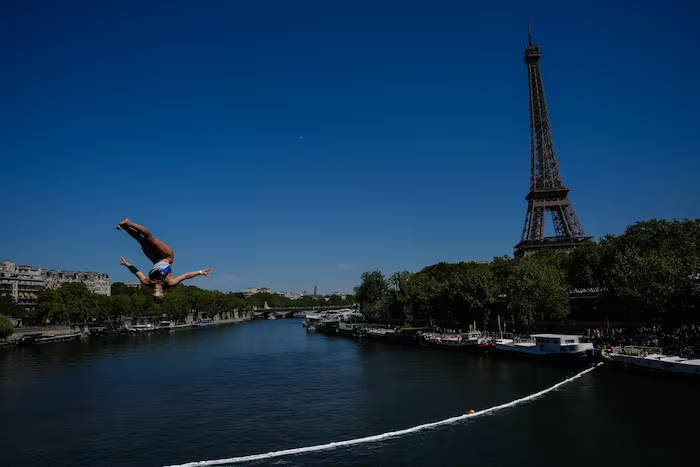
Athletes launched themselves from a 20-meter platform in front of the Eiffel Tower during Paris’ inaugural high-diving competition on the Seine, representing a bold new chapter in the French capital’s campaign to transform its celebrated river into a venue for athletic competition. The event, held on the Bir-Hakeim Bridge, marks a significant milestone in the city’s broader vision of reclaiming the waterway for recreational and competitive purposes.
The spectacle demonstrated both the promise and the challenges of using the Seine as a sporting stage. Organizers halted training Thursday after discovering hydrocarbon traces in the water upstream, though French Swimming Federation officials confirmed by Friday that affected sections had been treated, enabling the competition to resume and proceed as scheduled.
The high-diving finals and medal events conclude Saturday, while the 38th European Aquatics Championships extend through August 16, featuring more than 1,000 competitors across five disciplines including swimming, artistic swimming, open-water swimming, diving and high diving. The championships mark the centenary of the inaugural event held in Budapest in 1926 and represent Paris’ first hosting since 1931.
Hundreds of spectators lined the riverbanks Friday to observe the divers, many discovering the competition by chance while visiting the iconic tower nearby. Rebecca Kapogiannis, a 45-year-old from London, Ontario, expressed surprise and enthusiasm about witnessing elite competition in the river running through the city’s heart, noting she had not anticipated such a use of the waterway.
The Seine’s transformation reflects decades of municipal ambition that seemed improbable to many French citizens. Former Paris Mayor Jacques Chirac’s 1988 pledge to restore the river to swimmable condition faced skepticism given decades of pollution and commercial use, yet the 2024 Olympics accelerated investments totaling 1.4 billion euros in water quality and infrastructure improvements.
Swimming in the Seine was officially prohibited in 1923 due to pollution and river traffic dangers, with public bathing remaining forbidden until 2025. The river now hosts designated swimming areas that attracted approximately 70,000 visitors in July alone, compared with nearly 100,000 during the entire preceding summer, signaling growing public interest in reclaiming the waterway for recreation.
Maxime Sauvage, Paris deputy mayor responsible for sports and equal access to athletic facilities, characterized the event as emblematic of the city’s broader transformation. “There are things that are within our control, and there are uncertainties that are inevitably linked to any outdoor activity,” Sauvage said, emphasizing the distinctive appeal of staging elite sport in public spaces rather than enclosed facilities.
City officials under newly elected Mayor Emmanuel Grégoire aim to position Paris as increasingly favorable to physical activity and sport across all neighborhoods. The Seine’s evolution from purely commercial and touristic purposes toward recreational and competitive uses represents a fundamental reimagining of the river’s role in urban life without abandoning its historical economic functions.

More Stories
Indiana coach Curt Cignetti tells restless Hoosiers fans not to gripe over 38-0 win
Colombia backs Trump security push while limiting U.S. role in anti-gang operations
Federal Prosecutors Convene Special Grand Jury to Investigate D.C. Schools’ Attendance and Graduation Practices