




💛 A quick favor, if you've got a second.
We're really happy that you chose to read one of our stories and sincerely hope you'll stick around to read more. We took our paywall down — for now — but that won't last forever, and when the gate goes back up, we'd love for you to already be on the inside.
It's free. So please enter your email here and don't forget to like and follow us on all of your favorite Social Media platforms!
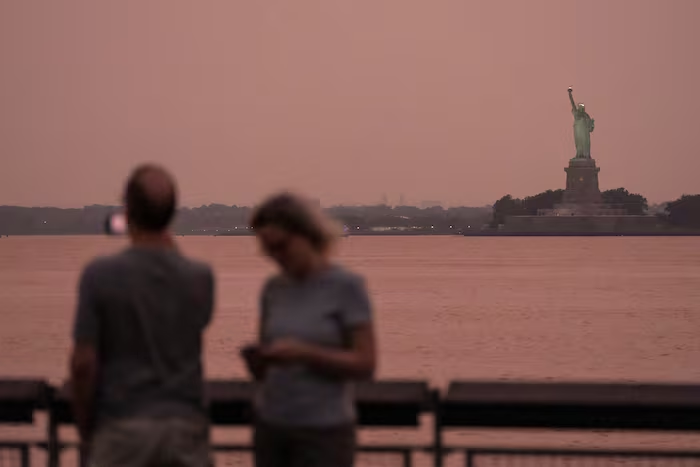
A new scientific analysis released Thursday attributes a doubling of wildfire risk in Canada’s Northwest Territories and northwestern Ontario to human-caused climate change, directly contradicting assertions from U.S. President Donald Trump that poor forest management caused the blazes. The World Weather Attribution group, comprised of international climate researchers, determined that global warming made the extreme fire weather conditions twice as likely compared to pre-industrial climate patterns.
Researchers compared current conditions to a baseline world without the 2.5 degrees Celsius of warming experienced since the industrial revolution began. The weather patterns that sparked this summer’s fires—combining extreme heat, low precipitation, reduced humidity and strong winds—now occur roughly every six years, whereas historically such conditions might have been expected once per human lifetime, according to the study.
The analysis, which remains unpublished and unreviewed by peer experts, mirrors findings from French wildfires but pales in comparison to Spanish fires, which scientists determined were 20 times more likely due to climate change. Fire scientist Jonathan Boucher of Canada’s Forest Service emphasized that climate conditions, rather than management practices, fundamentally enabled the fires to spread uncontrollably after lightning ignitions in the remote northern regions.
Trump asserted on July 21 that Canada’s forest management failures caused the fires and threatened unspecified punishments, citing smoke impacts on New York City, Detroit and Michigan. However, Canadian climate scientists countered that Trump ignores America’s substantial historical carbon emissions, which exceed any other nation’s contribution to atmospheric warming.
University of Victoria climate scientist Andrew Weaver stated that while “smoke does not carry a passport,” carbon pollution carries a documented history directly traceable to American industrial emissions. Canada has warmed 65 percent faster than the United States in recent decades, with annually burned forest acreage increasing roughly 50 percent over the past three decades.
Mike Flannigan, a fire scientist at Thompson Rivers University, noted that much of Canada’s forestland consists of remote, northern spruce and pine forests that burn rapidly and intensely, making fire suppression extraordinarily difficult. With only approximately 30 minutes available to extinguish fires before they become uncontrollable, and many ignition sites located more than 30 minutes by aircraft from airports, even optimal detection systems cannot prevent large-scale burns, Flannigan explained.
Lightning strikes account for more than 90 percent of burned acreage across Canada despite humans starting approximately half of all wildfires, underscoring that ignition sources matter far less than underlying climate conditions in determining fire intensity and spread. The hazardous smoke affected major population centers across both nations, including New York City.


More Stories
Trump Threatens FCC Action Against NBC’s Welker Over Endorsement Coverage
Trump Backs Christian-Led Initiative for Expedited U.S. Entry for Canadian Jews Facing Antisemitism
Trump Calls NASA to Congratulate Agency on Roman Space Telescope Launch