


💛 A quick favor, if you've got a second.
We're really happy that you chose to read one of our stories and sincerely hope you'll stick around to read more. We took our paywall down — for now — but that won't last forever, and when the gate goes back up, we'd love for you to already be on the inside.
It's free. So please enter your email here and don't forget to like and follow us on all of your favorite Social Media platforms!
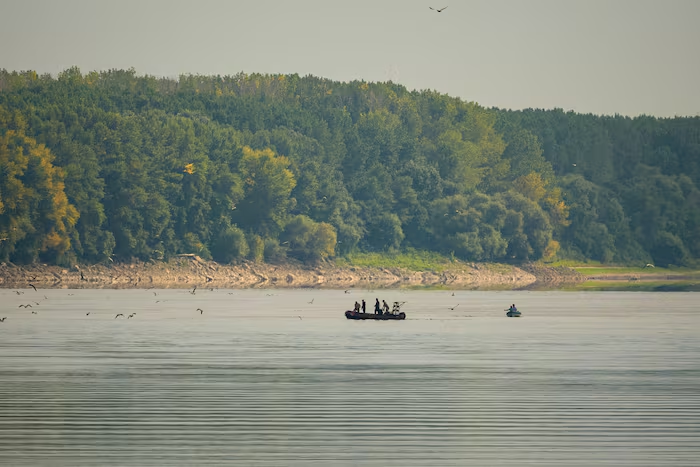
Eastern European governments are implementing emergency conservation protocols as the Danube River has dropped to historic lows, threatening to cripple the region’s power generation capacity. Hungary’s capital of Budapest registered water levels of approximately 10 centimeters on Monday, shattering the previous 2018 record of 33 centimeters, with forecasters predicting no significant rainfall relief in coming weeks.
Hungary’s Paks nuclear facility, the nation’s sole atomic power plant, has been forced to operate at a fraction of its normal output due to inadequate cooling water from the Danube. The Soviet-era, four-reactor installation generated only 240 megawatts Monday compared to its standard 2,000 megawatt capacity, marking the first near-complete operational shutdown in its 44-year history.
Prime Minister Péter Magyar announced that engineers temporarily prevented a full shutdown scheduled for the weekend but warned that a complete power-down would likely occur by Tuesday or Wednesday. The Paks facility, situated approximately 90 kilometers south of Budapest, typically supplies nearly half of Hungary’s electricity production and roughly one-third of national consumption.
The Hungarian government has mandated that electric freight trains cease operations during peak consumption hours between 5 p.m. and 10 p.m., projecting daily electricity savings of 70 to 90 megawatt-hours. Officials issued a decree Saturday permitting voluntary conservation measures to become mandatory for large industrial and commercial consumers, with Magyar crediting the public for reducing electricity usage by 700 megawatts the previous day.
Romania’s military detonated 180 kilograms of explosives Monday near the lower Danube’s Bala Canal in an attempt to redirect water toward the state-owned Cernavoda nuclear plant. The Danube’s flow has diminished to 1,500 cubic meters per second in Romania, representing less than one-third of July’s average, forcing operators to shut down one reactor at Cernavoda and reduce overall capacity to approximately 50 percent.
Acting Romanian Prime Minister Ilie Bolojan declared a nationwide energy sector alert Friday and warned citizens that the second Cernavoda reactor risked shutdown without voluntary conservation efforts during evening peak hours. In Serbia, record-low water levels have constrained the nation’s principal hydroelectric facility to merely 20 percent capacity, prompting Prime Minister Djuro Macut to convene an emergency energy meeting Monday.
Macut urged Serbian residents to restrict usage of high-consumption appliances, particularly air conditioning units, characterizing the situation as “serious and demanding.” Sustained drought conditions and consecutive extreme heat waves, with temperatures exceeding 38 degrees Celsius, have depleted one of Europe’s major waterways while simultaneously intensifying regional electricity demand.



More Stories
Federal voting arrest in New Jersey adds new pressure point in Sherrill-Trump standoff
Colombia backs Trump security push while limiting U.S. role in anti-gang operations
Former NFL cheerleader and ex-aide face off in close Rhode Island GOP primary