



💛 A quick favor, if you've got a second.
We're really happy that you chose to read one of our stories and sincerely hope you'll stick around to read more. We took our paywall down — for now — but that won't last forever, and when the gate goes back up, we'd love for you to already be on the inside.
It's free. So please enter your email here and don't forget to like and follow us on all of your favorite Social Media platforms!
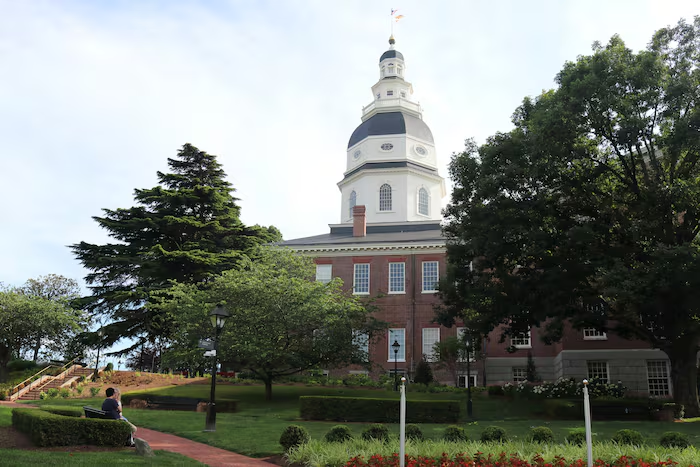
The Maryland General Assembly convenes Monday for a special legislative session focused on advancing a proposed constitutional amendment that would permit Democratic lawmakers to redraw congressional districts with partisan intent, potentially securing an additional U.S. House seat by 2028. Democrats currently control seven of Maryland’s eight House seats, and the amendment would remove constraints that courts previously cited when striking down redistricting efforts in 2022. The proposal requires approval from three-fifths of both legislative chambers before advancing to voters in the November 3 general election.
A state judge rejected Maryland’s 2021 redistricting maps designed to make Rep. Andy Harris’s conservative 1st District more competitive, ruling the effort represented “extreme partisan gerrymandering.” Harris, the sole Republican in Maryland’s congressional delegation and chairperson of the House Freedom Caucus, represents an Eastern Shore district separated from the rest of the state by the Chesapeake Bay. The proposed amendment would clarify that compactness requirements and consideration of “natural boundaries” apply exclusively to state legislative districts rather than congressional ones.
Democratic Senate President Bill Ferguson blocked an earlier redistricting initiative this year, fearing adverse court rulings, but shifted his position after the U.S. Supreme Court weakened the Voting Rights Act in late April. Ferguson described witnessing Republicans reconfigure Southern districts as “painful,” characterizing the situation as “the unwinding of any type of democratic norms in the blink of an eye.” Gov. Wes Moore supported the effort as a necessary response to Republican redistricting nationwide, emphasizing that voters ultimately would decide the amendment’s fate.
Republicans characterized the initiative as a partisan power grab aimed at disenfranchising rural voters by fragmenting areas of common interest into urban and suburban districts. House Minority Leader Jason Buckel criticized limitations on witness testimony during the special session, calling scheduled hearings “a brief and meaningless formality.” Harris predicted the maps would face court challenges if approved.
Maryland’s redistricting effort joins a broader national struggle over congressional maps that began one year ago when President Donald Trump encouraged Republican-controlled states to redraw districts ahead of the 2022 midterms. Republicans enacted new maps in eight states—Texas, Missouri, North Carolina, Ohio, Florida, Tennessee, Louisiana, and Alabama—seeking as many as 16 additional House seats, while Democrats pursued gains in California and Utah. New York’s Democratic Legislature separately approved a constitutional amendment authorizing mid-decade redistricting and relaxing prohibitions on partisan gerrymandering, pending another legislative vote before appearing on a future statewide ballot.


More Stories
Former NFL cheerleader and ex-aide face off in close Rhode Island GOP primary
Trump Threatens FCC Action Against NBC’s Welker Over Endorsement Coverage
Chicago Mayor Issues Executive Order Requiring Contractor Diversity Disclosures and ICE Ties Reporting