



💛 A quick favor, if you've got a second.
We're really happy that you chose to read one of our stories and sincerely hope you'll stick around to read more. We took our paywall down — for now — but that won't last forever, and when the gate goes back up, we'd love for you to already be on the inside.
It's free. So please enter your email here and don't forget to like and follow us on all of your favorite Social Media platforms!
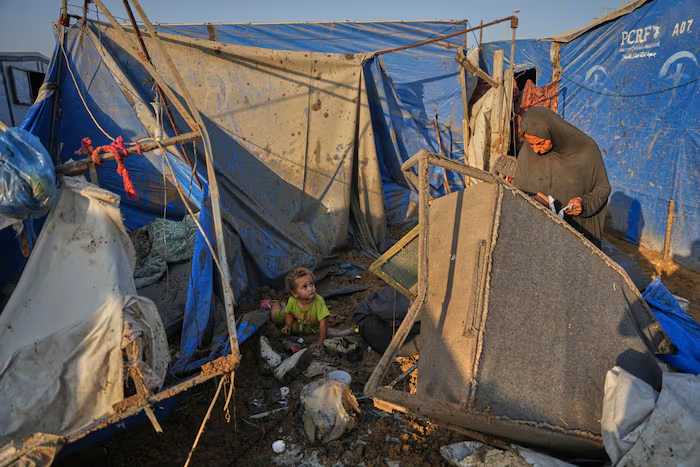
A proposal outlined by President Donald Trump that would require Hamas to surrender its weapons has generated measured optimism among Gaza’s Palestinian population, who hope it could lead to an end of Israeli military operations and a chance to rebuild their devastated communities. The announcement, made late Thursday in Washington and confirmed by Hamas, offered a glimmer of possibility for residents enduring displacement and deteriorating living conditions across the territory.
The optimism, however, has been tempered by the grim reality facing Gaza’s 2 million residents. Israeli military strikes have persisted since Trump’s initial announcement, and the broader ceasefire framework established in October has stalled as both sides accuse each other of violations. Most Palestinians remain displaced, living in overcrowded tent camps plagued by rodent infestations and infectious disease outbreaks including chickenpox.
Abdel Moneim Aboul-Roos, a 24-year-old tuk-tuk driver who lost his leg in an Israeli airstrike, expressed the sentiments of many Palestinians prioritizing immediate survival over political developments. “They can talk about withdrawal and disarmament,” he said. “I don’t care about any of it as long as there is no food or medicine.”
The U.S.-backed ceasefire agreement signed in October ended major combat operations, facilitated the release of Israeli hostages, and increased humanitarian aid flows to Gaza. It also stipulated a gradual Israeli military withdrawal, establishment of an international stabilization force, and disarmament of Hamas. Negotiations have faltered, however, with Hamas retaining its arsenal and Israeli forces refusing to leave.
Since October, Israel has killed more than 1,200 Palestinians in Gaza and expanded the territory under its control, while five Israeli soldiers have died in militant attacks. The new roadmap Trump announced provides more specific language regarding weapons to be handed over to a new technocratic government and mandates an Israeli halt to all military operations to enable the transition and recovery efforts.
Israeli officials, speaking anonymously, have signaled displeasure with the roadmap and reiterated that Israel will not withdraw from the Yellow Line, the demarcation separating Israeli-controlled eastern territory from western Gaza. The military has constructed a substantial earthen barrier along this line and developed what it describes as a security zone equipped with surveillance and technological capabilities.
Many Palestinians remain deeply skeptical that either Israel or Hamas will honor the agreement’s terms. Ayman Ahmed, a displaced resident in southern Gaza, acknowledged viewing the roadmap positively but expressed doubt about implementation. “This is enough. We need improvement in our lives,” he said. “They don’t care about Palestinians’ lives.”
The conflict erupted on October 7, 2023, when Hamas-led militants attacked southern Israel, killing approximately 1,200 people and seizing 251 hostages. Israel’s subsequent military campaign has claimed more than 73,300 lives according to the Gaza Health Ministry, with women and children comprising roughly half of all casualties.
Ghazal Astal, living amid rubble in southern Gaza, described her surroundings as an “indescribable battlefield” marked by relentless Israeli gunfire. Ammar Kaskeen, 30, expressed conviction that the roadmap will not compel Israeli withdrawal, suggesting Israel’s true objective extends beyond Hamas disarmament to forcibly displacing Gaza’s Palestinian population.
Israel has conducted controlled demolitions and clearing operations across much of its occupied territory, leaving Palestinians uncertain whether their former homes remain standing. Anas Nakla, displaced from Rafah, acknowledged his house has been destroyed but expressed determination to return and rebuild with his family.
Mohamed Hamad, forced to abandon his northern Gaza home, hopes the American-backed roadmap will pressure Israel to relinquish some controlled areas. He believes even limited returns would signal to displaced Palestinians that eventual homecoming remains possible.


More Stories
Former NFL cheerleader and ex-aide face off in close Rhode Island GOP primary
Trump Threatens FCC Action Against NBC’s Welker Over Endorsement Coverage
Chicago Mayor Issues Executive Order Requiring Contractor Diversity Disclosures and ICE Ties Reporting