




💛 A quick favor, if you've got a second.
We're really happy that you chose to read one of our stories and sincerely hope you'll stick around to read more. We took our paywall down — for now — but that won't last forever, and when the gate goes back up, we'd love for you to already be on the inside.
It's free. So please enter your email here and don't forget to like and follow us on all of your favorite Social Media platforms!
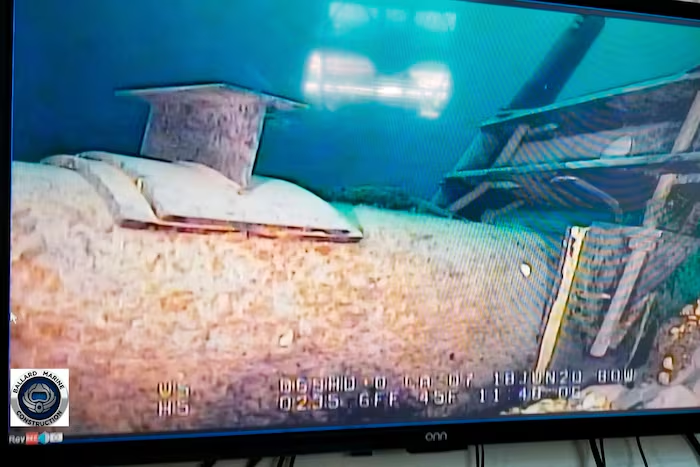
Michigan’s highest court ruled Friday that state regulators must reexamine a critical permit authorizing construction of an underground tunnel for a major oil pipeline beneath the Great Lakes. The 6-1 decision by the Michigan Supreme Court creates significant uncertainty for Enbridge’s Line 5 project, a 73-year-old conduit operated by Canadian energy firm Enbridge that transports petroleum from Superior, Wisconsin, to Sarnia, Ontario.
The disputed section of Line 5 spans 4 miles along the bottom of the Straits of Mackinac, where Lakes Huron and Michigan converge. Enbridge seeks to bury the existing pipeline within a tunnel to shield it from environmental hazards, while Michigan Gov. Gretchen Whitmer and environmental advocates contend the line should be relocated away from the waterway entirely, citing catastrophic spill risks to the Great Lakes ecosystem.
The Michigan Public Service Commission approved the tunnel permit in 2023, but four tribal nations and environmental organizations immediately challenged the decision in court. The state Supreme Court determined that regulators failed to examine whether the tunnel would extend the pipeline’s operational lifespan and thereby increase cumulative environmental harm over time.
Justices also found that the commission inadequately evaluated alternative transportation methods such as trucks or rail, and neglected to assess potential impacts on fishing, boating, and other public rights tied to the Great Lakes. The Straits of Mackinac hold sacred significance for the Indigenous Anishinaabe peoples, who oppose using the location as a construction zone for years.
David Gover, an attorney with the Native American Rights Fund, stated that pumping more than 500,000 barrels of oil daily through the Great Lakes’ center—whether suspended in water or encased in a tunnel—remains fundamentally flawed. Enbridge spokesperson Ryan Duffy expressed disappointment over the delay in a project under regulatory review for nearly a decade, asserting the tunnel would enhance environmental safeguards while preserving regional energy security.
The company proposed the tunnel approximately nine years ago following an incident in which a ship anchor damaged part of the line. Enbridge maintains that underground installation would substantially reduce spill probability, though opponents warn that tunnel construction would generate noise, vibrations, and lasting environmental degradation beneath the straits.
In parallel litigation, Michigan’s governor and state officials have pursued efforts since 2020 to shut down the pipeline entirely under the straits, adding another layer of legal complexity to the project’s fate.



More Stories
Former NFL cheerleader and ex-aide face off in close Rhode Island GOP primary
Trump Threatens FCC Action Against NBC’s Welker Over Endorsement Coverage
Chicago Mayor Issues Executive Order Requiring Contractor Diversity Disclosures and ICE Ties Reporting