



💛 A quick favor, if you've got a second.
We're really happy that you chose to read one of our stories and sincerely hope you'll stick around to read more. We took our paywall down — for now — but that won't last forever, and when the gate goes back up, we'd love for you to already be on the inside.
It's free. So please enter your email here and don't forget to like and follow us on all of your favorite Social Media platforms!
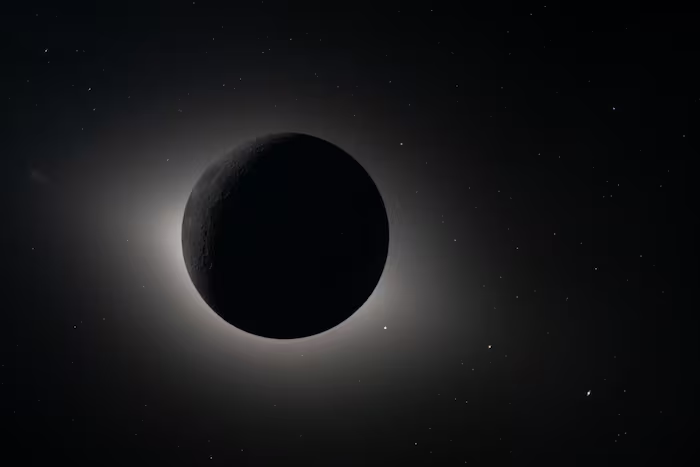
Mainland Spain will experience its first total solar eclipse in over a century when the moon passes directly between Earth and the sun on August 12. The celestial event will also cast darkness across portions of Iceland and Greenland, with totality persisting for up to two minutes and 18 seconds. This eclipse serves as a preview for an even more dramatic solar show scheduled for the following year, which will stretch across six and a half minutes and span from Spain through North Africa and the Middle East.
The moon’s shadow will travel southward from the North Pole along a 5,130-mile path, with most of the journey occurring over the Atlantic Ocean. The shadow’s race will take approximately one and a half hours to complete its course. Maximum totality will occur off Iceland’s western coast, but by the time the eclipse reaches Portugal and Spain, where crowds will gather, the duration will have diminished to roughly one minute before the event concludes in the Mediterranean.
Observers outside the direct path of totality will still witness significant solar coverage. Dublin will experience 94 percent obscuration, while Oslo records 83 percent. Montreal will see an 18 percent bite taken from the sun, with diminishing coverage extending to New York at 9 percent and Norfolk, Virginia at just 2 percent. Partial eclipse visibility will extend to Alaska, Siberia, Canada, the northern United States, Europe and West Africa.
The day will offer multiple astronomical spectacles beyond the eclipse itself. Six planets will form an arc across the predawn sky, while the Perseid meteor shower will peak after nightfall under a new moon, potentially creating rare photographic opportunities during totality. Eclipse mapmaker Michael Zeiler will observe the event from a Greenland fjord aboard a cruise ship, positioning his camera to capture potential aurora activity during the eclipse’s totality phase.
Major scientific institutions are mobilizing for the occasion. The European Space Agency will broadcast live coverage from Spain’s Astrophysical Observatory of Javalambre and host a public celebration in Leon, while NASA will provide its own transmission. Two ESA space telescopes will observe the eclipsed sun’s corona and outer atmosphere during the event.
Over 60 high-altitude balloons will launch from Spain and Iceland to study atmospheric changes during totality, when temperatures momentarily drop. A NASA high-altitude jet will chase the eclipse at 460 miles per hour, carrying four cameras that will record the corona across nine wavelengths and extend observation time to nearly three minutes. Scientists anticipate gathering thousands of images during the brief window of totality.
Spain’s celestial calendar promises additional eclipse events in subsequent years. An exceptionally long total solar eclipse lasting up to six minutes and 23 seconds will occur on August 2, 2027, extending from southern Spain through Morocco, Algeria, Libya, Egypt, Saudi Arabia, Yemen and Somalia. A ring-of-fire eclipse will complete Spain’s eclipse trilogy on January 26, 2028, marking what scientists describe as a fortunate celestial alignment.
Spain’s previous total solar eclipse, excluding the Canary Islands, occurred in 1912, two days before the Titanic’s sinking. Some astronomers consider 1905 as Spain’s last comprehensive total solar eclipse experience. The Royal Observatory of Belgium has created more than 60 simulated total solar eclipses over the past two years through its Proba-3 satellite mission, with the longest artificial eclipse lasting five hours and 38 minutes.


More Stories
Federal Prosecutors Convene Special Grand Jury to Investigate D.C. Schools’ Attendance and Graduation Practices
State Department Reissues Level 3 Travel Advisory for Israel Amid Terrorism and Armed Conflict Concerns
Republican Gubernatorial Candidate Byron Donalds Discusses Florida’s Future