




💛 A quick favor, if you've got a second.
We're really happy that you chose to read one of our stories and sincerely hope you'll stick around to read more. We took our paywall down — for now — but that won't last forever, and when the gate goes back up, we'd love for you to already be on the inside.
It's free. So please enter your email here and don't forget to like and follow us on all of your favorite Social Media platforms!
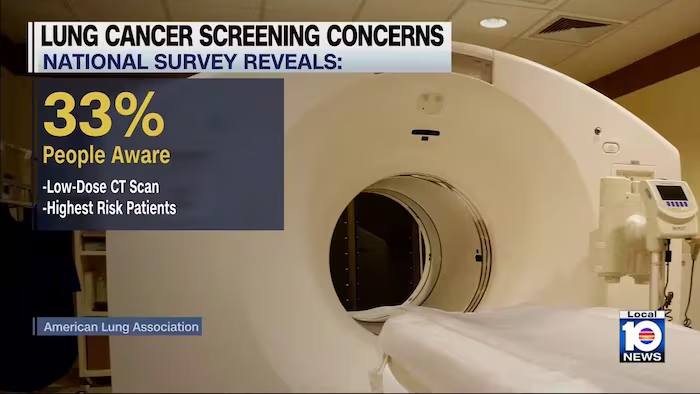
August 1 marks World Lung Cancer Day, a global observance drawing attention to a disease that kills approximately 125,000 Americans annually and remains the leading cancer killer for both men and women. While the five-year survival rate has climbed 26% in recent years, the disease continues to devastate patients and families nationwide, according to medical experts and advocacy groups monitoring progress in treatment and detection.
A significant awareness problem plagues the nation’s screening efforts. The American Lung Association’s latest national survey found that only about one-third of respondents knew that rapid, low-dose computed tomography scans are available for individuals at highest risk of developing lung cancer. Dr. Panagis Galiatsatos, medical spokesperson for the American Lung Association, characterized this knowledge gap as troubling given the proven benefits of early detection.
Eligibility for screening encompasses current smokers aged 50 to 80 with a 20 pack-year history—equivalent to smoking one pack daily for two decades or two packs daily for ten years—plus former heavy smokers who quit within the previous 15 years. The screening procedure itself requires no intravenous lines or contrast agents and takes less than 60 seconds to complete, making it far more convenient than the paperwork patients must complete beforehand.
Stigma surrounding smoking behavior presents another barrier to screening uptake. Many patients avoid disclosing continued smoking to physicians due to fears of judgment, Galiatsatos noted, while lung cancer screening recommendations themselves are relatively recent, having been formally endorsed only since 2013. Experts also stress that individuals without smoking histories should consult their doctors about personal risk factors, including family medical history or prior radiation exposure.



More Stories
New York Health Officials Sound Alarm Over Rising Measles Cases as School Year Approaches
CareCloud Breach Compromises 3.75 Million Patient Records, Among Largest Healthcare Data Thefts of 2026
Month-Long HEPA Use Linked to Faster Cognitive Processing in Middle-Aged Adults