


💛 A quick favor, if you've got a second.
We're really happy that you chose to read one of our stories and sincerely hope you'll stick around to read more. We took our paywall down — for now — but that won't last forever, and when the gate goes back up, we'd love for you to already be on the inside.
It's free. So please enter your email here and don't forget to like and follow us on all of your favorite Social Media platforms!
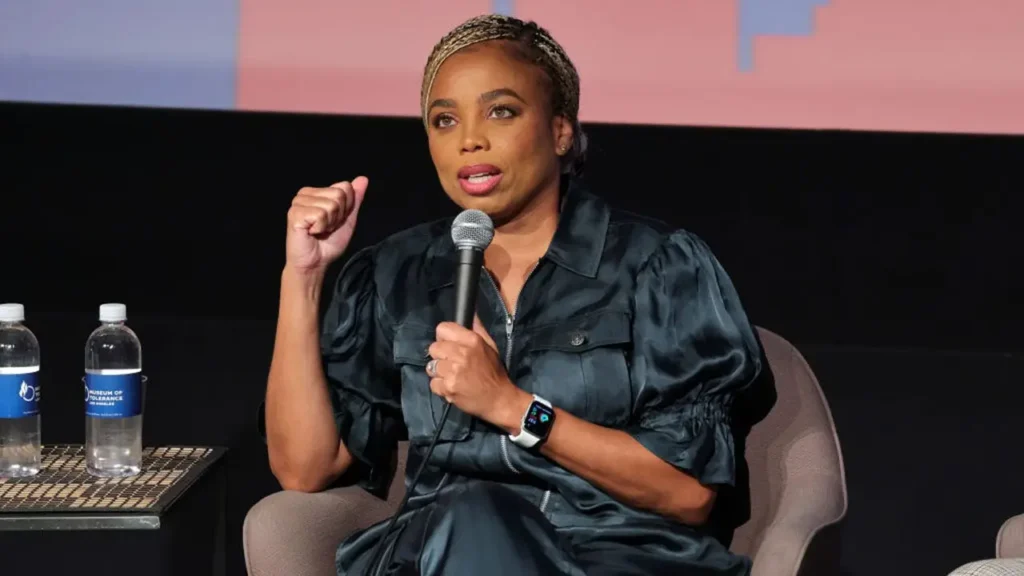
Jemele Hill, the former ESPN commentator, has entered the Sophie Cunningham controversy with pointed criticism of how the Indiana Fever guard and her organization handled questions about a rally held outside Climate Pledge Arena. Hill’s commentary reflects broader tensions within sports media regarding athlete activism and accountability. The dispute centers on Cunningham’s recent statements defending women’s sports and her subsequent handling of public support for those remarks.
During Indiana’s 105-95 victory over Seattle, reporters sought to question Fever head coach Stephanie White about the “Support Sophie Cunningham” demonstration outside the venue. The team responded with a prepared statement asserting that neither the organization nor Cunningham possessed knowledge of or contact with the rally’s organizers, emphasizing their focus on winning basketball games and building fan loyalty.
Hill used social media to accuse Cunningham of evading responsibility while simultaneously faulting the Fever for placing other players and White in an awkward position by deflecting inquiries. Hill noted that Cunningham had previously described herself as an entertainer aware of the scrutiny accompanying women’s sports visibility, making her reluctance to address the matter inconsistent with her established public persona.
Hill further argued that the reporter who posed questions about the rally acted appropriately, contending that demonstrations occurring at game venues warrant immediate journalistic scrutiny. Hill stated that athletes who build public identities around outspoken positions must accept the accompanying scrutiny rather than retreat when controversial moments arise.
The broader controversy originated when Cunningham told ESPN that she opposes transgender athletes who are biologically male from competing against women in women’s sports. This statement catalyzed grassroots organizing efforts, including rallies scheduled for upcoming Fever games in Oregon and Minnesota.
The situation escalated when Seattle Storm co-owner Celeste Keaton verbally confronted two teenage girls holding a sign thanking Cunningham for her advocacy inside Climate Pledge Arena. According to the girls, Keaton directed profanities at them, leaving at least one tearful. The WNBA responded by fining the Storm $25,000 and suspending Keaton for five games.
Cunningham subsequently addressed the episode on social media, condemning Keaton’s conduct while affirming her belief in inclusive spaces for all individuals. She praised the teenagers for their advocacy and indicated she would contact them personally with gifts. She also characterized the co-owner’s behavior as reflective of poor leadership.
Hill’s social media posts attracted mixed reactions, with some critics questioning why Hill, whom they characterized as a “disgraced” commentator, remained focused on Cunningham’s perceived inconsistency. Others suggested that Cunningham had sufficiently addressed the matter and required no further public commentary.

More Stories
Trump Threatens FCC Action Against NBC’s Welker Over Endorsement Coverage
Looney Tunes’ ‘Coyote vs. Acme’ Debuts With $15.5 Million as ‘Spider-Man’ Holds Box Office Crown
Country Music Legend Dolly Parton Laid to Rest; Niece Shares Touching Remembrance