



💛 A quick favor, if you've got a second.
We're really happy that you chose to read one of our stories and sincerely hope you'll stick around to read more. We took our paywall down — for now — but that won't last forever, and when the gate goes back up, we'd love for you to already be on the inside.
It's free. So please enter your email here and don't forget to like and follow us on all of your favorite Social Media platforms!
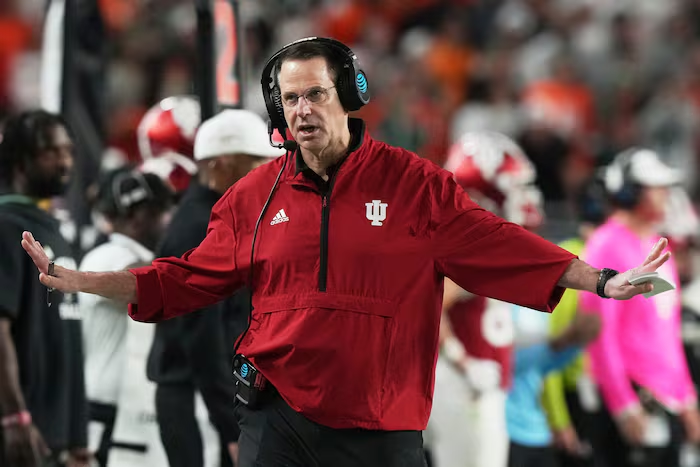
The Big Ten is pushing back against criticism that it relies too heavily on elite programs, citing three consecutive College Football Playoff championships as proof of conference-wide strength. Big Ten Commissioner Tony Petitti pointed to Michigan’s 2023 title, Ohio State’s 2024 crown and Indiana’s 2025 championship as evidence that top-tier teams cannot succeed without navigating a rigorous regular-season schedule.
Petitti dismissed the notion that the conference’s middle tier lacks competitive merit, speaking alongside the Big Ten’s three recent CFP trophies at media days. Indiana coach Curt Cignetti declared “there’s no doubt” the Big Ten is the nation’s strongest conference, emphasizing that accomplishments are earned rather than promoted. Illinois coach Bret Bielema suggested the SEC was relying on historical success, saying the conference wanted “to live in 2005 forever.”
The Southeastern Conference countered with arguments about its superior depth and consistent weekly competition. SEC Commissioner Greg Sankey maintained that no other conference creates the level of competitive intensity found throughout his 16-team league. While five different SEC schools won 13 national titles between 2006 and 2022, no SEC team has reached the last three championship games.
Statistical measures present a mixed picture of conference strength. The Big Ten placed three teams in the top four of ESPN’s SP+ rankings for the 2025 season, while the SEC had no teams in the top five. However, seven Big Ten programs ranked below Kentucky, the SEC’s lowest-ranked team at No. 67.
Head-to-head results over the past two seasons favored the Big Ten, which compiled a 10-7 record against the SEC, including a perfect 3-0 mark in playoff matchups. The Big Ten won all five of its non-playoff bowl contests against SEC opponents despite being favored in none of them, with Illinois accounting for two upsets.
Bielema attributed the shift in power dynamics to changes in college football’s transfer portal and athlete compensation mechanisms. The former Arkansas coach, who coached in the SEC from 2013 to 2017, said the sport fundamentally transformed once those elements took hold. Fourteen of the past 22 playoff games have featured Big Ten teams, with two contests pitting conference rivals against each other.
Even coaches with SEC experience acknowledged the Big Ten’s current superiority. Purdue’s Barry Odom, who previously coached Missouri, cited the conference’s three straight national championships and double the playoff wins of the next-best conference. UCLA quarterback Nico Iamaleava, who played for Tennessee in 2024, described both conferences as physically demanding while noting the competitive gap has narrowed.
Washington coach Jedd Fisch expressed frustration with the ongoing debate, suggesting the intensity of the argument distracted from the sport itself. He urged coaches and conferences to focus on competition rather than promotion, drawing a parallel to how the NFL does not engage in similar conference rivalry claims.


More Stories
Packers Running Back Josh Jacobs Placed on Commissioner Exempt List Pending Misdemeanor Charges
Denver Broncos Linebacker Jonathon Cooper Placed on Commissioner’s Exempt List Amid Domestic Violence Charges
Rose Scores Spectacular Hole-in-One During Tour Championship Final Round