



💛 A quick favor, if you've got a second.
We're really happy that you chose to read one of our stories and sincerely hope you'll stick around to read more. We took our paywall down — for now — but that won't last forever, and when the gate goes back up, we'd love for you to already be on the inside.
It's free. So please enter your email here and don't forget to like and follow us on all of your favorite Social Media platforms!
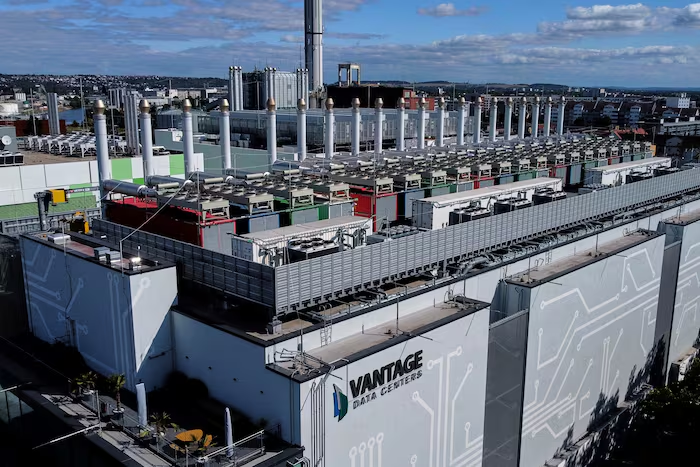
The European Commission unveiled a strategy Thursday to invest 10 billion euros ($11.4 billion) in the construction of seven artificial intelligence gigafactories across the 27-nation bloc. The initiative represents a major effort to address Europe’s competitive disadvantage in AI development compared to the United States and China. Officials hope the public investment will catalyze an additional 20 billion euros ($22.8 billion) in private sector funding.
Henna Virkkunen, the Commission’s executive vice president responsible for technology sovereignty, characterized access to large-scale computing infrastructure as essential for Europe’s AI future. The gigafactories under development will each house at least 100,000 advanced AI chips, delivering computational power roughly four times greater than existing EU data centers. Once operational, the seven facilities will more than double Europe’s total computing capacity across its current network of 19 AI data centers stretching from Finland to Spain.
Europe’s technological vulnerabilities have become increasingly apparent amid rising geopolitical tensions. A 2025 Federal Reserve assessment found the continent lags significantly behind competitors in critical AI sectors, with China commanding vast electrical capacity for data infrastructure and the United States capturing the bulk of private AI investment. The EU also faces cost disadvantages, with electricity prices double or triple those in the U.S. and China, while Europe manufactures few of the specialized components required for modern data centers.
Commission reports to the European Parliament in June highlighted the continent’s reliance on American technology providers, with all five leading cloud service providers operating in the EU originating from the United States. This dependency poses risks to data security and operational independence, officials warned. France’s Mistral operates the EU’s largest AI data center at its Paris campus and produces the Le Chat chatbot, but has struggled to match the trajectory of American rivals like OpenAI or Chinese competitors such as DeepSeek.
The Commission indicated that AI systems developed within the expanding data center network will adhere to EU standards governing data protection, safety, security, and ethical considerations, likely referencing the bloc’s Digital Services Act and Digital Market Act. Concerns about the gigafactory initiative extend beyond competition, however, as 40 mayors globally signed a pact in June to mitigate the environmental and economic impacts of AI data center construction on their communities, citing effects ranging from natural resource depletion to climate implications.


More Stories
Former NFL cheerleader and ex-aide face off in close Rhode Island GOP primary
Trump Threatens FCC Action Against NBC’s Welker Over Endorsement Coverage
Chicago Mayor Issues Executive Order Requiring Contractor Diversity Disclosures and ICE Ties Reporting