


💛 A quick favor, if you've got a second.
We're really happy that you chose to read one of our stories and sincerely hope you'll stick around to read more. We took our paywall down — for now — but that won't last forever, and when the gate goes back up, we'd love for you to already be on the inside.
It's free. So please enter your email here and don't forget to like and follow us on all of your favorite Social Media platforms!
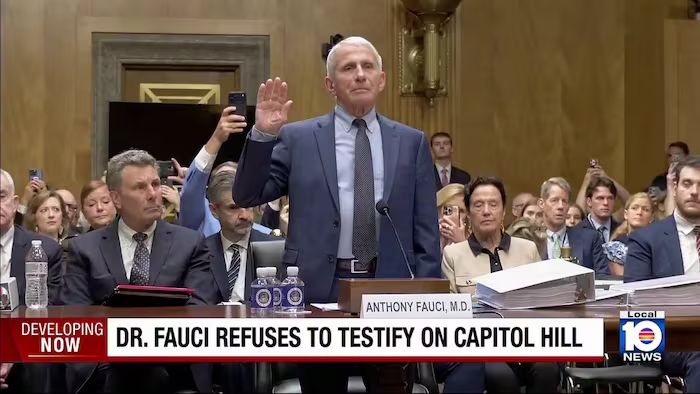
Dr. Anthony Fauci exercised his Fifth Amendment right and refused to answer questions Wednesday during a Republican-controlled Senate committee hearing examining his role in the nation’s coronavirus response. The retired infectious-disease expert’s decision to remain silent escalates ongoing partisan disputes regarding pandemic origins and the scientific guidance he provided throughout the health crisis.
Republican Sen. Rand Paul of Kentucky, who subpoenaed Fauci and has maintained a contentious relationship with the former government scientist, led efforts to compel his testimony under oath. Fauci’s invocation of his constitutional right to remain silent potentially shields him from potential perjury charges, a prosecution goal some Republicans have pursued for years despite his receipt of a presidential pardon from Joe Biden.
In his opening remarks, Fauci accused Paul of harboring an “obvious obsession” with demanding his imprisonment, asserting the hearing existed solely to elicit statements that might fulfill Paul’s public promises of seeing him incarcerated. Fauci stated he was following legal counsel’s guidance in declining to respond to lawmakers’ inquiries.
Paul distributed over 1,000 pages of Fauci’s personal diary from the pandemic era, claiming discrepancies between Fauci’s private writings and public statements regarding virus origins. The senator contended Fauci facilitated research funding that produced the pandemic while subsequently concealing his involvement in the crisis.
Democratic Sen. Gary Peters of Michigan characterized the proceeding as a partisan undertaking focused on historical grievances rather than current national security threats. More than 150 infectious-disease specialists and scientists issued a public letter denouncing the accusations against Fauci as unfounded and urging Congress to halt what they termed “witch-hunts.”
The central dispute concerns whether federally financed coronavirus research conducted in China contributed to the pandemic’s emergence. While most scientists support a natural-origin theory with animal-to-human transmission at a Wuhan wildlife market, Paul champions a laboratory-leak hypothesis lacking substantial scientific corroboration.
Republicans have also alleged Fauci misrepresented his agency’s funding of gain-of-function research, which involves laboratory enhancement of viruses to assess pandemic potential. The National Institutes of Health provided grants to EcoHealth Alliance, which collaborated with a Chinese facility studying bat-carried coronaviruses, though Fauci previously emphasized that such experiments could not biologically produce the pandemic pathogen.
Health Secretary Robert F. Kennedy Jr., a longtime vaccine skeptic, stated Monday that his department supplied the diary entries to the committee and suggested Fauci might commit perjury during testimony. President Donald Trump posted on social media that he discontinued relying on Fauci’s counsel regarding masks, shutdowns and other pandemic policies, which he deemed counterproductive.
Paul warned Fauci that refusing to testify could result in obstruction-of-Congress consequences, potentially including a contempt citation forwarded to the Justice Department. Fauci’s attorney, David Schertler, characterized Paul’s allegations as “false and disgraceful” and stated the legal team would examine accountability options.

More Stories
Packers Running Back Josh Jacobs Placed on NFL Commissioner’s Exempt List Following Domestic Arrest
Federal Prosecutors Convene Special Grand Jury to Investigate D.C. Schools’ Attendance and Graduation Practices
Chicago Mayor Issues Executive Order Requiring Contractor Diversity Disclosures and ICE Ties Reporting