


💛 A quick favor, if you've got a second.
We're really happy that you chose to read one of our stories and sincerely hope you'll stick around to read more. We took our paywall down — for now — but that won't last forever, and when the gate goes back up, we'd love for you to already be on the inside.
It's free. So please enter your email here and don't forget to like and follow us on all of your favorite Social Media platforms!
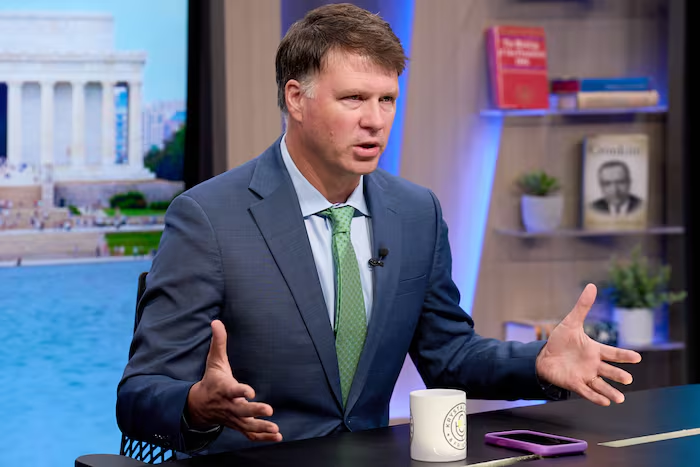
A growing number of left-leaning Americans are abandoning traditional broadcast news in favor of independent podcasts, social media accounts and digital news organizations, creating an alternative media ecosystem that is reshaping Democratic politics. The shift mirrors a similar movement among conservatives years earlier, when skepticism of mainstream outlets led to the rise of right-wing sites like Breitbart and the Daily Caller. This year’s wave of anti-establishment Democratic candidates is benefiting from visibility on platforms that mainstream outlets have largely ignored.
Farah Berent, a Michigan teacher, exemplifies the trend. Dissatisfied with cable news coverage of the Gaza conflict, she turned to Instagram and other independent sources for political information. “I couldn’t stand all the lies on the stations,” Berent said, citing insufficient attention to Palestinian suffering. Her experience reflects broader frustration among progressives with institutional media that has prompted many to seek alternative sources.
Independent media outlets and commentators have become influential enough to move voters and boost candidate campaigns. Ryan Grim, co-founder of Drop Site News, noted that progressive politicians now actively seek coverage on his platform to reach voters without reliance on traditional gatekeepers. Abdul El-Sayed, running for U.S. Senate in Michigan against moderate incumbent Haley Stevens in the Aug. 4 primary, has leveraged independent media to amplify his anti-establishment message.
The New York City Democratic primary earlier this month demonstrated the power of this alternative ecosystem. Progressive congressional candidates endorsed by Mayor Zohran Mamdani defeated establishment-backed opponents, with voters citing YouTube videos and podcasts from outlets like MeidasTouch as influential in their decision-making. Policy analyst Sara Hyler switched her support from Rep. Adriano Espaillat to progressive challenger Darializa Avila Chevalier after learning about the candidate through independent media sources.
Democratic consultant Mike Nellis attributed the shift to institutional distrust spanning all sectors of society. “There’s a complete lack of trust in any and all institutions now,” Nellis said. “That has led people to turn to individuals, and so now you’re picking your flavor of person to listen to.” This dynamic has accelerated since Sen. Bernie Sanders’ 2016 presidential campaign first energized left-wing alternative media channels like The Young Turks and Chapo Trap House.
The Michigan primary race illustrates how alternative media is directly impacting campaign dynamics. Drop Site’s reporting revealed that Stevens’ campaign consultant had worked for Palantir, a company controversial in liberal circles for government contracts related to immigration enforcement. Stevens subsequently parted ways with the consultant, demonstrating the investigative capacity and political influence of independent outlets.
Outlets including Secular Talk, Breaking Points, streamer Hasan Piker, More Perfect Union and The Lever have all significantly expanded their audiences in recent months. Drop Site News has accumulated 800,000 free subscribers and 60,000 paid subscribers since launching two years ago, exceeding founder Grim’s expectations. The growth reflects both technological accessibility and deepening skepticism of traditional institutions.
El-Sayed, himself a longtime podcaster, embraces the new media landscape while maintaining presence across multiple platforms. “I go on Fox News, I go on podcasts, I Twitch stream, we have a YouTube channel,” he said. His opponent Stevens has relied on traditional endorsements from outgoing Sen. Gary Peters, Gov. Gretchen Whitmer and Senate Democratic leader Chuck Schumer, along with substantial backing from AIPAC-affiliated groups that have spent close to $30 million on the race.
The Democratic National Committee has also adapted to changing media consumption patterns. Its new digital media account, @FactPostNews, accumulated more than 2 billion impressions across Threads, X, Facebook, Instagram and Bluesky in 2026 alone, according to DNC Deputy Chief Mobilization Officer Paulina Mangubat. The rapid success surprised party officials who questioned whether the initiative would gain meaningful traction.
Tensions have emerged within the progressive media space as outlets pursue aggressive editorial approaches. Grim faced criticism for coverage of a failed Maine candidate accused of sexual assault, with critics claiming he attempted to undermine credibility of the allegation. Grim defended his reporting as providing necessary context rather than dismissing the accusation. Similar controversy arose when Drop Site pressed Rep. Ro Khanna on whether Hamas attacks against Israeli soldiers on Oct. 7, 2023 were justified, with the California Democrat declining to agree.
Grim argued that independent media outlets have a responsibility to hold elected officials accountable with difficult questions. “People want to see you being accountable to questions, and if they don’t agree with you, sometimes that’s fine,” he said. “I think the smarter politicians are starting to recognize that.” The emerging media ecosystem, despite occasional controversies, continues reshaping how Democratic voters access information and make electoral decisions.


More Stories
Federal voting arrest in New Jersey adds new pressure point in Sherrill-Trump standoff
Colombia backs Trump security push while limiting U.S. role in anti-gang operations
Former NFL cheerleader and ex-aide face off in close Rhode Island GOP primary