



💛 A quick favor, if you've got a second.
We're really happy that you chose to read one of our stories and sincerely hope you'll stick around to read more. We took our paywall down — for now — but that won't last forever, and when the gate goes back up, we'd love for you to already be on the inside.
It's free. So please enter your email here and don't forget to like and follow us on all of your favorite Social Media platforms!
A labor union and two female correctional officers from a Louisiana federal prison filed a lawsuit Tuesday challenging the Equal Employment Opportunity Commission’s indefinite suspension of all federal-sector class complaints pending before the agency’s administrative judges. The action targets what plaintiffs characterize as an unlawful freeze on an entire category of discrimination cases involving federal workers, a process distinct from the procedures governing private-sector employment disputes.
The two women, Deanna Chelette and Alexzandria Boyd, had filed a certified class complaint against the Federal Bureau of Prisons alleging that management systematically failed to prevent or address widespread sexual harassment by inmates, including rape threats, unwanted physical contact, and exposure. The American Federation of Government Employees, representing the largest membership of federal workers, joined the women as co-plaintiffs in the federal court filing.
The EEOC has not publicly disclosed the suspension order or explained the rationale behind it, and the scope of affected cases remains unclear. The agency declined to provide comment, instead referring all inquiries to the Department of Justice, which also refused to elaborate on the directive.
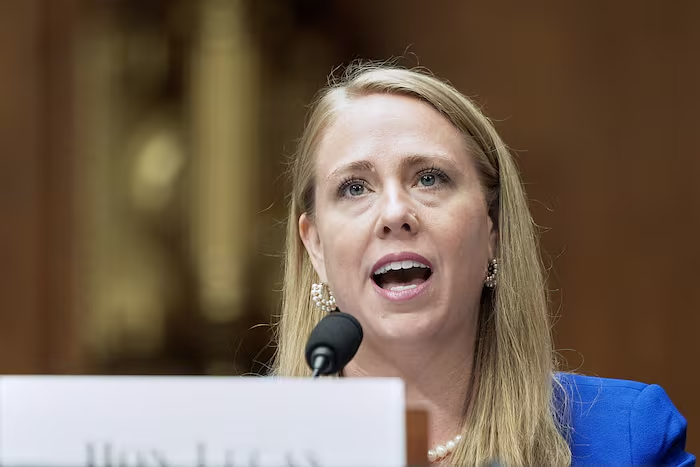
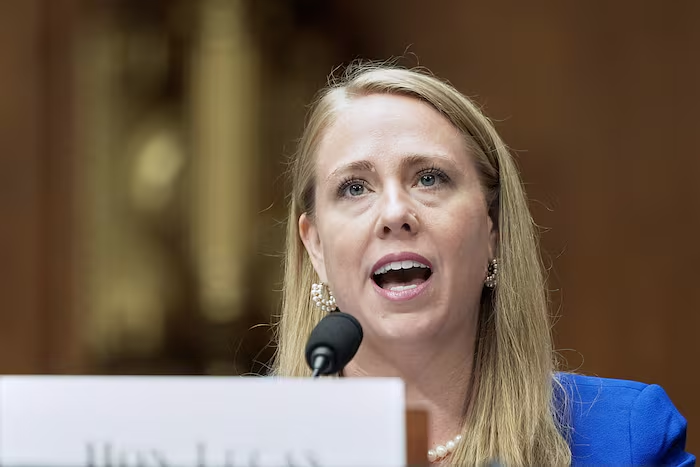
Under President Donald Trump’s administration, the EEOC has fundamentally restructured its civil rights enforcement agenda, reprioritizing cases to challenge diversity initiatives, withdrawing support for transgender workers’ claims, and eliminating long-established methods for investigating patterns of systemic discrimination. EEOC Chair Andrea Lucas has defended these shifts as advancing an “even-handed” and “colorblind” approach to workplace civil rights, drawing criticism through multiple lawsuits filed against her office.
Attorneys representing the plaintiffs stated in court filings that the EEOC offered “no reasoned explanation for a blanket policy that halts an entire category of discrimination cases.” They argue the suspension violates the agency’s own procedural regulations requiring prompt handling of federal-worker complaints and seek to have the directive invalidated.
An administrative judge had certified the class action in March 2025, but in December issued a notice halting proceedings indefinitely. The original complaint included declarations from eight additional women describing incidents of harassment and management’s failure to respond, with projections that the class would encompass at least 182 women employed at Louisiana’s Federal Correctional Complex at Pollock.
Joseph Sellers, co-chair of Cohen Milstein Sellers & Toll’s civil rights and employment practice and lead counsel for the plaintiffs, said the blanket suspension appears consistent with a broader pattern at the EEOC to weaken employee protections established under federal civil rights statutes. “Without an explanation, it’s hard to infer what the EEOC’s intentions were, but it’s hard to ignore that this is part of a broader campaign to undermine the ability of employees to protect rights that Congress has provided,” Sellers stated.
During the seven-month suspension, the women have faced ongoing sexual harassment with no relief, according to the lawsuit. Co-counsel Heidi Burakiewicz, founding partner at Burakiewicz & DePriest, described how the pause has emboldened prison management to take minimal corrective action, effectively signaling to inmates that harassment carries no consequences.
While the precise number of suspended cases is unknown, plaintiffs’ attorneys indicated they represent federal employees in at least five additional stalled class complaints, including actions against the FBI and the Department of Defense. Though workers retain the option to withdraw from the EEOC process and litigate in federal court, attorneys cautioned that such a move would require rebuilding the case entirely and securing class certification anew, a process potentially spanning years.


More Stories
Former NFL cheerleader and ex-aide face off in close Rhode Island GOP primary
Trump Threatens FCC Action Against NBC’s Welker Over Endorsement Coverage
Chicago Mayor Issues Executive Order Requiring Contractor Diversity Disclosures and ICE Ties Reporting