



💛 A quick favor, if you've got a second.
We're really happy that you chose to read one of our stories and sincerely hope you'll stick around to read more. We took our paywall down — for now — but that won't last forever, and when the gate goes back up, we'd love for you to already be on the inside.
It's free. So please enter your email here and don't forget to like and follow us on all of your favorite Social Media platforms!
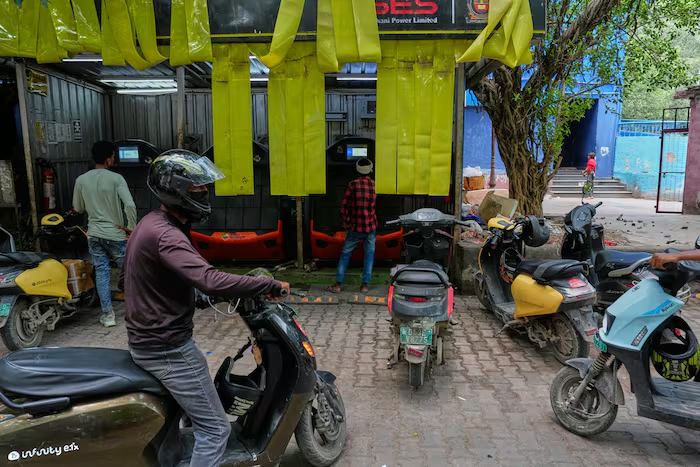
Delhi adopted a sweeping electric vehicle policy on July 1 designed to make the vast majority of newly registered vehicles electric by 2027, marking one of India’s most ambitious efforts to combat severe urban air pollution. The initiative does not ban existing gas-powered vehicles but expects their numbers to decline significantly as stricter registration requirements take effect. Energy experts view the plan as a watershed moment for the Indian capital’s environmental future.
The policy establishes aggressive timelines for specific vehicle categories, mandating that all newly registered three-wheeled vehicles and small trucks be electric starting in 2027, followed by two-wheelers in 2028. These vehicle classes comprise nearly 70 percent of Delhi’s 8.7 million registered vehicles and account for approximately half of all vehicular pollution in the city. Currently, electric vehicles represent only about 5 percent of total registrations, though over 100,000 new EV registrations occurred in the past year.
Financial incentives form a cornerstone of the strategy, with the local government budgeting 150 billion rupees ($1.5 billion) for the initiative. Residents purchasing electric vehicles receive cash subsidies up to 50,000 rupees ($522), while those scrapping old gasoline-powered vehicles can claim up to 100,000 rupees ($1,044). The program also expands charging infrastructure and waives registration fees and certain road taxes for EV buyers.
Jaideep Saraswat, who oversees clean power initiatives at the Vasudha Foundation, called Delhi’s policy exceptional among Indian states, noting that firm deadlines signal to manufacturers and consumers that the transition is “inevitable.” While other states including Maharashtra, Karnataka, Telangana and Tamil Nadu have offered EV incentives and charging investments, Delhi becomes the first to systematically phase out new internal combustion engine vehicle registrations.
Severe winter air pollution routinely forces Delhi authorities to close schools, ban construction and implement emergency public health measures. Vehicles contribute approximately one-quarter of air pollution in the National Capital Region, with two- and three-wheelers responsible for nearly half of vehicular emissions citywide. Electric vehicles already account for 12.7 percent of Delhi’s new vehicle sales in the 2026 financial year, substantially above the national average of 8.3 percent.
Charging infrastructure remains a critical bottleneck, with current facilities insufficient to support widespread adoption, according to EV owners interviewed in affluent Delhi neighborhoods. Siddhant Jha, a 22-year-old software engineer, expressed concerns about vehicle longevity and annual street flooding that could damage electrical components, preferring to wait for improved models and lower battery costs. Limited charging accessibility also deters potential buyers from switching to electric two-wheelers.
Ruchita Shah, energy analyst at the Ember think tank, emphasized that policy success depends on Delhi expanding charging infrastructure while sourcing more electricity from renewable sources rather than fossil fuel plants. Most vehicle charging occurs at night when solar power is unavailable, forcing reliance on thermal power plants to meet demand. The city must also upgrade its electrical grid to accommodate fast chargers needed by buses, cargo vehicles and cars.
Environmental researcher Sunil Dahiya cautioned that benefits will materialize gradually since existing gasoline, diesel and compressed natural gas vehicles will continue operating for years. He recommended installing battery storage at charging stations and implementing time-of-day pricing to encourage charging during peak renewable energy availability. Delhi must also coordinate with surrounding states to decarbonize the regional electricity grid and accelerate public transportation electrification.


More Stories
Federal Prosecutors Convene Special Grand Jury to Investigate D.C. Schools’ Attendance and Graduation Practices
State Department Reissues Level 3 Travel Advisory for Israel Amid Terrorism and Armed Conflict Concerns
Forest Service Proposes Steep Fee Increases at Lake Tahoe Recreation Sites