


💛 A quick favor, if you've got a second.
We're really happy that you chose to read one of our stories and sincerely hope you'll stick around to read more. We took our paywall down — for now — but that won't last forever, and when the gate goes back up, we'd love for you to already be on the inside.
It's free. So please enter your email here and don't forget to like and follow us on all of your favorite Social Media platforms!
Christopher Nolan’s adaptation of “The Odyssey” introduces audiences to a succession of legendary creatures drawn from Homer’s ancient epic. The major box-office success features an ensemble of A-list talent navigating supernatural encounters as the protagonist Odysseus battles his way homeward across a perilous mythical landscape.
Joel P. Christensen, provost and senior vice president for academic affairs at the CUNY Graduate Center and a Homer scholar, praised the film’s visual presentation. “The movie is visually stunning. It needs to be seen in the theater,” Christensen told Fox News Digital, adding that viewers do not require prior familiarity with the source material since Nolan provides adequate context.
Unlike typical blockbusters centered on a single antagonist, Nolan’s film presents distinct monsters and supernatural dangers at nearly every stage of Odysseus’ voyage. The legendary beings that populate the narrative demonstrate how the adaptation draws directly from Homer’s foundational text to construct its menacing encounters.
Polyphemus, the most renowned Cyclops in mythology, traps Odysseus and his men in a cave before consuming several crew members. The name translates roughly to “rich in songs and legends,” according to Britannica. Bill Irwin portrays the creature in Nolan’s film, which depicts Odysseus blinding the Cyclops with a sharpened wooden stake to secure his escape.
As a son of Poseidon, Polyphemus’ blinding sets the sea god upon a course to curse Odysseus’ homebound journey. This divine retaliation becomes central to understanding the obstacles that define the hero’s extended voyage.
The Laestrygonians, depicted as giant cannibals in Homer’s narrative, nearly obliterate Odysseus’ entire fleet after decoying his ships into their harbor. Appearing in Book 10 of “The Odyssey,” these creatures hurl massive boulders that devastate the assembled vessels, leaving only one ship intact for Odysseus to continue toward Circe’s island.
Circe, a powerful sorceress and daughter of Helios the sun god, encounters Odysseus on the island of Aeaea. She famously transforms his men into swine but proves unable to curse the hero himself, eventually falling in love with Odysseus and providing crucial guidance for his continued journey.
Christensen identified the transformation scene as the film’s most “unforgettable sequence,” noting its capacity to disturb viewers. “It makes audiences viscerally uncomfortable: It is well paced, imaginative and unsettling,” he explained, observing that the sequence reveals men cast in their most animalistic forms. Samantha Morton takes the role of Circe in Nolan’s adaptation.
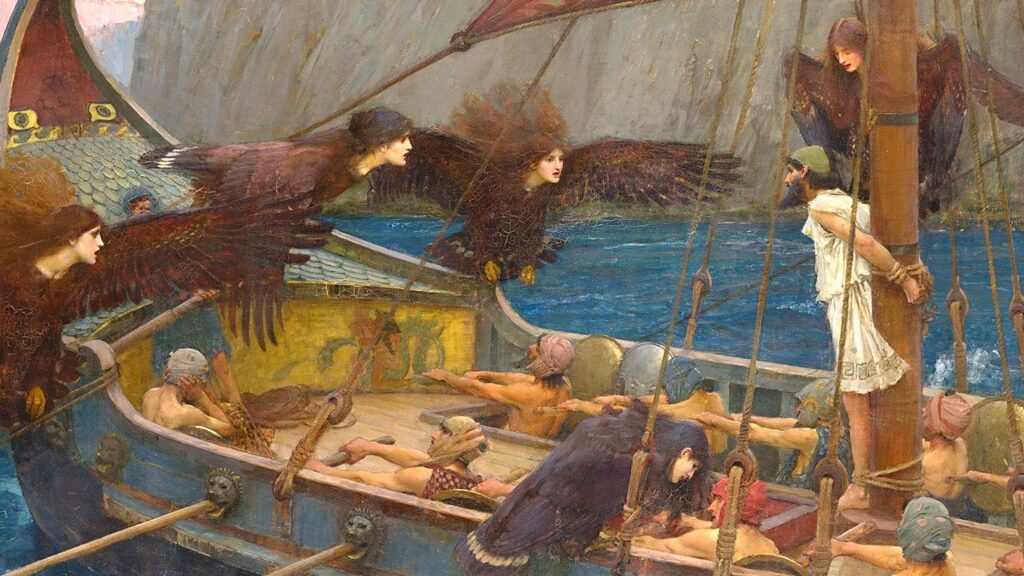
Sirens, characterized in Greek mythology as half-bird and half-woman beings, lured sailors to their deaths through irresistible song. In Book 12 of Homer’s epic, Circe warns Odysseus of the Sirens’ danger, prompting him to order his crew’s ears plugged with beeswax while binding himself to the mast to experience their song without succumbing.
Scylla and Charybdis represent twin perils that force Odysseus into a harrowing choice within a narrow strait. Scylla waits to snatch sailors from passing vessels while Charybdis generates a massive whirlpool on the opposing side. By heeding Circe’s counsel to sail past Scylla despite certain losses, Odysseus sacrifices six men but preserves the majority of his crew.
Calypso, a nymph inhabiting the mythical island of Ogygia, detains Odysseus for years after falling in love with him. She releases him only when Zeus commands his freedom, assisting in the construction of a raft for his departure. Charlize Theron portrays the character in the film.
Christensen acknowledged that Nolan’s condensation of Homer’s sprawling narrative necessitated significant modifications for cinematic presentation. While praising the visual spectacle, he noted that certain adaptational choices diverge meaningfully from the source material.
The scholar specifically critiqued the film’s portrayal of Polyphemus as “more of a monster than a man” and objected to the reframing of Circe’s mythology. Nolan’s interpretation suggests she transforms men into pigs as a consequence of prior sexual assault, a departure Christensen identified as problematic storytelling that substitutes gender tropes for substantive narrative development.
Christensen acknowledged the practical constraints of translating ancient epic poetry to film format. “Nolan had to reduce some of the repetitions we see in the Homeric ‘Odyssey’ and had to limit the length of some scenes,” he stated, noting also the director’s deliberate reduction of divine elements that define the source text.
Despite such modifications, the film retains the epic’s most recognizable mythological figures as central components. “This is Nolan’s ‘Odyssey,’ not Homer’s,” Christensen concluded, emphasizing that the fundamental differences between poetic and cinematic mediums necessitate substantial creative revision.

More Stories
Looney Tunes’ ‘Coyote vs. Acme’ Debuts With $15.5 Million as ‘Spider-Man’ Holds Box Office Crown
Country Music Legend Dolly Parton Laid to Rest; Niece Shares Touching Remembrance
Britt Baker’s Surprise Return Helps Persephone Capture AEW TBS Championship at All In