


💛 A quick favor, if you've got a second.
We're really happy that you chose to read one of our stories and sincerely hope you'll stick around to read more. We took our paywall down — for now — but that won't last forever, and when the gate goes back up, we'd love for you to already be on the inside.
It's free. So please enter your email here and don't forget to like and follow us on all of your favorite Social Media platforms!
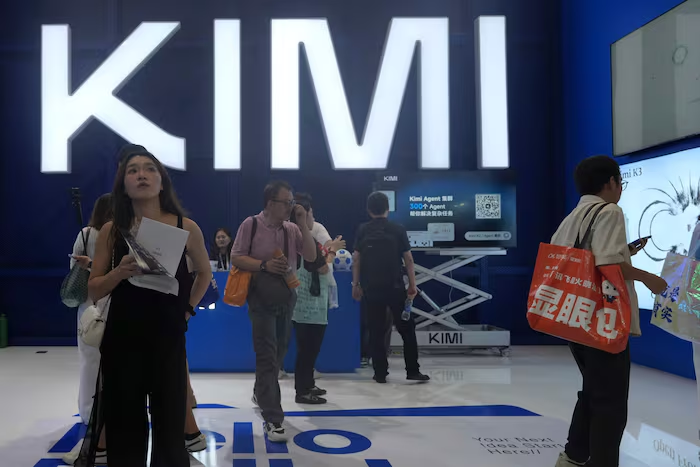
Chinese artificial intelligence startups are making significant inroads into the American market, attracting tech professionals and companies seeking cost-effective alternatives to established U.S. platforms. Mozilla Chief Technology Officer Raffi Krikorian recently switched to Moonshot’s Kimi K3 model for daily work tasks, praising its performance relative to Anthropic’s Claude offering. Major corporations including cryptocurrency exchange Coinbase have similarly shifted to Chinese AI systems to reduce operational expenses, marking a notable shift in the competitive landscape.
The latest generation of Chinese AI models demonstrates near-parity with frontier U.S. alternatives developed by OpenAI and Anthropic. Zhipu launched its GLM-5.2 model in June, while Moonshot released K3 in July, and Alibaba previewed Qwen3.8 Max the same month. DeepSeek unveiled its V4 model in April, challenging competitors from Google and OpenAI, according to technology experts monitoring the sector.
Cost efficiency has emerged as a primary driver of Chinese model adoption, particularly as artificial intelligence agents requiring autonomous execution of complex tasks become more prevalent. Pricing structures based on token usage amplify cost disparities between Chinese providers and U.S. counterparts, with some alternatives available at a fraction of premium American options. Technology executive Curt Meinhold noted that most users require adequate rather than cutting-edge capabilities, making affordable Chinese alternatives sufficient for routine applications.
Moonshot’s Kimi platform achieved 930,000 downloads during the week following K3’s July launch, representing a 200 percent increase from the previous week. In the United States specifically, downloads jumped 387 percent to approximately 86,000 during the same period. The surge in demand forced Moonshot to temporarily suspend new subscriptions as infrastructure reached capacity limits.
The Trump administration accused Moonshot on Wednesday of employing “covert” methods to develop K3 based on Anthropic’s technology, though not necessarily through illegal means. U.S. policymakers and companies have alleged that Chinese startups engage in unauthorized model “distillation” to extract proprietary technologies, claims Beijing characterizes as baseless. American export controls on advanced semiconductors and restrictions on certain technologies continue to constrain Chinese AI development capabilities.
Most Chinese AI models operate on open-source frameworks, permitting public examination and modification, contrasting with the proprietary closed-source systems favored by U.S. leaders Anthropic and OpenAI. Technology analysts predict Chinese vendors will leverage open-source advantages to accelerate global adoption. Recent export restrictions targeting Anthropic’s models inadvertently created market opportunities for Chinese competitors, according to Arena platform co-founder Anastasios Angelopoulos.
Chinese President Xi Jinping has promoted open-source AI development and expanded access in developing nations at recent technology summits, signaling strategic intent to dominate international markets. Domestic competition among Chinese AI companies is intensifying investments and spurring international expansion efforts, including through public equity offerings. However, sustainability concerns persist, with Zhipu reporting a 60 percent increase in net losses to 4.7 billion yuan ($694 million) despite 132 percent revenue growth to 724 million yuan ($107 million) last year.
While Chinese models continue advancing rapidly, they remain behind U.S. leaders in overall comprehensive capabilities, according to independent evaluators. Tech industry observers expect Chinese and American AI ecosystems to compete fiercely for global market share while maintaining strategic protections against rival technological advancement.

More Stories
Colombia backs Trump security push while limiting U.S. role in anti-gang operations
Federal Prosecutors Convene Special Grand Jury to Investigate D.C. Schools’ Attendance and Graduation Practices
State Department Reissues Level 3 Travel Advisory for Israel Amid Terrorism and Armed Conflict Concerns