


💛 A quick favor, if you've got a second.
We're really happy that you chose to read one of our stories and sincerely hope you'll stick around to read more. We took our paywall down — for now — but that won't last forever, and when the gate goes back up, we'd love for you to already be on the inside.
It's free. So please enter your email here and don't forget to like and follow us on all of your favorite Social Media platforms!
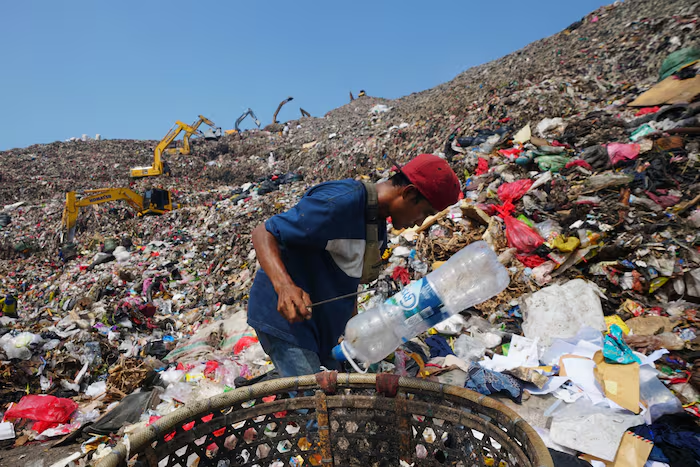
Bantargebang, Jakarta’s enormous waste facility, will undergo a significant operational shift beginning August 1 as the Indonesian government implements sweeping reforms designed to reduce methane emissions and improve environmental conditions. The 110-hectare landfill, which receives approximately 7,500 tons of waste daily from the capital, currently ranks as the world’s second-largest source of landfill methane emissions, according to UCLA’s STOP Methane initiative analysis from 2025. Jakarta’s Environment Agency head Dudi Gardesi Asikin announced that 343 of Indonesia’s 550 disposal sites must transition from open dumping to controlled or sanitary landfill systems.
The policy shift directly impacts an estimated 600,000 waste pickers across Indonesia, with more than 4,000 registered workers at Bantargebang alone who depend on salvaging recyclables to survive. Nur Wencih, a 35-year-old widow and two-decade veteran of the site, earns approximately $12 daily collecting discarded items—a precarious income that supports her household and two daughters living in a rural village. “What worries me most is how I will feed my family,” Wencih stated regarding the impending changes that will restrict access to the waste mountain.
Bantargebang originally opened in 1989 as an equipped sanitary landfill with methane extraction capabilities, but deteriorated into open dumping after a private-sector contract ended in 2016. Only two of the facility’s original 12 methane extraction wells remain operational, according to Asikin, who estimates covering the remaining disposal areas could cost up to 200 billion rupiah, or approximately $12 million. The landfill’s human-made mountain reaches 60 meters in height—equivalent to a 20-story building—and its carrying capacity is approaching or exceeding limits.
The government’s broader waste management transformation requires Jakarta residents to separate organic waste, recyclables, and residual trash before collection, a practice most households have never routinely performed. Environmental researcher David Sutasurya noted that approximately 80 percent of Jakarta’s waste could be diverted from landfills through composting and recycling, yet only about one-quarter of Indonesia’s daily waste currently enters formal management systems. Government institutions including education and health ministries are supporting public awareness efforts, though residents report confusion about the new sorting requirements.
Asikin expressed confidence that the policy will eventually create safer formal employment in recycling and composting sectors, replacing the dangerous work of scavenging among excavators and trucks. A March 2024 collapse triggered by heavy rain killed seven people, illustrating the hazards posed by the landfill’s massive scale and operational challenges. Methane, which accounts for roughly one-third of global warming and traps more heat than carbon dioxide, has become a priority focus for international climate initiatives led by UN Secretary-General António Guterres.
Community advocates demonstrate that transformation is achievable: Monica T. Anggriani has spent over a decade building neighborhood support for waste separation, establishing a community waste bank that now processes approximately one ton of organic waste daily. “If we don’t start now, nothing will change in the future,” Anggriani emphasized, recognizing that behavioral shifts must accompany infrastructure development to sustain long-term reform.

More Stories
Colombia backs Trump security push while limiting U.S. role in anti-gang operations
Federal Prosecutors Convene Special Grand Jury to Investigate D.C. Schools’ Attendance and Graduation Practices
State Department Reissues Level 3 Travel Advisory for Israel Amid Terrorism and Armed Conflict Concerns