

💛 A quick favor, if you've got a second.
We're really happy that you chose to read one of our stories and sincerely hope you'll stick around to read more. We took our paywall down — for now — but that won't last forever, and when the gate goes back up, we'd love for you to already be on the inside.
It's free. So please enter your email here and don't forget to like and follow us on all of your favorite Social Media platforms!
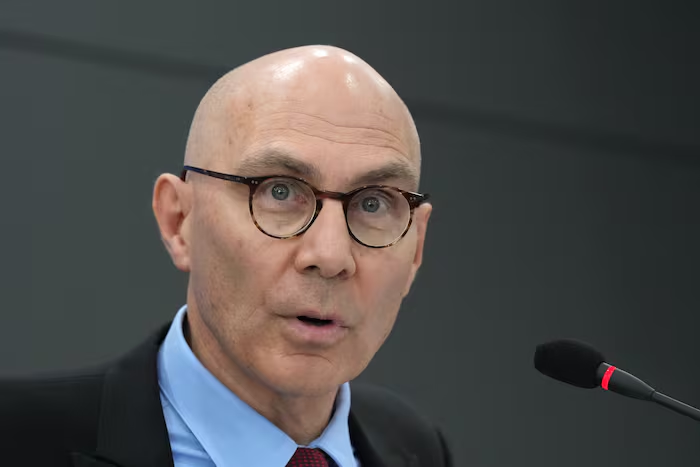
Volker Türk, the U.N. high commissioner for human rights, confronts a Friday General Assembly vote on his reappointment to a second four-year term, with several nations and advocacy groups challenging his record on high-profile human rights disputes. Secretary-General Antonio Guterres nominated the Austrian lawyer for another term without significant public debate, drawing criticism from those who question his handling of Israel’s military operations in Gaza and his approach to allegations of Chinese persecution of Uyghurs.
The 193-member assembly will vote on Türk’s extension following closed consultations among regional groups, a process that Ken Roth, former head of Human Rights Watch, described as a “stealth procedure” designed to sidestep public and civil society scrutiny. Russia has separately proposed limiting any extension to the end of 2024, which would defer the appointment decision to Guterres’ successor, as six candidates compete to become the next secretary-general.
Israel’s Foreign Ministry characterized Guterres’ reappointment push as a “moral failure,” asserting on social media that the decision should rest with the incoming secretary-general rather than the current one. Latin American nations including Nicaragua, Argentina, and Paraguay have raised objections to the reappointment, though the African group has offered no opposition.
Critics contend Türk has insufficiently championed human rights violations in China, particularly regarding the detention of Uyghurs and other Muslim minorities in Xinjiang. Roth called the commissioner “a disaster,” arguing that his reliance on private engagement with Beijing instead of aggressive public advocacy amounts to abandoning the persecuted populations he is mandated to protect.
U.N. spokesman Stephane Dujarric defended Guterres’ conduct as consistent with the 1993 resolution establishing the human rights post, which permits a second term. Türk’s office stated the commissioner remains willing to serve and views engagement with all nations as integral to promoting and protecting rights globally.
The human rights chief has expressed concern over China’s detention of individuals including artist Gao Zhen, lawyer Yu Wensheng, and media figure Jimmy Lai, as well as counterterrorism measures affecting ethnic minorities across Xinjiang, Inner Mongolia, and Tibet. However, Türk has declined to endorse genocide accusations made by independent U.N. experts regarding Israel’s military campaign against Hamas, a position Israel categorically rejects.

More Stories
Federal voting arrest in New Jersey adds new pressure point in Sherrill-Trump standoff
Colombia backs Trump security push while limiting U.S. role in anti-gang operations
Former NFL cheerleader and ex-aide face off in close Rhode Island GOP primary