


💛 A quick favor, if you've got a second.
We're really happy that you chose to read one of our stories and sincerely hope you'll stick around to read more. We took our paywall down — for now — but that won't last forever, and when the gate goes back up, we'd love for you to already be on the inside.
It's free. So please enter your email here and don't forget to like and follow us on all of your favorite Social Media platforms!
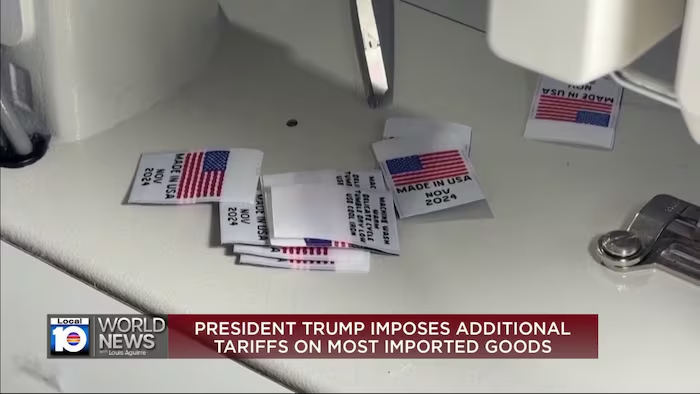
The Trump administration’s newly announced tariffs targeting 60 nations ignited fierce opposition Friday from trading partners worldwide, including Australia, Japan, China and the European Union. The levies, ranging from 10 percent to 12.5 percent, took effect just as temporary duties expired, with officials claiming the affected countries have inadequately banned imports produced through forced labor practices.
Australian Trade Minister Don Farrell characterized the tariffs as baseless, noting his nation’s strong stance against modern slavery. Australia’s tariff rate climbed to 12.5 percent from the 10 percent level imposed during Trump’s earlier “Liberation Day” increases last year. Farrell vowed to petition the U.S. Trade Representative to eliminate all duties on Australian goods, describing them as unjustified given the country’s serious commitment to labor standards.
New Zealand’s Prime Minister Christopher Luxon similarly condemned the 12.5 percent import duty as “extremely disappointing” and unsupported by evidence, arguing that tariffs increase costs and create business uncertainty. European Union foreign policy chief Kaja Kallas questioned the rationale, pointing out that EU labor protections—including paid vacation and worker benefits—exceed those in the United States.
Japan expressed particular dismay, asserting it had received assurances from the Trump administration that no additional tariffs would follow a prior 10 percent agreement. Chief Cabinet Secretary Minoru Kihara stated the tariff contradicted Tokyo’s compliance with international labor standards. Singapore’s trade ministry indicated it would continue discussions with U.S. officials to explore alternatives to the 12.5 percent duty.
China’s Foreign Ministry opposed what it termed “all forms of unilateral tariffs,” with spokesman Lin Jian warning that trade wars benefit no one. Earlier Trump tariffs significantly reduced Chinese exports to America, though current rates remain lower than last year’s initial 34 percent levels. Some Chinese manufacturers, like Christmas decoration maker Golden Arts Gifts & Decor in Dongguan, report shifting sales toward Europe to mitigate tariff impacts.
The new duties stemmed from a four-month Section 301 investigation conducted by the U.S. Trade Representative’s office. Wendy Cutler, former senior trade official and current Asia Society Policy Institute vice president, predicted these tariffs face fewer legal challenges than earlier versions because their modest range between 10 and 12.5 percent provides stronger statutory grounding. She cautioned that additional tariffs related to alleged industrial overcapacity may emerge this autumn.
The Liberty Justice Center, a libertarian group that previously defeated Trump tariff initiatives, immediately filed suit in U.S. Court of International Trade, arguing the administration circumvented legal limits by substituting one tariff authority for another following a Supreme Court setback. Chair Sara Albrecht contended the new approach violates statutory boundaries that constrain executive power.
Congressional Democrats criticized the tariffs’ selective application and consumer impact. Representative Linda Sanchez of California questioned why China, acknowledged as a major forced labor violator, faced identical rates as Australia, which manufactures no Trump corporation products. Senator Kirsten Gillibrand of New York warned Americans would bear the financial burden through higher prices as the administration perpetuated what she characterized as a failing tariff strategy.
Analysts noted the duties’ limited scope offered some mitigation. William Bratton of BNP Paribas observed that lower rates than previous reciprocal tariffs and substantial exemptions for Asian trade flows would reduce disruption. Nevertheless, Cutler warned the tariffs will contribute to elevated prices for both consumers and businesses importing inputs and equipment, while exemptions for non-domestically produced goods may provide partial relief.

More Stories
Trump Threatens FCC Action Against NBC’s Welker Over Endorsement Coverage
University of Pennsylvania Climate Scientist Demands Supreme Court Packing Pledge From Democratic Candidates
Looney Tunes’ ‘Coyote vs. Acme’ Debuts With $15.5 Million as ‘Spider-Man’ Holds Box Office Crown