


💛 A quick favor, if you've got a second.
We're really happy that you chose to read one of our stories and sincerely hope you'll stick around to read more. We took our paywall down — for now — but that won't last forever, and when the gate goes back up, we'd love for you to already be on the inside.
It's free. So please enter your email here and don't forget to like and follow us on all of your favorite Social Media platforms!
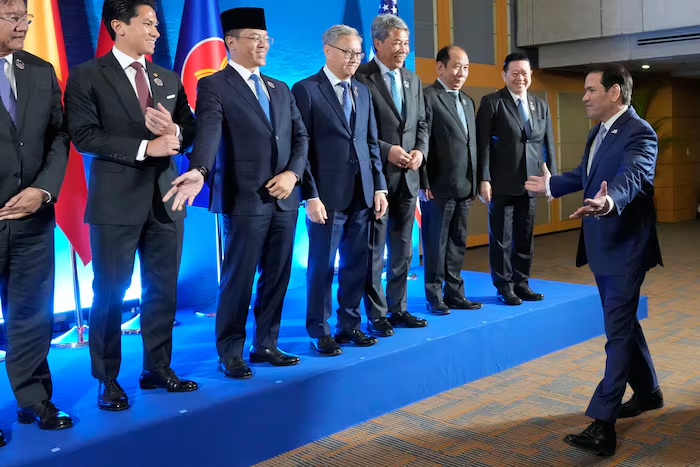
Secretary of State Marco Rubio is scheduled to meet Thursday with Russian Foreign Minister Sergey Lavrov in Manila during a gathering of Southeast Asian foreign ministers. The high-profile encounter will take place on the sidelines of an Association of Southeast Asian Nations event and represents one of the most significant diplomatic meetings at the regional forum.
Rubio indicated Wednesday that he plans to discuss the Ukraine conflict with Lavrov and suggested Washington remains willing to facilitate negotiations if circumstances allow. The U.S. official acknowledged that American mediation efforts have “kind of fallen off a little bit over the last few months” as indirect discussions stalled and focus shifted to the Iran-Israel escalation following the collapse of a ceasefire agreement.
The secretary of state emphasized the importance of maintaining dialogue between the world’s two largest nuclear powers despite significant disagreements. Lavrov told reporters he intends to question Rubio about recent statements from President Donald Trump indicating a settlement may be approaching in the Ukraine war.
The potential for revived peace discussions emerges as Ukraine has achieved military gains this year, though tensions between defense officials have complicated efforts. President Volodymyr Zelenskyy recently reshuffled his government, including replacing top military leadership.
Beyond Ukraine, Rubio signaled the agenda would encompass broader areas of potential cooperation between Washington and Moscow. The secretary also met Wednesday with Chinese Foreign Minister Wang Yi and Indian External Affairs Minister Subrahmanyam Jaishankar.
During his conversation with Wang, Rubio characterized a recent confrontation between Chinese and Philippine forces in a disputed South China Sea shoal as “escalatory.” The Trump administration has consistently criticized Beijing’s assertive regional behavior that disadvantages smaller claimant nations including the Philippines, a longtime U.S. treaty partner.
Wang objected to what the Chinese Foreign Ministry described as “recent negative words and actions by the U.S. side,” though specifics remained unclear. China indicated both nations are preparing high-level exchanges, including a planned September visit by President Xi Jinping to the United States.
ASEAN foreign ministers acknowledged Tuesday that long-running negotiations between China and the regional bloc on a proposed non-aggression code of conduct have made progress. Both sides aim to finalize the agreement this year to prevent major conflict in the strategically vital waterway.

More Stories
Federal voting arrest in New Jersey adds new pressure point in Sherrill-Trump standoff
Colombia backs Trump security push while limiting U.S. role in anti-gang operations
Former NFL cheerleader and ex-aide face off in close Rhode Island GOP primary