

💛 A quick favor, if you've got a second.
We're really happy that you chose to read one of our stories and sincerely hope you'll stick around to read more. We took our paywall down — for now — but that won't last forever, and when the gate goes back up, we'd love for you to already be on the inside.
It's free. So please enter your email here and don't forget to like and follow us on all of your favorite Social Media platforms!
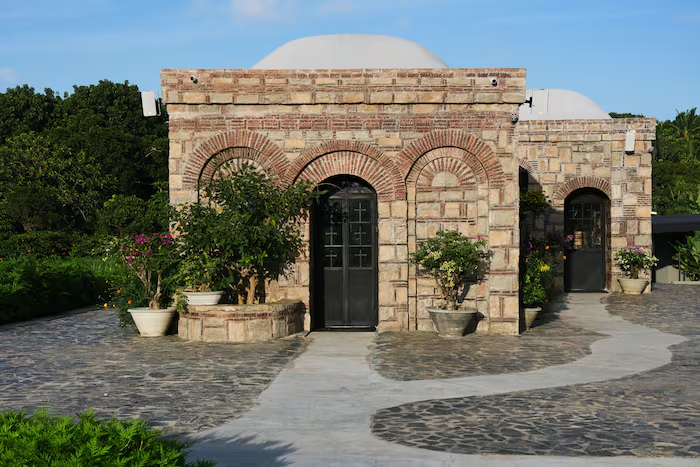
A shrine modeled after the House of the Virgin Mary in Ephesus, Turkey, has opened its doors to Catholic pilgrims in Alfonso, a municipality located roughly 45 miles south of Manila in Cavite province. The 720-square-foot structure, which officially began welcoming visitors in 2024, replicates the exact proportions and architectural details of the original site where Catholics believe Mary spent her final years following the crucifixion of Jesus.
Father Dennis Paez, a priest and psychologist who spearheaded the initiative, oversaw construction that required approximately 10 months and involved workers of various faith backgrounds. Paez conceived the project as a sanctuary offering unconditional acceptance to visitors seeking spiritual solace. The shrine has already hosted Catholic celebrations, including observances of the Feast of Our Lady of Mount Carmel in mid-July since its inauguration.
The Philippines, with a population exceeding 113 million, maintains deep Catholic traditions with nearly 80 percent of residents identifying with the faith. Devotion to the Virgin Mary, whom Filipino Catholics revere as the Blessed Mother, has been woven into the nation’s spiritual fabric since Spanish colonizers introduced Christianity in the 16th century, according to religious historian Michael Delos Reyes.
Filipinos have attributed significant historical events to Mary’s intercession, including the 1986 People Power Revolution that toppled President Ferdinand Marcos and community resilience following Typhoon Haiyan’s devastation in 2013. The phrase “to Jesus through Mary” encapsulates the central role the Virgin holds in Filipino Catholic practice, scholars note.
Marian imagery permeates Filipino daily life, appearing on vehicles, public transportation, and personal altars throughout urban and rural areas. Deirdre de la Cruz, a historian of Southeast Asian studies at the University of Michigan, attributes this widespread devotion to Mary’s portrayal as a compassionate intercessor and maternal figure offering comfort during hardship.
The Alfonso replica features donated Marian icons lining interior walls and houses a statue modeled after the Turkish original, alongside a relic purportedly from Mary’s veil. Art collector Maritess Pineda contributed most of the displayed artworks from her personal collection, fulfilling a longtime goal to find a permanent home for her Marian-focused acquisitions.
Despite minimal public promotion since opening, the shrine has attracted pilgrims through word-of-mouth and spiritual motivation, Paez reported. Rupert Suarez, who previously visited the original House of the Virgin Mary in Turkey, joined the construction effort after learning of the Philippine project.

More Stories
Christa Pike Survives Botched Double Execution Attempt; Tennessee Halts Remaining 2026 Executions
Tennessee’s Lone Death Row Female is Scheduled for Execution Wednesday for 1995 Torture/Murder
Colombia backs Trump security push while limiting U.S. role in anti-gang operations