

💛 A quick favor, if you've got a second.
We're really happy that you chose to read one of our stories and sincerely hope you'll stick around to read more. We took our paywall down — for now — but that won't last forever, and when the gate goes back up, we'd love for you to already be on the inside.
It's free. So please enter your email here and don't forget to like and follow us on all of your favorite Social Media platforms!
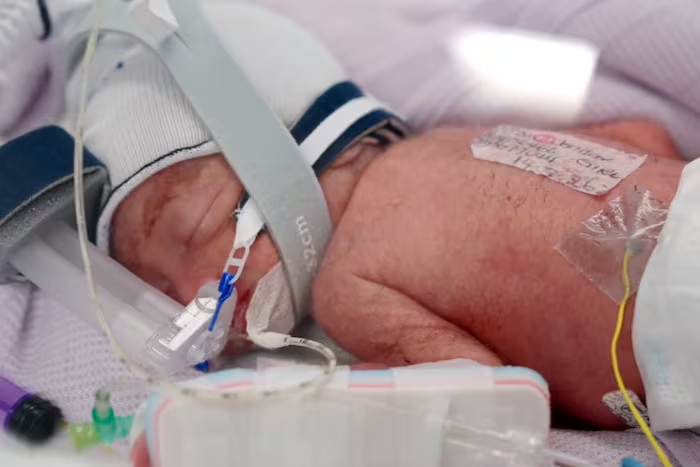
A 34-year-old Australian mother has delivered identical quadruplet girls in what medical specialists describe as an extraordinarily uncommon occurrence. The four babies arrived at Royal Brisbane and Women’s Hospital in Queensland last week following a naturally conceived pregnancy that physicians say may represent the first documented case of its kind in Australia.
Jenitar Sau Na’amoana and her husband, Jortham, were not anticipating another pregnancy, having already raised four children. The conception resulted from a single fertilized egg that spontaneously divided into four identical embryos—a development Dr. Alexa Bendall, the maternal fetal medicine specialist overseeing the case, characterized as remarkable. Medical experts estimate such spontaneous quadruplet conceptions occur in approximately one of every 15 million pregnancies, contrasting sharply with the already-rare natural quadruplet rate of one in 700,000, most of which result from assisted reproductive technology.
The pregnancy posed significant health risks, particularly because all four fetuses shared a single placenta. Na’amoana received care from a specialized medical team beginning at 10 weeks of gestation and was hospitalized starting at 25 weeks for continuous monitoring. She underwent cesarean delivery on July 14 at 28 weeks and four days of gestation.
All four babies—named Emily, Harriet, Catherine, and Alexa—were born in good health and are currently in neonatal intensive care. The mother recovered well following delivery with minimal blood loss relative to the complexity of her case. Bendall said the outcome represents both an academic achievement and a profound human experience.
More Stories
Christa Pike Survives Botched Double Execution Attempt; Tennessee Halts Remaining 2026 Executions
Tennessee’s Lone Death Row Female is Scheduled for Execution Wednesday for 1995 Torture/Murder
Colombia backs Trump security push while limiting U.S. role in anti-gang operations