


💛 A quick favor, if you've got a second.
We're really happy that you chose to read one of our stories and sincerely hope you'll stick around to read more. We took our paywall down — for now — but that won't last forever, and when the gate goes back up, we'd love for you to already be on the inside.
It's free. So please enter your email here and don't forget to like and follow us on all of your favorite Social Media platforms!
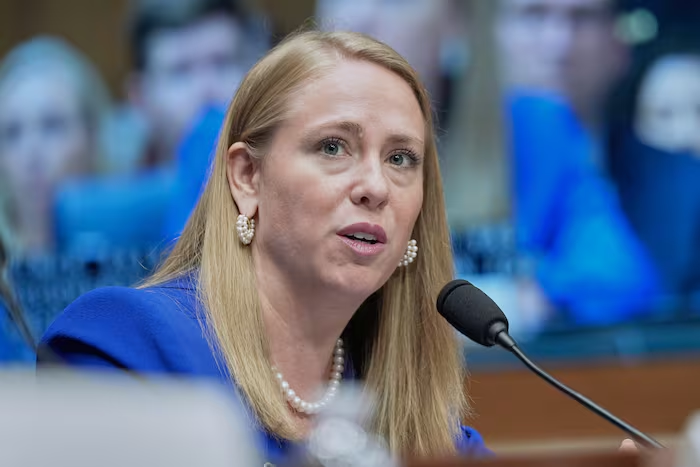
The Trump administration’s Equal Employment Opportunity Commission moved Tuesday to dismantle a six-decade-old mandate requiring tens of thousands of private employers to annually submit workforce demographic information to the federal agency charged with enforcing workplace anti-discrimination statutes. The EEOC’s Republican-controlled board voted 2-1 to rescind the requirement, setting the proposal for a 30-day public comment period ahead of final implementation.
EEOC Chair Andrea Lucas, a vocal opponent of diversity initiatives, contended that the annual reporting burden—estimated in the hundreds of millions of dollars—encourages companies to engage in discriminatory hiring practices and perpetuates racial stereotyping. The move marks a significant shift in civil rights enforcement that has persisted across 10 consecutive administrations spanning both parties since 1966.
Since 1966, the EEOC has required companies with at least 100 employees and federal contractors employing 50 or more workers to submit the EEO-1 form annually. The reporting mechanism categorizes 10 job classifications from executive and senior management to laborers and service workers, capturing demographic information for more than 50 million employees across approximately 73,000 employers nationwide.
The most recent publicly available data from 2023 reveals significant gender disparities in upper management. Women comprised nearly half of surveyed company workforces yet held only 34.5 percent of executive and senior manager positions, up from 29.2 percent a decade prior. White men constituted one-third of overall employees but occupied 52.7 percent of senior management roles.
Commissioner Kalpana Kotagal, the sole remaining Democrat on the five-member commission following Trump’s personnel changes, voted against the proposal and warned that rescinding the requirement represents a retreat from civil rights protections. Former Democratic EEOC commissioners and civil rights advocates have denounced the move as depriving the agency of critical investigative tools for identifying discrimination patterns.
While the EEOC cannot publicly disclose individual company EEO-1 forms, major corporations had increasingly begun voluntarily releasing the data in response to shareholder pressure and calls for transparency. That trend has reversed, with 24 companies in the S&P 100 halting voluntary disclosure of their 2024 EEO-1 data after having previously published it.
Companies remain likely to continue collecting demographic workforce information internally, given that federal law requires employers to maintain records relevant to discrimination investigations and the EEOC retains authority to demand such data during enforcement actions. Legal counsel advise businesses to maintain current record-keeping practices despite the elimination of mandatory federal reporting.

More Stories
Colombia backs Trump security push while limiting U.S. role in anti-gang operations
Chicago Mayor Issues Executive Order Requiring Contractor Diversity Disclosures and ICE Ties Reporting
University of Pennsylvania Climate Scientist Demands Supreme Court Packing Pledge From Democratic Candidates