


💛 A quick favor, if you've got a second.
We're really happy that you chose to read one of our stories and sincerely hope you'll stick around to read more. We took our paywall down — for now — but that won't last forever, and when the gate goes back up, we'd love for you to already be on the inside.
It's free. So please enter your email here and don't forget to like and follow us on all of your favorite Social Media platforms!
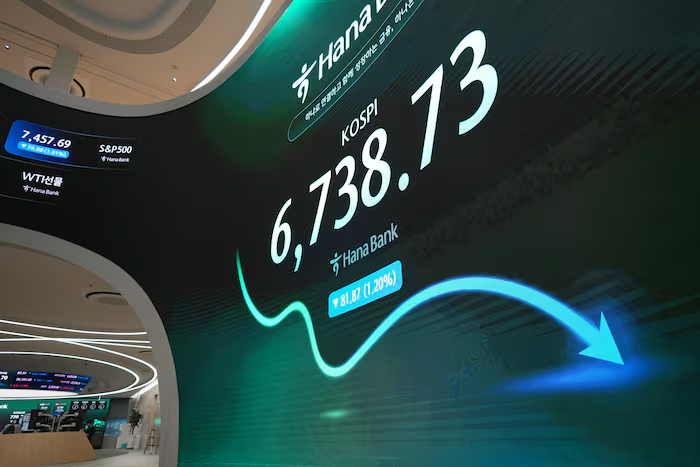
South Korea’s benchmark Kospi index plummeted 4.9% to 6,490.97 on Monday, extending declines in the artificial intelligence sector that have roiled global markets. The country’s heaviest technology stocks bore the brunt of selling pressure, with Samsung Electronics dropping 4.4% and memory chip manufacturer SK Hynix falling 3.3%, as investors moved to lock in profits from recent substantial gains.
Across the broader Asian region, sentiment remained mixed as most markets posted modest gains while Tokyo’s exchanges remained closed for a holiday. Taiwan’s Taiex index dipped less than 0.1%, though chipmaker TSMC recovered 2% following a steep 7.3% decline Friday after announcing plans for an additional $100 billion investment in U.S. manufacturing capacity. Hong Kong’s Hang Seng rose 2.1% to 25,105.78, Shanghai’s composite index gained 1.2% to 3,808.39, and Australia’s S&P/ASX 200 edged up 0.2% to 8,815.30.
Concerns about an artificial intelligence sector bubble have prompted widespread profit-taking among investors, compounded by competition from lower-cost Chinese AI models. Beijing-based Moonshot AI’s release of the Kimi K3 open-source model echoed market disruptions from China’s DeepSeek breakthrough in early 2025, underscoring how Chinese competitors are challenging established players like OpenAI and Anthropic.
Oil prices surged more than 2% as military tensions between the United States and Iran escalated, with Brent crude reaching $90.40 per barrel and U.S. benchmark crude climbing to $83.58 per barrel. The U.S. conducted its ninth consecutive night of strikes, while Iran continued retaliatory attacks against American allies throughout the Middle East, raising concerns about wider regional conflict.
Tanker traffic through the strategically vital Strait of Hormuz has nearly halted, threatening global oil supplies, according to commodity strategists at ING who warned that unchecked escalation could trigger widespread attacks across the Persian Gulf. The geopolitical risk contributed substantially to energy market gains despite broader equity weakness.
Wall Street ended the week sharply lower, with the S&P 500 falling 1% to 7,457.69, the Dow Jones Industrial Average declining 0.8% to 52,146.42, and the Nasdaq composite dropping 1.4% to 25,520.24. Chipmaking stocks suffered significant losses, including Nvidia down 2.2%, while Broadcom and Advanced Micro Devices each fell 1%.
Elon Musk’s SpaceX experienced a 5.4% decline after its stock fell below the $135 initial public offering price for the first time since its Nasdaq debut last month. In currency trading, the U.S. dollar weakened to 162.37 Japanese yen from 162.43 yen, while the euro strengthened to $1.1446 from $1.1438.

More Stories
Colombia backs Trump security push while limiting U.S. role in anti-gang operations
Federal Prosecutors Convene Special Grand Jury to Investigate D.C. Schools’ Attendance and Graduation Practices
State Department Reissues Level 3 Travel Advisory for Israel Amid Terrorism and Armed Conflict Concerns