

💛 A quick favor, if you've got a second.
We're really happy that you chose to read one of our stories and sincerely hope you'll stick around to read more. We took our paywall down — for now — but that won't last forever, and when the gate goes back up, we'd love for you to already be on the inside.
It's free. So please enter your email here and don't forget to like and follow us on all of your favorite Social Media platforms!
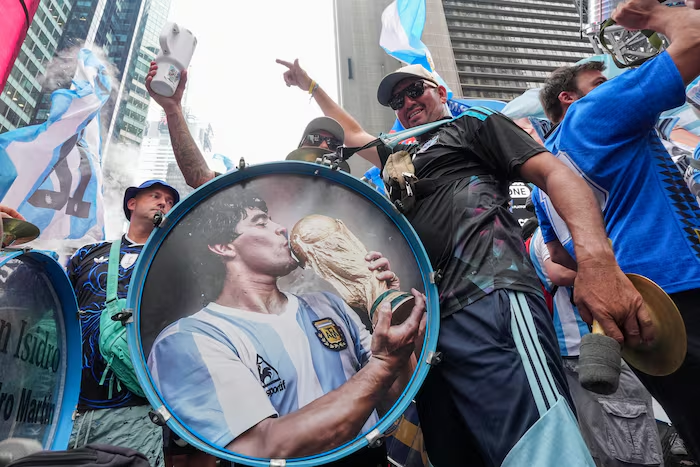
Spain and defending champion Argentina faced off in the 2026 World Cup final in New Jersey on Sunday, marking the conclusion of the competition’s largest tournament to date. The expanded event featured 104 matches played over nearly six weeks across the United States, Mexico and Canada. The tournament showcased electrifying moments on the pitch, including surprising victories, dramatic turnarounds and remarkable individual performances from the sport’s elite athletes.
The expanded 48-team format addressed early skepticism about potential mismatches and reduced stakes in preliminary rounds. Cape Verde, Congo and Curaçao each achieved historic milestones, with Cape Verde drawing Spain in its opener before advancing to the round of 32 and ultimately losing 3-2 to Argentina in extra time. Vozinha, Cape Verde’s 40-year-old goalkeeper, emerged as an unexpected star, accumulating millions of social media followers throughout the tournament.
Elite players dominated the scoring race heading into the final matchup. Kylian Mbappé led with 10 tournament goals and a record 22 World Cup career goals, while Lionel Messi contributed eight goals this tournament alongside 21 career World Cup tallies. Erling Haaland, Harry Kane and Jude Bellingham also delivered strong performances for their respective nations.
Video Assistant Referee technology sparked heated disputes throughout the tournament, with controversial calls eliminating goals for Germany, Croatia and Egypt. Croatia’s coach Zlatko Dalić voiced strong objections after a high-tech ball equipped with sensors overruled Josko Gvardiol’s potential equalizer against Portugal in the round of 32. Egypt’s coach Hossam Hassan condemned what he characterized as unfair treatment following Argentina’s dramatic 3-2 comeback victory from a 2-0 deficit.
FIFA’s dynamic pricing model generated significant backlash from supporters concerned about affordability. General admission tickets ranged from $140 to $2,735 for group stage matches, with final tickets reaching $8,680—substantially higher than the 2022 Qatar World Cup. FIFA subsequently committed to offering $60 tickets for every match through national federations following public criticism.
Despite the steep pricing and initial empty seats at some early matches, stadiums across the three nations filled substantially as the tournament progressed. International visitors praised the hospitality encountered throughout North America. FIFA’s resale marketplace enabled sellers to charge dramatically above face value, with final tickets listed at nearly $2.3 million, though FIFA declined to regulate secondary market pricing while retaining a commission on sales.
Hydration breaks introduced midway through each half drew considerable criticism from fans and former players alike. Roy Keane and others compared the stoppages to American sports timeouts, though FIFA maintained the breaks would occur regardless of weather conditions. Coaches utilized the pauses to deliver tactical instructions, while broadcasters incorporated commercial breaks, leaving uncertain prospects for the innovation at future tournaments.
Iran’s participation overshadowed ongoing Middle East conflict concerns. The delegation initially relocated its base camp from Arizona to Mexico following visa denials for several team members from the U.S. government. After Iran’s group stage elimination, Homeland Security Secretary Markwayne Mullin expressed satisfaction with the team’s departure.
Donald Trump’s administration enforced travel restrictions affecting some international supporters, yet widespread aggressive immigration enforcement around stadiums did not materialize. Trump attended only the final match, though his direct involvement became apparent when U.S. striker Folarin Balogun’s suspension for a red card was lifted before the round of 16 matchup against Belgium—a decision Trump claimed resulted from his conversation with FIFA president Gianni Infantino. FIFA maintained its disciplinary bodies operated independently, yet the episode raised concerns regarding political influence on tournament proceedings.

More Stories
Indiana coach Curt Cignetti tells restless Hoosiers fans not to gripe over 38-0 win
Colombia backs Trump security push while limiting U.S. role in anti-gang operations
Federal Prosecutors Convene Special Grand Jury to Investigate D.C. Schools’ Attendance and Graduation Practices